


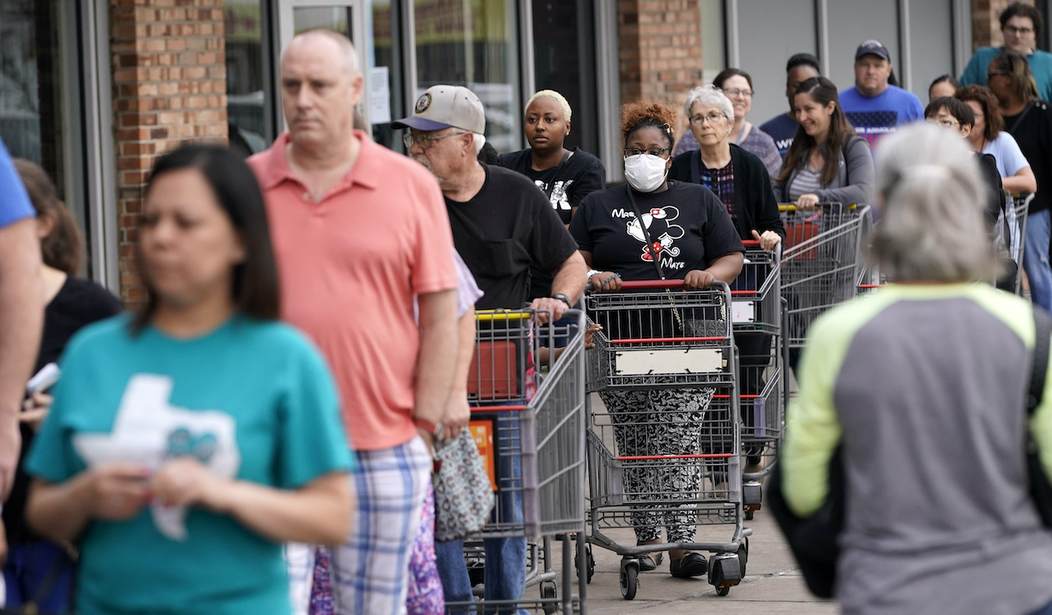
So-called “price gouging” is a gimmick used by politicians and the media to rally supporters and viewers. It’s almost never about predatory business practices, and it’s always the people who end up paying the cost of price control laws.
Governments can’t alter the laws of economics any easier than they can the laws of physics. Yet, they seemingly never cease trying, either under some private or public pressure to skew economic outcomes.
Particularly in vogue these days is outrage over “price gouging.” In this way, the political and media response to Covid-19 is the same as it always is during hurricanes or other natural disasters.
Now there’s no telling how extreme anti price gouging policies will get, considering the economic lockdown continues unabated even as a record-shattering 6.6 million jobless claims are filed as a result.
One outstandingly bad case of government and media double teaming against an honest business is what’s happening to Menards in Michigan.
The hardware store got hit with two cease-and-desist letters from the state’s attorney general in as many weeks. The first was for price gouging, which Menards denies, and the second was for dropping their prices too low! Advertising a sale is now a crime in capitalist America.
Jokes should be left to comedians, but sometimes economists can’t help themselves. Walter Block is among the latter, but he illustrates a key truth about government policing prices.
There are three prisoners in jail for economic crimes, the joke goes. The first inmate charged higher prices than anyone else, so he was guilty of profiteering and gouging. The second charged lower prices than anyone else, so he was guilty of predatory pricing. The third convict charged the same price as everyone else, so he was guilty of collusion.
Recommended
It would be funny if it wasn’t so sadly representative of reality. So-called consumer advocate reporters accuse Menards of “taking advantage” of the crisis.
Such a misunderstanding of how prices work comes at a high cost.
In fact, it is especially vital during massive emergencies that prices be allowed to perform their function. Yes, they have a function and a purpose beyond what so many politicians and TV talking heads apparently see.
Prices facilitate communication between consumers and producers, what’s in demand and what’s in supply.
Low prices may normally be preferable for consumers, but high prices help keep masks, hand sanitizer, food, and other high demand products on shelves longer.
Instead of the first guy in line buying up 300 rolls of toilet paper at the normal price, a “gouged” price would leave enough for the last shopper, or even eliminate the tight-windowed long line altogether.
Additionally, “gouged” prices rarely last, as they encourage more production, because there is greater potential profit. As more producers rush to meet the high demand, competition drives prices down once again.
As economist Robert Murphy puts it in The Politically Incorrect Guide to Capitalism, “When the government interferes with prices, it cripples the ability of free people to make intelligent economic decisions, just as surely as if the politicians interfered with phone lines, e-mail, or other means of communication.”
Many stores now are limiting customers to one or two milk or egg cartons, instead of raising prices. This may stave off higher prices temporarily, but of course, customers will shop at multiple stores, multiple times a day if demand is high enough.
When the government rations or fixes prices, it is rarely as temporary as when a business does so. The result is a shortage. It’s the same principle easily recognized in making college and healthcare “free.”
Although basic economic laws and principles can be understood without a PhD or even a high school diploma, they are often eschewed by the elites in politics, academia, and media. Unfortunately, too many Americans follow these so-called leaders.
What should always be kept in mind is that the size and scope of this COVID-19 pandemic is largely unknown. The stats of coronavirus-related deaths are muddled because so many deaths would have otherwise been attributed to pneumonia or other underlying conditions such as cancer.
Some precautions are undoubtedly in order, but government intervention is at least on the verge of overreach and overreaction.
In New York City, already over 550 price gouging violations have tallied up $275,000 in fines.
In Tennessee, Knox County Mayor Glenn Jacobs warned his Governor Bill Lee that the state was “testing the very limits” of free government. Knox County saw eight suicides within 48 hours after its lockdown went into effect, representing nearly 10 percent of the total suicides of the previous year.
All of this raises the question of how future governors, presidents and legislators will act, or whether President Donald Trump will use even more executive power the next time some crisis emerges.
For now, there are many bright spots to appreciate. Some regulations are being rolled back, such as doctors being allowed to work across state lines without cumbersome license requirements. The FDA took too long, but it did finally relax its grip on the medical device and drug industries.
These positive changes must be made permanent for the sake of public health, not reinstated after bureaucrats save face.
If America regained its faith in private enterprise, not only would the urgent needs of providers and people be met, the economic and political ramifications would be much easier weathered in the short and long terms.
Social trust may even climb during a presidential election when divisions run their deepest. The challenge for many Americans will be to snap out of complacence when they see politicians and the media attempting to undermine the price system.
Gavin Wax is president of the New York Young Republican Club, an Associate Fellow at the London Center for Policy Research, and publisher of The Schpiel. His work has appeared in Townhall, The Daily Caller, The Hill, The Washington Examiner, The Federalist, Human Events, and Newsmax. He is a frequent guest on Fox News. You can follow him on Twitter @GavinWax





Join the conversation as a VIP Member