







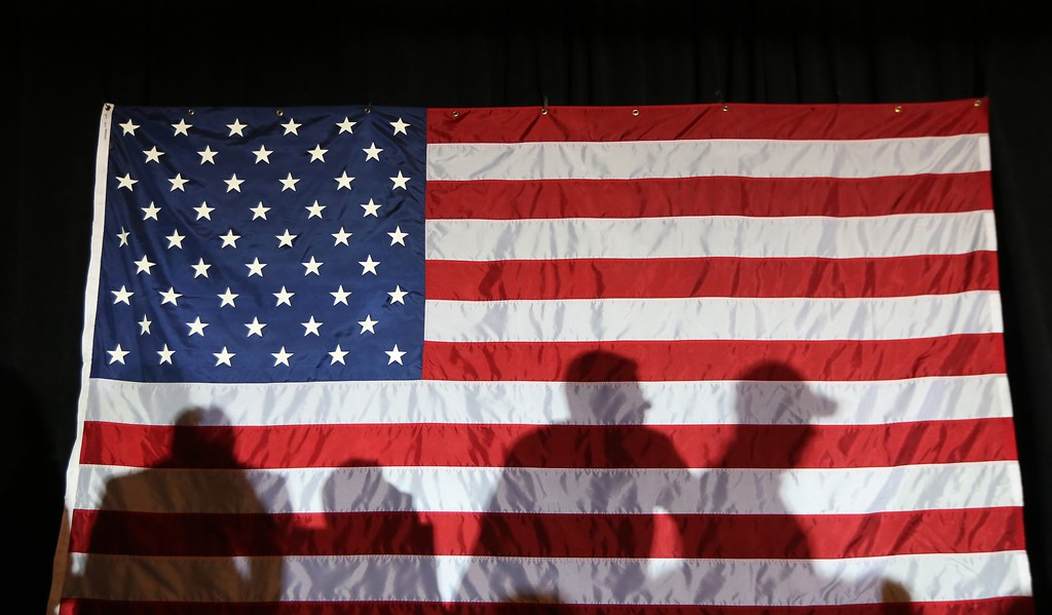
Americans still enjoy freedom of religion. But these days, they’re expected to leave their faith in the pew or at home -- not allow it to influence their behavior in the public square.
The founding fathers didn’t take that view. "Of all the dispositions and habits which lead to political prosperity, religion and morality are indispensable supports,” George Washington said. “In vain would that man claim tribute to patriotism who should labor to subvert these great pillars of human happiness.”
Yet many do, in fact, work very actively to undermine these pillars. That’s why I was honored to join the Ethics and Public Policy Center recently at its 40th anniversary event. EPPC’s motto is “defending American ideals since 1976.” But what really makes its contributions so invaluable is that it’s defending ideals that date back two centuries before that.
“We take great pride in the fact that people with differing viewpoints can come to the table and be a part of a larger conversation about these very important and very urgent issues,” according to EPPC Vice President Michael Cromartie. At a time when those who take their faith seriously can feel highly marginalized, EPPC is a necessary advocate.
I’m not just talking about cultural issues, where the role of faith seems more obvious. I’m referring to the whole gamut of issues. As EPPC President Ed Whelan has noted, the Center was founded at the height of the Cold War “to counter the myth of moral equivalence” between the East and the West.
Beyond the missile counts and competing proxy battles in far-flung hotspots lay the oft-overlooked fact that the Soviet Union was based on a godless, morally bankrupt system. The intellectual contributions of EPPC helped Cold War generals such as Ronald Reagan break through the malaise of détente, and achieve what EPPC Distinguished Senior Fellow George Weigel calls “the successful endgame of the Cold War -- the victory of freedom over Communism.”
Besides foreign policy, there is a wide range of other important issues to be addressed -- and EPPC scholars are there. From stem-cell research and Medicare spending to judicial activism and entitlement reform, they provide legislative testimony, hard-hitting op-eds, and timely reports that flout the superficial analysis so common in our sound-bite culture.
And all from an organization that employs fewer than two dozen people. No wonder Weekly Standard co-founder Fred Barnes has said the Center “punches above its weight.”
The goal, as House Speaker Paul Ryan said in his keynote speech at the EPPC event, is to take what we’ve learned from the great thinkers of the past and apply it to the moment. To the issues at hand. We shouldn’t simply react -- we should be making informed decisions that adhere to a clearly defined standard.
Because as much as we’re involved in policy-related, day-to-day issues, we always need to go back to first principles. The team at the EPPC -- which includes James Capretta, Mona Charen, Pete Wehner, Stanley Kurtz and so many others -- is absolutely central to what is really involved in leading the conservative movement. They put the daily news cycle into a larger context.
Perhaps more importantly, they highlight the need for civil society. You’d never know it from the shouting heads on the cable-news stations and on the op-ed pages, but not everything has to be about politics. EPPC knows that.
President Reagan once honored EPPC “for its singular contribution in clarifying and reinforcing the bond between the Judeo-Christian moral tradition and the momentous problems that confront the United States.” Here’s hoping its next 40 years are even more productive.

Join the Conversation
VIP members get the ability to comment on articles.