



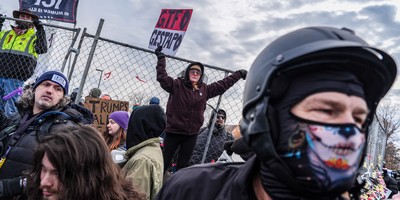
America over the last few weeks has suffered a debilitating outbreak of polarized politics and violent public protests that have shaken the nation to its core. In Washington, DC, and cities across the country, citizens have been convulsed by paroxysms of anger, violence and extremism. As troubling as the events themselves is the realization that “it can happen here.” Over the past 50 years, ever since 1968, Americans have been lulled into believing that they are immune from the civil unrest that plagues so much of the rest of the world.
That illusion has now been dispelled, and we are left to confront the reality that we are a nation divided, both in our homes and in our institutions of government. Racial, geographic, demographic, political and economic disparities force us to come to terms with the ghosts of our past as we look to the future. Only by acknowledging our shortcomings and by taking meaningful action to address them can we hope to restore public confidence in the American dream.
Other countries have faced similar “come-to-Jesus” moments – crises that compel a national reckoning – and their varied responses can prove instructive. In some cases – Russia, Iran, Egypt and China, for example – regimes that are facing popular unrest over social and economic injustice choose to use the heavy hand of the state to suppress dissent. The costs of such repression are high: international isolation, economic stagnation and political fragmentation.
In other cases, governments acknowledge the need for change and try to manage that process in a peaceful, transparent and inclusive manner. Kazakhstan offers an interesting case study in that it has chosen a carefully deliberated process of reform over the mass punishment of its citizens. The decision by President Nursultan Nazarbayev – who had ruled the country since independence in 1989 – to step down and transfer power to his chosen successor, Kassym-Jomart Tokayev, in March of last year was met with nationwide demonstrations calling for free elections and more representative government.
Recommended
While security forces cracked down harshly, the country's newly-elected president took notice. In commenting on the challenges facing him, he declared: "different opinions, but one nation. It is through the exchange and dialogue that the country should move forward."
Democracy in Kazakhstan is a work in progress and requires careful scrutiny. But it is learning from experience and trying to improve. In contrast to regional superpowers Russia and China as well as its neighbors, Kazakhstan has opted for dialogue and reform.
For example, Tokayev’s government went on a listening tour of the country. It heard from citizens throughout Kazakhstan in dozens of hearings that included the general public, civil society representatives, journalists and observers from international organizations.
Based on the findings of these inclusive consultations, the government then drafted what is arguably the most profound set of legislative reforms in the country’s history. Last month, President Tokayev signed into law these measures that will radically alter provisions regarding peaceful assembly, elections and political parties.
The new law on peaceful assemblies flips what had been an approval process to a notification process. Previously, in order to hold a legal demonstration, activists had to seek the state’s permission, and it was rarely granted. Under the new law, organizers are only required to provide advance notice, making the entire process less bureaucratic. In many ways, the new law conforms with similar legislation from advanced democracies around the world in its respect for civil rights and fundamental freedoms.
The new elections law requires an obligatory 30 percent quota for women and young people under 29 years of age to be included in party registry lists.The law on political parties has been amended to reduce by half – from 40,000 to 20,000 -- the number of signatures needed to create a political organization.
Religious practices are equally free for the majority Islam, Christianity, Judaism, Buddhism and other faiths. Defamation will be decriminalized, allowing for greater freedom of expression and removing the heavy hand of governmental prosecution every time a public figure feels insulted. This is a striking move that numerous other OSCE members have been unwilling to take.
No reform process is perfect, and numerous critics argue that there are gaps, loopholes and shortcomings that make Kazakhstan’s less than ideal. Nevertheless, it is clear that Kazakhstan’s leadership has made the right choice. The voices of the people are being heard, which is more than one can say about other countries in the region. As in any developing society, there will be hiccups and bumps in the road. The important point, however, is that Kazakhstan is reforming, not cracking down.
Words matter, and President Tokayev’s comments on signing these new laws should be recognized as significant. “We are shaping a new political culture. Pluralism of opinions and alternative views are coming to the fore. The authorities do not believe that disagreement is destructive,” he said. “And it is better to come to this independently, consciously, and not forcibly.”
If only more national leaders were so forthcoming. The world would be a much better place.
Joseph Adam Ereli was the U.S. State Department spokesman, U.S. the ambassador of the United States to the Kingdom of Bahrain from 2007 to 2011. He subsequently was the Principal Deputy Assistant Secretary of State for Education and Cultural Affairs.





Join the conversation as a VIP Member