





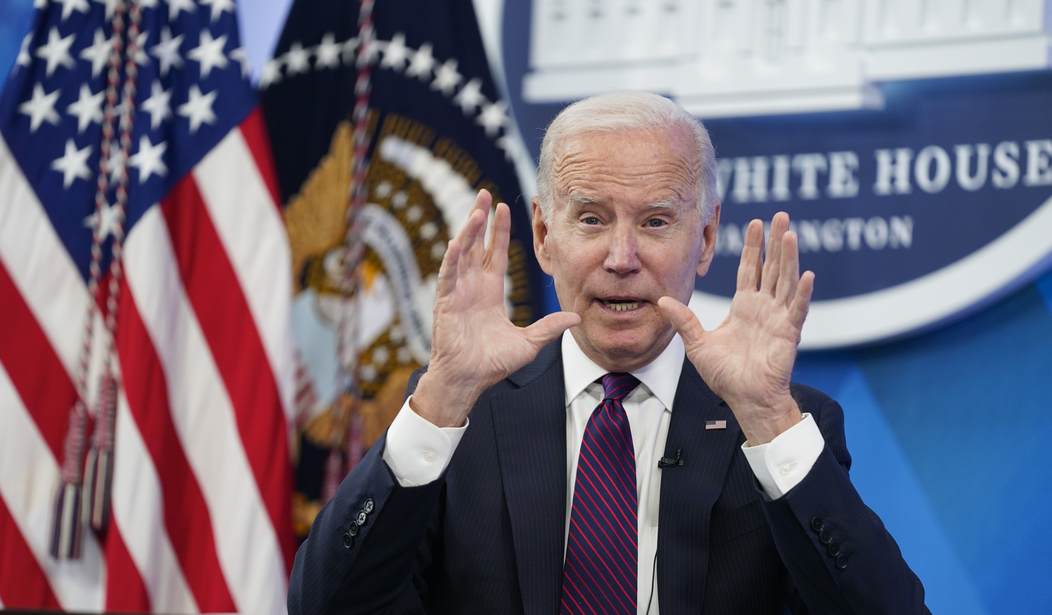
In Tuesday's White House press briefing, Karine Jean-Pierre failed to provide much reassurance for American citizens or businesses eyeing the looming threat of a rail worker strike that is shaping up to be something of a repeat of the Biden administration's previous mismanagement of U.S. port backlogs and infant formula shortages.
As Vespa explained on Tuesday morning, potential rail disruption is "another looming economic crisis that could strike hard this week," one that "could cost the US economy billions and disrupt virtually all commercial and passenger traffic."
So what does the White House have to say about the situation? Well, according to Biden's press secretary, they're working on it, and have been for months, and the most they have to show is a contingency plan that Jean-Pierre mentioned without any concrete details.
"We have made crystal clear to the interested parties the harm that American families, businesses, and farmers and communities would experience if they were not to reach a resolution," Jean-Pierre said while emphasizing that it's "incredibly important" for the rail unions and rail companies to remain at the negotiating table. But, the deadline for negotiations is midnight on Friday, and if the two unions that are still holding out don't reach something by then, their employees — plus all the employees of ten other unions in an act of solidarity — will go on strike.
"The president has been involved in this," Jean-Pierre continued — as if that's supposed to be reassuring — and the cabinet secretaries have been involved since the early days of this effort" that she said date back to earlier this spring.
On the looming rail strike, KJP says "our administration, our secretaries have been at this since early spring." pic.twitter.com/BwAzeB0rHW
— Townhall.com (@townhallcom) September 13, 2022
Those cabinet secretaries? Marty Walsh (Labor), Tom Vilsack (Agriculture), and Pete Buttigieg (Transportation). Those with a memory longer than about 5 minutes will remember that Buttigieg was at the helm as the Biden administration's previous supply chain crisis developed, then stepped away for a family leave that was only discovered when reporters started asking questions at the Department of Transportation. His — as well as the rest of the Biden administration's — ability to handle transportation crises deserves a significant amount of healthy skepticism.
So, what has the White House come up with as its plan should a deal not be reached by midnight Friday? Karine Jean-Pierre called it a "contingency plan" which may be the understatement of the year. A U.S. rail shutdown is not merely a contingency, it's an estimated $2 billion-per-day cost to an economy that's in a recession and still dealing with 40-year-high inflation.
Offering limited details, Jean-Pierre said that the White House is "working with other modes of transportation including the shippers and truckers, air freight, to see how they can step in and keep goods moving in case of this rail shutdown."
Karine Jean-Pierre: The Biden administration's "contingency plan" in the event of a devastating rail strike is "working with other modes of transportation including the shippers, and truckers, airfreight..." pic.twitter.com/dR1CDHALBc
— Townhall.com (@townhallcom) September 13, 2022
Really? The White House's plan to prevent another supply chain and economic crisis is just taking everything that's transported by rail — some 1.7 billion tons across nearly 140,000-miles of track annually — and put it on boats, planes, and 18-wheelers? In something of a doth protest too much moment, Jean-Pierre reiterated "we're really working with and trying to figure out with other modes of transportation how to move forward." Right.
So, according to the White House, the president and his administration have been working on averting a strike that is now just days away since early spring? Despite the "hundreds of phone calls and meetings with unions and companies" Jean-Pierre tried to use as proof that the Biden administration was "directly engaged," in "constant communication," and on top of things, it just sounds like a repeat of the formula shortage.
And while Jean-Pierre might think that bragging about all the communication and "direct" engagement the Biden administration has had in the negotiations between rail companies and rail unions is proof of working to help the American people, all it does is make the White House culpable if a deal isn't reached by midnight Friday.
KJP: "The president strongly supports collective bargaining...he encourages them to continue to negotiate at the table in good faith." pic.twitter.com/PIqsiPqQMi
— Townhall.com (@townhallcom) September 13, 2022
"A shutdown would have a tremendous impact on our supply chains, as you all know, it's going to have ripple effects into our overall economy," Jean-Pierre added in response to another question on the potential rail strike, again admitting that the White House knows it's toying with another potential disaster just a few weeks before the midterm elections. "A shutdown is not acceptable," she added.
Well, if talks break down or a deal isn't reached by midnight, it's going to be Joe Biden and his administration's fingerprints that are all over the latest economic failure. You can be sure that if a strike kicks off over the weekend, the Biden administration will quickly change its tune to pretend it never had a role in the negotiations. Then, the scrambling will begin again to make excuses for why it wasn't better prepared for the disruptions a strike will cause.


Join the Conversation
VIP members get the ability to comment on articles.