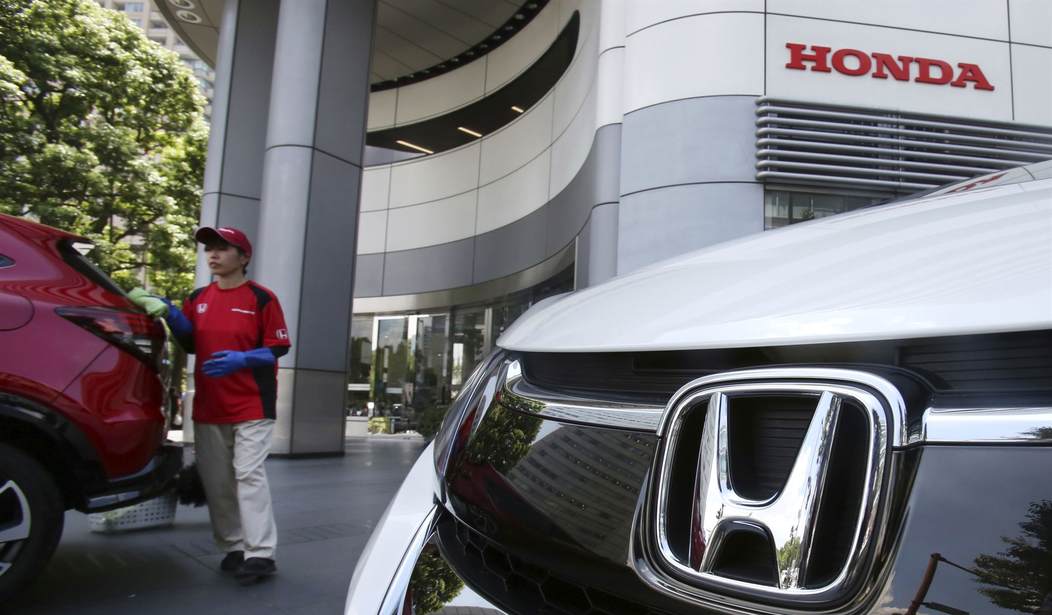

Automaker Honda is bracing for nearly $16 billion in expenses and losses on its electric vehicle strategy, it announced this week.
The automaker has canceled three EVs planned for production in North America after President Donald Trump’s administration trashed a Biden-era EV mandate in February and Congress eliminated the EV subsidy. That mandate would have forced about two-thirds of new vehicles produced to be electric.
Honda canceled the Honda 0 SUV, Honda 0 Saloon, and Acura RSX.
NEWS: Honda announced it expects to report its first annual loss in nearly 70 years as a public company in the fiscal year ending March 2026, after recording a $15.7 billion write-down tied to its EV business.
— Sawyer Merritt (@SawyerMerritt) March 12, 2026
Honda is also cancelling three EVs, including the Acura RSX, that… pic.twitter.com/DUSvBUJ6Fh
Honda was chasing a carbon-neutral goal by 2050. But profitability is dropping because of tariff impacts on gasoline and hybrid vehicles and a decline in the competitiveness of Honda products in Asia because it over-invested in EVs, which many consumers don’t want in the U.S.
Many U.S. consumers rejected EVs because of a limited charging network, range anxiety, and the time difference between charging a vehicle and refilling with fuel.
Most EVs are also expensive, with an average transaction price of about $57,000, according to Kelley Blue Book.
“However, in the U.S., the expansion of the EV market has slowed down due to several factors including the easing of fossil fuel regulations and revisions to EV incentives,” Honda said in a news release.
Honda joins the billion-dollar EV regret club with up to $15.7B down the drain. Add in Stellantis ($26B), Ford ($19.5B), and GM ($6B), and we're talking ~$67B collectively torched because no one wants glorified golf carts.
— Larry Behrens 🇺🇸 (@larrybehrens) March 12, 2026
Reality is undefeated.
“Honda automobile business has fallen into an extremely challenging earnings situation due to various factors, including its inability to respond flexibly to these changes in the business environment, compounded by a decline in the profitability of gasoline and hybrid models due to the impact of newly imposed tariffs.”
More evidence of government's failed EV strategy despite all the photo ops
— MikesMoneyTalks.ca (@moneytalkstweet) March 12, 2026
Honda reports its 1st annual loss in almost 70 yrs after taking up to US$15.7B in restructuring costs at its EV business
Honda’s charge brings the industry tally to about $67B. General Motors has warned…
Honda. Wow.
— Michael Dunne (@dunne_insights) March 12, 2026
First loss since the 1950s.
“Honda’s automobile business has fallen into an extremely challenging earnings situation due to various factors, including its inability to respond flexibly to these changes in the business environment,”
Honda slumps to first annual…
Most automakers are eating billions of dollars in losses from EVs.
Stellantis claimed $26 billion in losses, Ford Motor Company lost about $30 billion over a handful of years, and General Motors reported a $7 billion loss on electric vehicles.
Honda said that it will maintain stable returns to shareholders and will leverage earnings power from its motorcycle and financial service business.
Honda will announce more news in May.