





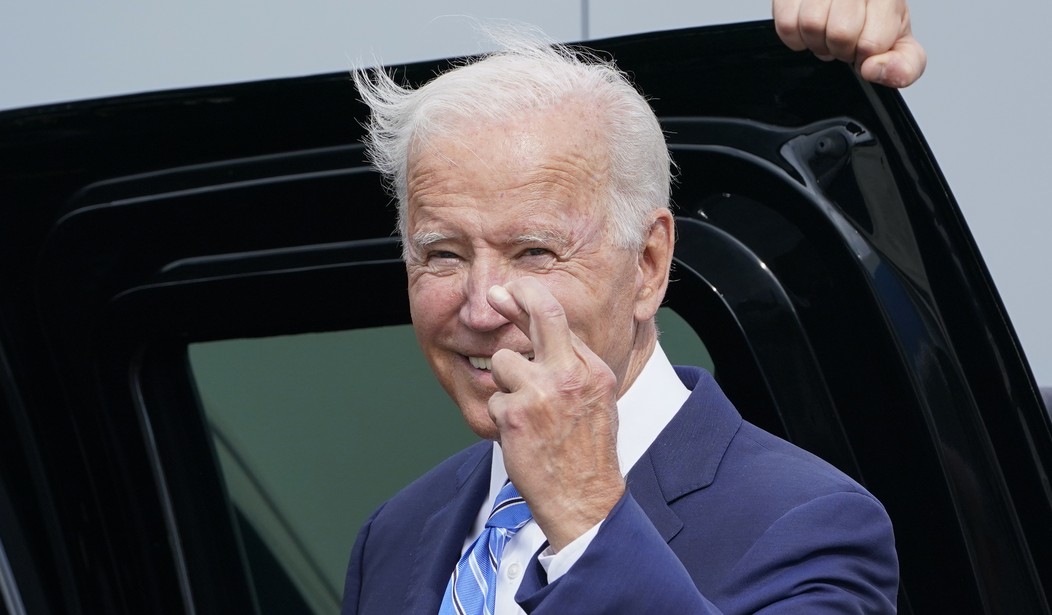
President Joe Biden has an approval rating of 42 percent and a disapproval rating of 52 percent, according to the results of the latest Gallup poll released on Friday. Biden's total third quarter approval rating, for July 20-October 19, was at 44.7 percent, down 11 points from his first quarter rating. Jeffrey M. Jones in his write-up for Gallup acknowledges that the "decline is larger than any prior president registered between his first and third quarters," yet he still chose to go with a headline highlighting how "Biden Job Approval Steady at Lower Level."
(Gallup poll) Do you approve/disapprove of Biden?
— Ryan James Girdusky (@RyanGirdusky) October 22, 2021
Overall: 42/52
Men: 38/58
Women: 46/46
White: 30/60
Non-white: 55/35
College educated: 54/43
Some college: 36/59
GOP: 4/94
Indie: 34/57
Dem: 92/6
(Gallup poll) support for Biden has fallen 21 points among independents since June pic.twitter.com/vFDBHYzgC1
— Ryan James Girdusky (@RyanGirdusky) October 22, 2021
To Jones' credit, his headline is accurate in that Biden was at a 43 percent approval rating in September and went down just 1 statistically insignificant point in October to 42 percent. While it is accurate, it hardly seems like the biggest takeaway.
While it's not much of a difference downward, it's also no improvement. As Jones acknowledges:
His latest rating suggests no improvement in his public support, as Democrats delayed passage of a pair of infrastructure bills due to internal disagreements on their size and scope. The U.S. economy continues to be plagued by supply chain issues, rising inflation and worker shortages, even as economic growth and stock values remain strong and the unemployment rate has fallen to its lowest level of the pandemic.
We certainly live in deeply partisan, divided times. Which is why it's befuddling that during Thursday night's town hall and over his official Twitter account the president reminded viewers that he ran to unify the country.
https://t.co/mICn5k7Try pic.twitter.com/BupjTaexDN
— Rebecca Downs (@RebeccaRoseGold) October 22, 2021
The only president with deeper partisan divides among those polled by Gallup is former President Donald Trump. In noting how "Extreme Party Polarization Characterizes Biden Job Ratings," Jones wrote:
As has been the case for Biden throughout his presidency, Democrats and Republicans hold diametrically opposite views of his performance. In the latest survey, 92% of Democrats approve and 6% disapprove of the job Biden is doing, while 4% of Republicans approve and 94% disapprove.
The 88-point partisan gap in job approval is the largest for Biden thus far in his presidency and ranks among the largest in more than eight decades of Gallup measurements of presidential approval. Donald Trump is the only president to receive more politically polarized approval ratings, having done so on several occasions, including a record 92 points just before the 2020 election.
But it's further highlighted then that Biden has lost so much ground among Independents, the group that helped propel him to the White House in the first place. As Jones continues:
Given the extreme partisan gaps in Biden's approval ratings, political independents' changing views of him are largely responsible for the recent declines in his approval rating. Currently, 34% of independents approve of the job Biden is doing, the lowest of his term to date. His approval among independents has fallen a total of 21 points since June, including nine points since August.
The Gallup Poll was conducted October 1-19 with a random sample of 832 adults and a margin of error of plus or minus 4 percentage points.
Meanwhile, on Thursday, Geoffrey Skelley noted for FiveThirtyEight that "Biden Has Lost Support Across All Groups Of Americans — But Especially Independents And Hispanics." He similarly wrote that:
But our hyperpolarized political environment could make it challenging for Biden to regain the support he’s lost since taking office. In fact, while Biden’s approval rating has seemingly stabilized in the mid-to-low 40s, there’s also no indication that his approval rating is about to bounce back. And part of that comes down to Biden’s rough numbers among independents and Hispanics, in addition to his standing on important issues like COVID-19 and the economy.
Perhaps the most obvious place where Biden has lost support is among independents. Across the polls we collected that measured support by party ID, Biden’s approval has dropped from 50 percent among independents in the late spring and early summer, to below 35 percent now, as the chart below details. His slides among Democrats and Republicans haven’t been nearly as sizable.
...
Biden has lost ground among almost every single demographic group over the past few months, but independents and Hispanics stick out as two key groups where Biden’s standing has especially faltered. For Democrats looking ahead to the 2022 midterms, Biden’s overall approval rating is concerning enough, but if Biden is struggling to win independents and Hispanics, that could snuff out any hope Democrats have of holding either chamber of Congress. After all, independents backed Democrats in the 2018 midterms and Biden last November, and even though Republicans made gains with Hispanics in places like Texas’s Rio Grande Valley, Hispanics still largely backed Biden and helped him win in key swing states, like Arizona. But if Republicans can capitalize on Biden’s weakness among these groups, that could be their ticket back to controlling Congress next year.
The takeaway here should be, and should remain, is that it shouldn't even be much of a question anymore as to if control of Congress will change hands.

Join the Conversation
VIP members get the ability to comment on articles.