





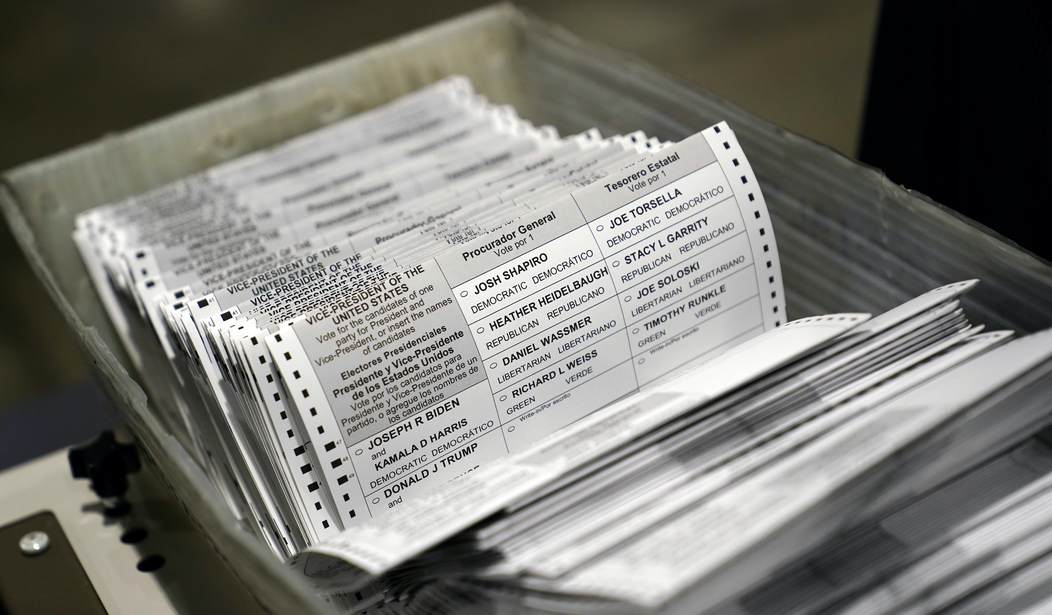
What is Election Day? That’s one of the issues before the Supreme Court regarding mail-in ballots. What is an acceptable timeframe to accept mail-in ballots? The federal statute is clear: they must be received by Election Day, not days afterward. The COVID pandemic is over; these silly laws allowing hordes of ballots to be accepted and counted after Election Day must end.
In March, the Court agreed to hear arguments in this case after Mississippi, the state where the legal dispute took place, couldn’t get the appeals court to rehear it. The initial decision from the Fifth Circuit favored the RNC through the Mississippi GOP. Amy Howe of SCOTUSBlog provided a good summary of the case, adding that a majority of the justices, at the time, seemed to agree that Mississippi’s mail-in ballot law should be overturned:
The Supreme Court … appeared ready to overturn a Mississippi law that allows mail-in ballots to be counted as long as they are postmarked by, and then received within five business days of, Election Day. After just over two hours of oral argument in Watson v. Republican National Committee, a majority of justices seemed to agree with the challengers – which included the Republican Party of Mississippi and the Libertarian Party of Mississippi – that the Mississippi law conflicts with federal laws that set the Tuesday after the first Monday in November as the “election day.”
Because more than a dozen states have similar laws, the court’s ruling – which is expected by late June or early July – could have significant implications for federal elections, beginning as soon as November.
Mississippi passed the law at the center of the case in 2020, in response to the COVID-19 pandemic. Four years later, the Republican National Committee, the Mississippi Republican Party, a Mississippi voter, and a county election official went to court to challenge the law, as did the Libertarian Party of Mississippi in a separate lawsuit (which was later combined with the Republicans’ lawsuit). They argued that Mississippi’s law clashed with a federal law, enacted by Congress in 1845, that establishes the Tuesday after the first Monday in November as “election day.” In 1872, Congress directed that congressional elections should occur on this day, as well.
A three-judge panel of the U.S. Court of Appeals for the 5th Circuit agreed with the challengers that federal law requires all ballots to be received by Election Day. After the full court of appeals – over a dissent by five judges – rejected the state’s petition to rehear the case, the state went to the Supreme Court, which agreed in November to weigh in.
… Mississippi Solicitor General Scott Stewart told the justices that states have broad power over elections. Laws like Mississippi’s, he argued, are consistent with federal election laws because voters make their final choices by Election Day.
Paul Clement, representing the challengers, countered that when Congress initially passed the law establishing the Tuesday after the first Monday in November as “Election Day,” the casting of ballots and the state’s receipt of ballots were “so inextricably intertwined” that “no one would have thought of one without the other” – supporting his argument that a ballot is final (and the election therefore occurs) when it is received by election officials.
Not the case.
Justice Samuel Alito responds to this ruling:
— Townhall.com (@townhallcom) June 29, 2026
"I cannot support this irresponsible escapade." https://t.co/Uq7p4F6UjG pic.twitter.com/ArnC6Ox4OL
In a 5-4 decision in which the Court ruled that Mississippi's law does not "the federal election-day statutes do not prevent Mississippi from counting absentee ballots postmarked by election day but received up to five days thereafter." Howe added in the SCOTUSblog's live reactions that this was a shock. Justice Amy Coney Barrett and Chief Justice John Roberts joined the liberal wing on this one:
🚨 In a 5-4 vote, the Supreme Court ruled that federal law does not require mail-in ballots to be received by Election Day, holding that states may count ballots postmarked by Election Day but received afterward if state law allows it. pic.twitter.com/j0QiGwhHUM
— SCOTUS Wire (@scotus_wire) June 29, 2026
The court holds that federal election-day statutes do NOT preempt a Mississippi law that allows mail-in ballots to be counted as long as they are postmarked by, and received within, five days of Election Day. The vote appears to be 5-4.
Alito dissents, joined by Thomas and Gorsuch and in part by Kavanaugh. This is a bit of a surprise, to be honest.
National Public Radio already had a fit, noting that states with bad weather, like Alaska, could be impacted, or something. Well, no need to worry, folks. Also, that state needs to trash its ranked choice voting, so I couldn't care less.
Editor's Note: Do you enjoy Townhall's conservative reporting that takes on the radical Left and woke media? Support our work so that we can continue to bring you the truth.
Join Townhall VIP and use promo code FIGHT to receive 60% off your membership.


Join the Conversation
VIP members get the ability to comment on articles.