





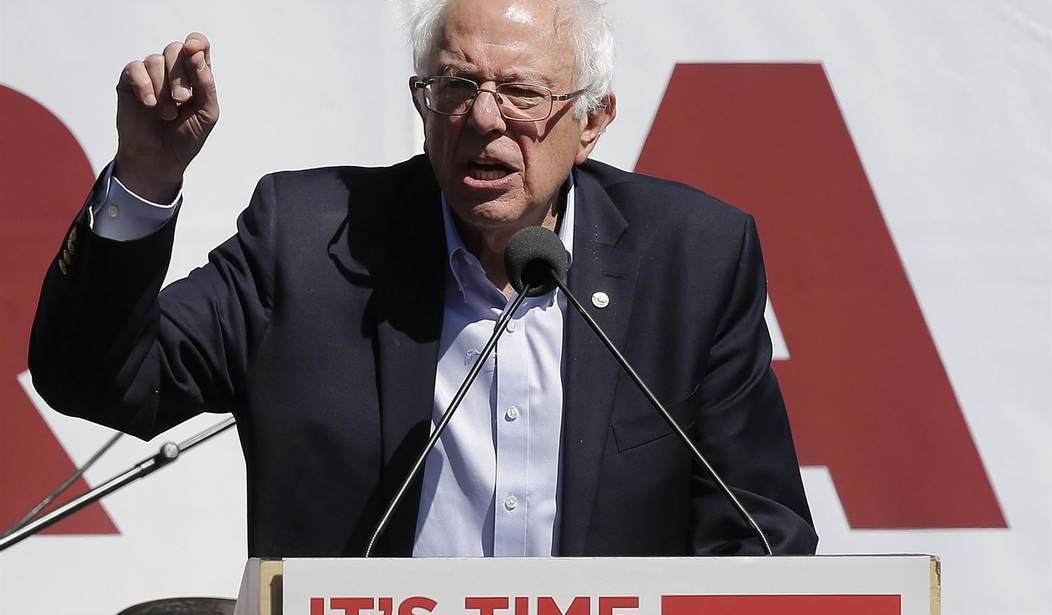
Sen. Bernie Sanders (I-VT) is not a Democrat, though he’s the progressive wing of the party’s de facto leader. He animated the young voter slice of the Obama coalition, which crippled Hillary in the general election. He’s pushing a rather lofty and economically unsound single-payer health care initiative. The price tag for this Medicare-for-All initiative is a hefty $32 trillion dollars. This proposal isn’t going anywhere. Support for it drops once you tell voters that their current health care plans would be cannibalized for a government one that reduces access to specialized care, doctors, and treatments to curb costs. To make him sound more like the American Jeremy Corbyn, Sanders is open to cutting aid to Israel. He said so himself in an interview with The Intercept:
One foreign policy issue, however, on which Sanders has attracted criticism from members of his own left-wing base is the Israel-Palestine conflict. Some pro-Palestinian progressives have accused him of giving Israel a pass. In an interview in April, for example, Sanders dismissed the Boycott, Divestment and Sanctions movement; he also signed his name to a controversial letter attacking the U.N. for having an “anti-Israel agenda.”
Nonetheless, it is undeniable that in recent years the Vermont senator, who is Jewish and briefly lived on a kibbutz in Israel in the 1960s, has taken a more pro-Palestinian position on the conflict and, specifically, against the right-wing government of Benjamin Netanyahu. “There comes a time when … we are going to have to say that Netanyahu is not right all of the time,” he told Clinton during a Democratic primary debate in April 2016.
These days, unlike other members of Congress, Sanders has no qualms about identifying, and decrying, the Israeli occupation of the West Bank and Gaza. But does he accept that the United States is complicit in Israel’s occupation, through its military aid and arms sales? And does he also accept, therefore, that the occupation of the Palestinian territories will never end until the U.S. stops arming and funding the Jewish state?
“Certainly the United States is complicit, but it’s not to say … that Israel is the only party at fault,” he tells me. However, he adds, “in terms of Israeli-Palestinian relations the United States has got to play a much more even-handed role. Clearly that is not the case right now.”
Would he, therefore, ever consider voting to reduce U.S. aid to Israel — worth at least $3bn per annum — or U.S. arms sales to the Israeli military?
“The U.S. funding plays a very important role, and I would love to see people in the Middle East sit down with the United States government and figure out how U.S. aid can bring people together, not just result in an arms war in that area. So I think there is extraordinary potential for the United States to help the Palestinian people rebuild Gaza and other areas. At the same time, demand that Israel, in their own interests in a way, work with other countries on environmental issues.” He then, finally, answers my question: “So the answer is yes.”
There was a lot of commentary about Sanders not being well versed or even comfortable talking about foreign policy during the 2016 primaries. Michael Cohen of the Boston Globe slammed Sanders’ response to the question about the war in Afghanistan and what he would do. The Vermont senator merely said we couldn’t withdraw tomorrow, which Cohen added was a weak answer. It’s America’s longest war—surely Sanders has been following it. At the same time, the far left has wanted to cut aid to Israel for years, so par for the course.

Join the Conversation
VIP members get the ability to comment on articles.