
During the height of the pandemic, government officials oftentimes put in place arbitrary rules that most realized had no connection to the pandemic whatsoever, giving away the game that it was all about power. Remember, Michiganders were prevented from buying seed and gardening supplies by Gov. Gretchen Whitmer, paddleboarders in California were arrested, mom-and-pop shops had to shut their doors unlike the big box stores, and casino lights stayed on while places of worship went dark.
The 15-day lockdown to slow the spread turned into 1,151 days, Rep. Brad Wenstrup pointed out during a Wednesday hearing before the Select Subcommittee on the Coronavirus Pandemic. During that time, Americans witnessed this uneven application of rules, they experienced heavy-handed censorship efforts of differing opinions and suffered under forced health measures that were not backed up by science, all of which fueled distrust in the federal government.
Why were constitutionally guaranteed rights ignored by the government during COVID-19?
— Select Subcommittee on the Coronavirus Pandemic (@COVIDSelect) June 21, 2023
Today, we examine the intrusion on American civil liberties.
Witnesses:
▪️ Missouri AG Bailey
▪️ Louisiana SG Murrill
▪️ Former Wis. SG Tseytlin
Tune in at 10am📺https://t.co/E8aU8axn60
Louisiana Solicitor General Elizabeth Murrill dove into the constitutionality of restrictions on businesses and limitations for in-person gatherings, referencing the legal battle faced by Rev. Tony Spell, who was arrested in April 2020 for violating Democrat Gov. John Bel Edwards' emergency orders by holding massive, in-person services.
Whether you like him or not, Rev. Spell believed, and rightly so, that the Governor’s executive orders were unconstitutional and that the Governor could not prohibit people from gathering to pray. Rev. Spell was extremely vocal in his opposition to the Governor’s orders, which severely limited the number of people who could gather and worship. He invited people to attend his church anyway, which antagonized the Governor. As a result, Rev. Spell was placed under surveillance and later arrested for violating the Governor’s executive orders. He was issued six misdemeanor citations.
Yet Reverend Spell was correct: these orders could never be criminally enforced as Louisiana law prohibits the Governor from creating any new crimes by executive order, even in a disaster. But what was most shocking is that the Governor’s legal team admitted that Rev. Spell had not been targeted for endangering others but because he was “unrepentant.” On May 13, 2022, the Louisiana Supreme Court ruled with the LADOJ in declaring that Governor John Bel Edwards’ mandates closing churches cannot be the basis to prosecute a governor-created crime of letting too many people into church for worship. “In this criminal proceeding,” the court ruled, “we find certain provisions of two executive orders, as applied to defendant, violate his fundamental right to exercise religion, do not survive strict scrutiny, and are thus unconstitutional.” It was a victory for Reverend Spell; but it took two years to achieve this ruling and at great expense.
Louisiana Sol. General Elizabeth Murrill Testifies on the COVID-19 Policies Which Exceeded the U.S. Government's Constitutional Authority
— Chief Nerd (@TheChiefNerd) June 21, 2023
"What was shocking was that a prosecutor admitted that [Reverend Tony] Spell was targeted for the sin of being unrepentant about criticizing… pic.twitter.com/5RveNrhPw4
And similar cases continued to take place in Louisiana and beyond, Murrill explained, citing several more examples.
"As for the constitutionality of these orders, it is clear that during the COVID-19 pandemic, the role of government became distorted and the Constitution was set aside without any meaningful resistance from the Congress, the legislatures, or even the Judiciary," she said. "That is why our constitutional structure, which is supposed to prevent one branch of government from ever exercising autocratic, tyrannical power over the people, was able to be violated from the top down, causing massive damage at an enormous cost."
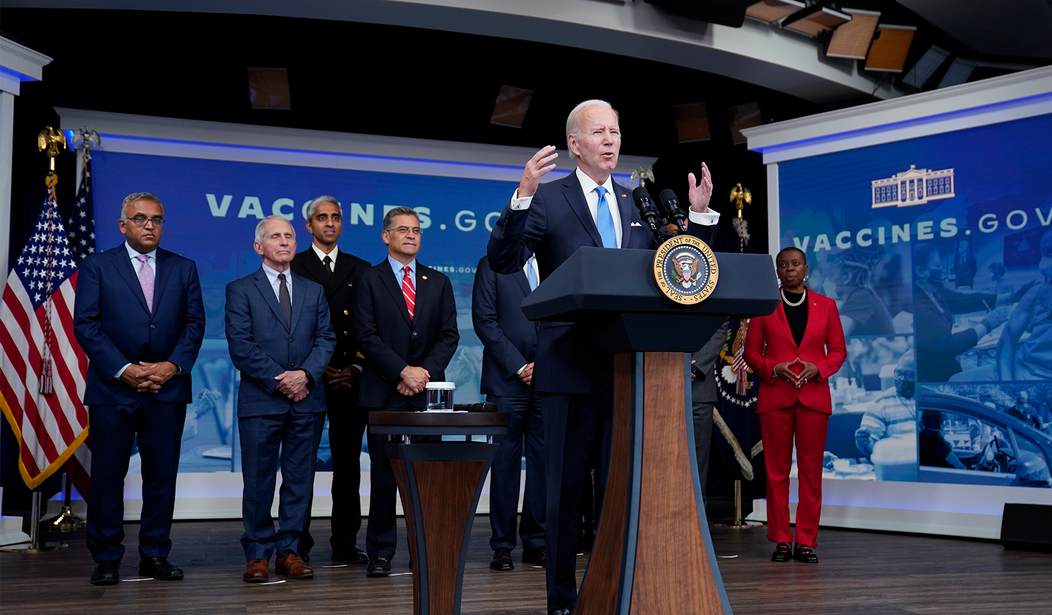
Of course, such unconstitutional measures occurred at the federal level, too. As president-elect, for example, Joe Biden took a very different position on vaccine mandates than he did once he took office and eventually announced vaccine mandates that would apply to massive swaths of Americans.
But the attack on Americans' constitutional rights didn't end there, as the pandemic was also used as a pretense for stifling free speech in the name of "misinformation" and "disinformation." Missouri Attorney General Andrew Bailey argued these censorship efforts were "the biggest violation of the First Amendment in this nation's history."
🔥🔥🔥
— Select Subcommittee on the Coronavirus Pandemic (@COVIDSelect) June 21, 2023
Censorship efforts during COVID by Dr. Fauci, @FBI, @StateDept, @CDCgov, etc. were “the biggest violation of the First Amendment in this nation’s history.”
@AGAndrewBailey details Missouri's effort to stop the federal government from infringing on free speech.
Watch👇 pic.twitter.com/2RN81CphiQ
The hearing wasn't just to rehash how the Constitution was trampled upon during the pandemic. Murrill said she hopes that by evaluating all that occurred, boundaries will be put in place at the state and federal levels to "ensure it never happens again."