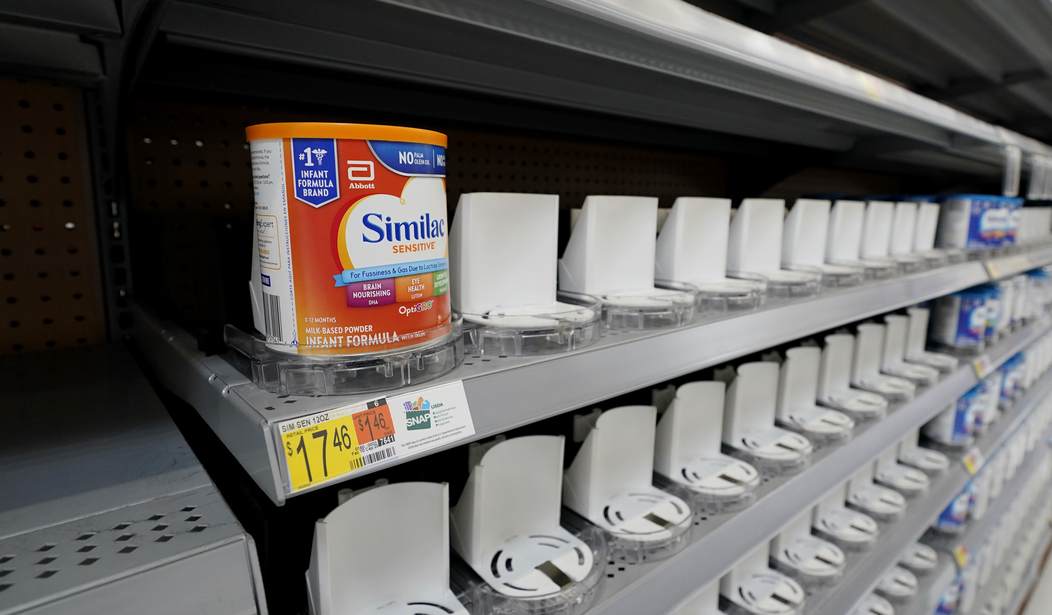

It's been eight months since Abbott voluntarily recalled several of its products over consumer complaints regarding bacterial infection in infants who consumed formula manufactured at its Sturgis, Michigan, plant. While Abbott says there's no evidence linking its formulas to the infant illnesses, that recall, coupled with already pandemic-strained supply chains, prompted a massive shortage nationwide. Parents and caregivers scoured store shelves, driving hours in some cases to look, and reached out to family members nationwide, searching for what their babies needed.
Instead of treating the shortage as the national emergency that it was, the Biden administration slow-walked its response, with the president admitting he wasn't even informed of a problem until two months after industry leaders were sounding the alarm, and in June admitted he didn't anticipate the plant closure would have such a big impact. While the FDA worked with formula manufacturers to ramp up production and flew in formula from overseas, many Americans continued to struggle finding formula.
A recent survey by the U.S. Census Bureau suggests there's still a problem. Adults in nearly one-third of households with infant children who typically buy formula had trouble finding it last month, according to the survey, while nearly one in five affected homes had less than a week's supply of formula.
Given this reality, White House Press Secretary Karine Jean-Pierre was asked during Wednesday's press conference why the shortage is still a problem.
In a response that channeled VP Harris, Jean-Pierre didn't have much to say.
"So, look, the president and his administration has taken actions, as you know, through the last several months to make sure that we have progress to address this current — this issue — this issue that is currently happening right now, and also to avoid any future issues," she said.
"As you know, we've ramped up the domestic production, which — including invoking the Domestic Production Act, which has allowed companies to increase production," Jean-Pierre continued. "And, as a result, U.S. infant formula production year-to-date has outpaced the 2020 level."
"So, we have seen some improvement. We understand that there's more work to be done. And — and so we're going to continue to work on that as well."
Americans are STILL having trouble finding baby formula — 8+ months after the crisis began.
— RNC Research (@RNCResearch) October 19, 2022
Karine Jean-Pierre says Biden is working "to make sure that we have progress to address this issue, this issue that is currently happening right now." pic.twitter.com/JQFikfliQd
Meanwhile, parents are livid over the ongoing shortage.
"The conclusion that I have come to is the American people need to remember this," mother of preemie twins Amber Bergeron told "Fox & Friends First" on Wednesday. "Remember that the children, our future, was not important to this administration. I'd like to ask the president, where are you for our future? Where are you? You need to wake up."