





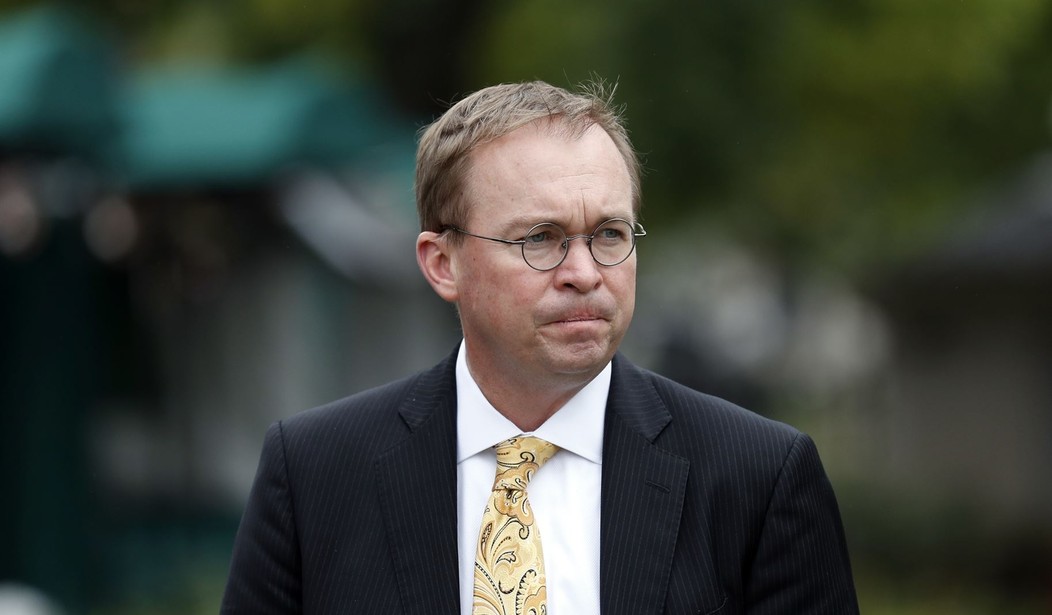
A Consumer Financial Protection Bureau official sued President Trump on Sunday over his appointment of Office and Management and Budget director Mick Mulvaney to serve as interim director of the agency.
Leandra English filed the lawsuit late Sunday to block Mulvaney from taking over the CFPB, and asked for a declaratory judgment by the United States District Court for the District of Columbia on the matter.
The federal official argues that the Dodd-Frank Act, a law championed by Democrats that created the Consumer Financial Protection Bureau, prohibits the White House from naming the director for the agency.
English, who is the deputy director of the bureau, said she became the acting director of the bureau under the law after Richard Cordray, the now-former director, resigned last Friday.
Cordray was appointed by President Barack Obama and has been the subject to criticism from congressional Republicans who said he was overzealous.
The White House argued in an opinion issued Saturday by the Justice Department's Office of Legal Counsel that it is within the president’s right to appoint an acting director. Steven A. Engel, newly confirmed head of the office, wrote that while the deputy director could serve as acting director under the statute, the president has the power to make appointments under the Vacancies Reform Act. (Fox News)
But English argues that provisions within the Dodd-Frank Act that lay out the agency’s line of succession override the Federal Vacancies Act.
“The president’s purported or intended appointment of defendant Mulvaney as Acting Director of the CFPB is unlawful,” the complaint reads, adding that the president’s use of the Federal Vacancies Act is “an obvious contravention of Congress’s statutory scheme” that “cannot be reconciled with Dodd-Frank’s mandatory language.”
White House Press Secretary Sarah Huckabee Sanders said the administration is aware of the lawsuit but there is no question the president was within his rights to appoint Mulvaney.
"The Administration is aware of the suit filed this evening by Deputy Director English," she said in a statement to CNN. "However the law is clear: Director Mulvaney is the Acting Director of the CFPB. Now that the CFPB's own General Counsel - who was hired under Richard Cordray - has notified the Bureau's leadership that she agrees with the Administration's and DOJ's reading of the law, there should be no question that Director Mulvaney is the Acting Director.
"It is unfortunate that Mr. Cordray decided to put his political ambition above the interests of consumers with this stunt. Director Mulvaney will bring a more serious and professional approach to running the CFPB."


Join the Conversation
VIP members get the ability to comment on articles.