


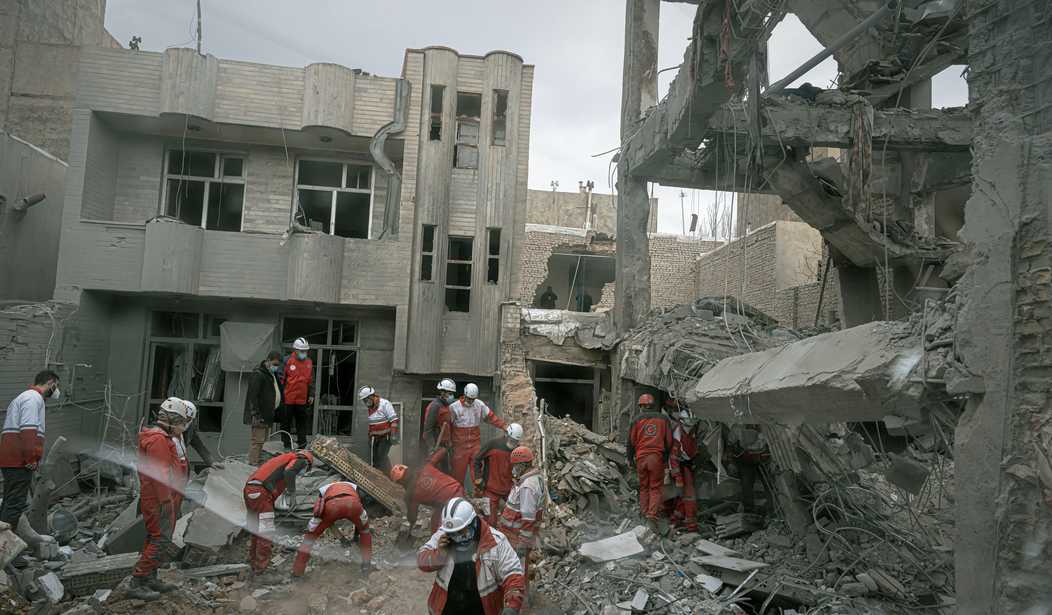
The Iranian government has threatened to retaliate if President Donald Trump orders a U.S. blockade of the Strait of Hormuz.
Currently, Iran is using its navy to enforce which vessels will be allowed to transport oil and other resources through the waterway. Trump repeatedly demanded that the regime lift its blockade of the region — but Iran has refused despite the president giving a two-week extension on the deadline he set for the regime.
From The Associated Press:
The U.S. military vowed to blockade all Iranian ports starting Monday, part of efforts to force Tehran into agreeing to open the crucial Strait of Hormuz and accepting a peace deal. Iran responded with threats on all ports in the Persian Gulf and the Gulf of Oman, taking aim at U.S.-allied countries.
That set the stage for an extraordinary showdown that contains serious risks for the global economy and raises the specter that a ceasefire that is currently holding could collapse and the war could resume. Talks aimed at permanently ending the conflict — which began Feb. 28 with U.S. and Israeli strikes on Iran — finished without an agreement this weekend, and there has been no word on whether negotiations will resume.
Iran’s effective closure of the strait, through which 20% of traded oil passes in peacetime, has sent oil prices skyrocketing, pushing up the cost of gasoline, food and other basic goods far beyond the Middle East. Tehran has allowed some ships perceived as friendly to pass while charging considerable fees, leading to accusations it is holding the global economy hostage.
Some analysts are doubtful that the U.S. can restore normal shipping through force alone — and it’s not clear how a blockade would work or what the dangers might be to U.S. forces. The question is essentially who can endure the most pain: Could a blockade make Iran’s economic situation untenable and force it to concede? Or will it drive global oil and other prices so high that U.S. President Donald Trump is forced to back down?
In response to Trump’s threat, the Iranian Revolutionary Guard Corps (IRGC) said, “Security in the Persian Gulf and the Sea of Oman is either for everyone or for NO ONE,” and that “NO PORT in the region will be safe.”
The global impact of Iran’s blockade has been severe. BBC News reported that it has pushed Brent crude oil above $100 per barrel, which has resulted in climbing gas prices in the United States and other nations.
In the U.S., average gas prices reached $4.16 a gallon on April 10 as diesel rose to $5.67. Before the war started, the national average price for a gallon of gasoline was about $2.98.
Under Trump’s blockade, the U.S. military would not shut down the Strait of Hormuz but would conduct a targeted naval blockade in which U.S. forces stop ships entering or leaving Iranian ports and coastal areas. It would allow all other traffic through the waterway, isolating Iran’s maritime trade.
The military will rely on surveillance, tracking data and intelligence to identify ships connected to Iranian ports instead of placing warships at harbor entrances. This would make it harder for the regime to move oil, import goods and earn revenue and weaken its leverage over the global energy market.
Editor’s Note: Do you enjoy Townhall’s conservative reporting that takes on the radical Left and woke media? Support our work so that we can continue to bring you the truth.
Join Townhall VIP and use promo code FIGHT to receive 60% off your membership.







Join the conversation as a VIP Member