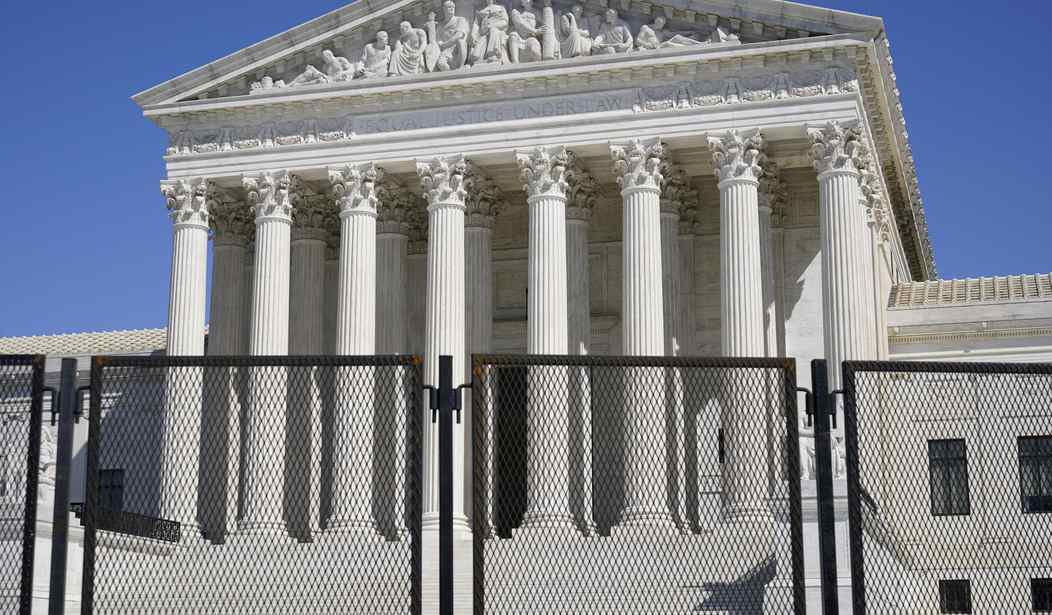

The Supreme Court is set to hear a case centered on a key component of the Voting Rights Act that could ensure a longstanding Republican majority in the House of Representatives.
The case of Louisiana v. Callais involves the redistricting of several areas of the state that is alleged to have violated the legislation’s prohibition on gerrymandering in a way that dilutes the voting power of racial minorities.
If the Supreme Court rules in the plaintiffs’ favor, it would allow the GOP to pick up 19 House seats through redistricting, according to Politico.
A group of non-Black voters in Louisiana sued the state over its new congressional map that was approved last year under Senate Bill 8. This occurred after a judge ruled in another case that the 2022 map broke the Voting Rights Act by weakening the votes of Black residents through “packing” many Black voters into one district.
In response, Louisiana Gov. John Bel Edwards called a special session, which resulted in the current map, which added a second majority-Black district.
The plaintiffs claim that the new district constitutes an illegal racial gerrymander that violates the Equal Protection Clause of the 14th Amendment. They contend that lawmakers focused primarily on race when they drew it and ignored usual rules such as keeping districts compact while still acknowledging city or parish lines. They point to the irregular shape oft he district to prove that the district was created for racial purposes.
A lower court agreed, with a judge said the district resembled “an inkblot which has spread indiscriminately across the Louisiana map.”
The plaintiffs are requesting that the Supreme Court declare SB8 unconstitutional under the 14th and 15th Amendments, stop the state from using the district in elections, and to order that a new map be drawn.
"SB8’s second majority-minority district, District 6, stretches some 250 miles from Shreveport in the northwest corner of the state to Baton Rouge in southeast Louisiana, slicing through metropolitan areas to scoop up pockets of predominantly Black populations from Shreveport, Alexandria, Lafayette, and Baton Rouge,” the lawsuit reads. "Accordingly, the State is enjoined from using SB8 in any future elections."
If the high court grants the plaintiffs’ request, it would provide Republicans with a significant advantage in the lower chamber, Politico noted.
That calculation, made in a new report from Fair Fight Action and Black Voters Matter Fund shared exclusively with POLITICO, would all but guarantee Republican control of Congress.
While a ruling in time for next year’s midterms is unlikely, the organizations behind the report said that it’s not out of the question. Taken together, the groups identified 27 total seats that Republicans could redistrict in their favor ahead of the midterms — 19 of which stem from Section 2 being overturned.
Doing so would “clear the path for a one-party system where power serves the powerful and silences the people,” Black Voters Matter Fund co-founder LaTosha Brown said in a statement.
Without Section 2, up to 30 percent of the Congressional Black Caucus and 11 percent of the Congressional Hispanic Caucus could be drawn out of their seats, according to the report.
Republicans have long sought to dismantle this portion of the VRA, which generally prohibits race-based discrimination in voting laws and practices, arguing that it gives Democrats a partisan advantage. The Supreme Court has previously rebuffed these arguments, but voting rights advocates are worried the Louisiana case will change that.