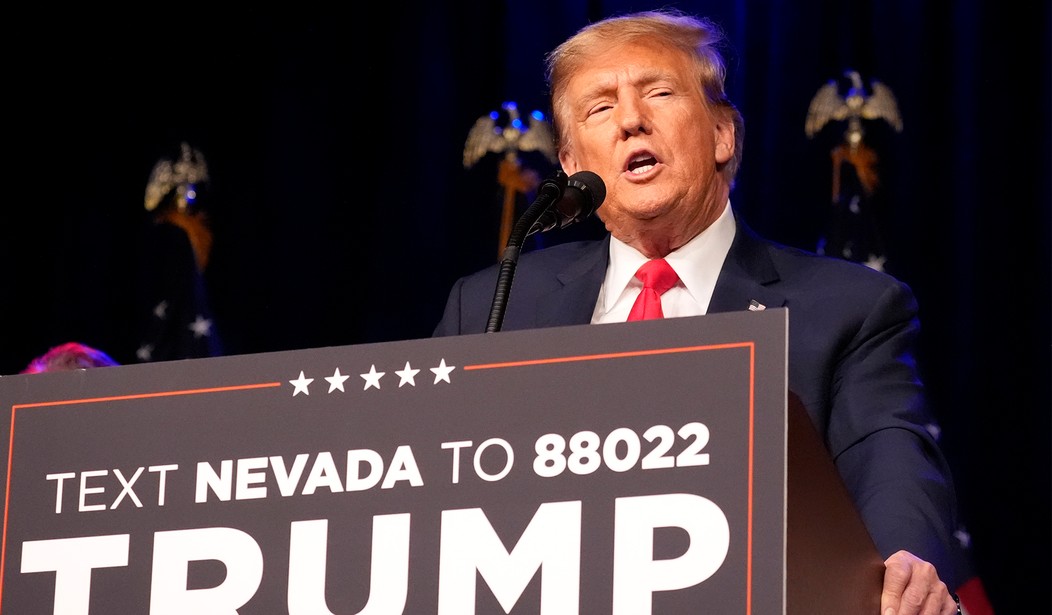

Nevada has been an elusive prize for Republicans, especially at the national level, over the last two decades. President George W. Bush was the last party nominee to carry the silver state, back in 2004. Since then, GOP tickets have lost there, both narrowly and handily. Donald Trump came close in 2016, falling short by a little more than two percentage points against Hillary Clinton. Joe Biden won Nevada by a similar margin four years later. In 2022, Republican Adam Laxalt held what appeared to be a modest but significant polling lead in the state's US Senate race heading into Election Day. Then he became a victim of the national Red Wave That Wasn't, losing narrowly. The Democrats' Nevada machine prevailed, though the GOP gubernatorial candidate hung on and won, marking one of the very few examples of incumbents losing anywhere in the country, for any major office. All of which is to say, Nevada has been a very tough nut for Republicans to crack -- for years.
Might that change in 2024? I remain skeptical, given the history rehearsed above, but there are signs pointing to a very real GOP opportunity in this election. Over the last few days, Nevada's top political analyst and prognosticator tweeted some admonitions for Democrats about party registration trends and their typical 'firewall' from early voting:
These are statewide numbers. It's essentially a tie in NV in voter reg.
— Jon Ralston (@RalstonReports) October 17, 2024
Normally, I'd say that in Nevada, home of The Reid Machine, ties go to the Dems.
Still could be true, but this year, only three words for Dems here:
Danger, Will Robinson! https://t.co/F76XwcG8vO
The early voting blog is updated!
— Jon Ralston (@RalstonReports) October 20, 2024
Bottom line: Dems have a small lead, but Rs surely are bullish because lead was much bigger after one day in 2020. Clark firewall is very small, will need to get bigger or Harris in trouble.
Lots of charts, data.https://t.co/Pl43XBLF02
"Danger." Harry Reid's political machine has outlived the former Senator, and it remains formidable. Donald Trump holds the slimmest of leads in the RealClearPolitics Silver State average, but as Ralston notes, virtual ties typically break for the Democrats out there. That could very well be the case. The Laxalt loss in the midterms came despite his campaign enjoying a substantially larger advantage in the RCP average than Trump is experiencing right now. Superior ground games can conceivably grind out a point or two, which in hyper-tight races could easily prove determinative. On the other hand, additional trends in Nevada are starting to draw attention from political data obsessives:
Democrats "only" winning Clark mail 45-26 and getting obliterated in in-person early voting, continuing a trend of GOP doing much better in early voting than they did in 2020 and even in 2022. Democrats will have to have a turnout surge on election day to counter these numbers. https://t.co/0Snf2xVuN6
— Political Election Projections (@tencor_7144) October 20, 2024
Democrats relying on a "turnout surge on Election Day to counter" the early numbers may not be music to the Harris campaign's ears. Granted, there are still two weeks for these trajectories to move. Generally speaking, Republicans are known for showing up in force on the day itself. Maybe that is changing, and the whole dynamic will be flipped on its head, again. But I doubt Democrats will feel too confident about needing to count on that happening. Others are mining specific numbers, too:
No Firewall for Ds in NV (where it is a true term to use) means a likely loss in the state. No this is not wish casting or bias, it is just a product of the nature of the state (60-70% of total vote is early vote).
— CA ET Nerd (@earlyvotedata) October 20, 2024
Don't take my word for it. @RalstonReports will provide his… https://t.co/wEeF8OBFe8
Nevada News - We now have the Clark Co mail file posted.
— Jeremy Hughes (@jeremybhughes) October 20, 2024
With mail and EV counted:
Statewide First Day 2020: D+40,000
Statewide First Day 2024: D+1,721
Day 1 of Nevada early voting in Clark was D+7 in 2020.
— Eric Daugherty (@EricLDaugh) October 20, 2024
Yesterday, it was R+18.
WOW. https://t.co/AtNYYztN53
Clark County, NV mail in ballots very telling.
— Ryan James Girdusky (@RyanGirdusky) October 20, 2024
Democrats are cannibalizing their high-propensity vote at a greater frequency than Republicans.
Republicans are doing a better job at getting low propensity voters than Democrats. pic.twitter.com/xS1KktFVoq
I'm very wary of over-interpreting or extrapolating too much from the early and mail-in data. Improvements in some areas could mean cannibalization elsewhere -- and what may look like good news, based on a previous cycle's dynamics, may not really amount to much under new circumstances. I'd say using 2020 in particular as too much of a balloting baseline may be risky, given how strange that election was, considering that it was carried out in the middle of an extremely disruptive pandemic. Still, are Democrats excited to see this?
ABC NEWS: The early vote shows a 10-point swing towards Republicans in the battleground states of FL, GA, MI, NC, PA, VA, and WIpic.twitter.com/9VNwA5UzYV
— Election Wizard (@ElectionWiz) October 20, 2024
Some early indicators in a number of places might be pointing to results that align with some of the other major, underlying 'fundamentals' of the race, which favor Trump and Republicans. Anything can happen, and I'd still consider this contest a pure tossup, with apparent advantages on both sides, but I know whose trajectory I'd rather have in the closing days -- for now, at least:
BREAKING — Harris' lead in the RCP Average has dropped to just 0.9. On this day in 2020, Biden was leading by 8.6; on this day in 2016, Hillary was ahead by 6.4. pic.twitter.com/mqX4cK3Kvh
— Election Wizard (@ElectionWiz) October 20, 2024
📊 TIPP Daily Tracking Poll
— InteractivePolls (@IAPolls2022) October 20, 2024
🟥 Trump: 49% [+2]
🟦 Harris: 47% [-1]
[+/- change vs 10/18]
——
Last 5 polls
10/15 - 🔵 Harris +4
10/16 - 🔵 Harris +3
10/17 - 🔵 Harris +2
10/18 - 🔵 Harris +1
10/19 - 🔴 Trump +2
——
#115 (1.8/3.0) | 10/17-19 | 1,254 LVhttps://t.co/2TjvRPjyMI pic.twitter.com/rzUnItc03Y
This is undeniably a bearish newsletter for Democrats, but I thought it was important to articulate why it wouldn’t be surprising if Trump wins and why Harris faces difficult circumstances.https://t.co/i5ZELFEqbn
— Nate Silver (@NateSilver538) October 20, 2024
Adding some context: how the top 5 most accurate national pollsters from 2016 and 2020 see the current race:
— Tom Bevan (@TomBevanRCP) October 20, 2024
1) Reuters/Ipsos: Harris +3
2) Rasmussen: Trump +2
3) IBD/TIPP: Trump +2
4) FOX News: Trump +2
5) NBC News: TIEhttps://t.co/ifWcliITMg pic.twitter.com/TJ4SYnd4CY