





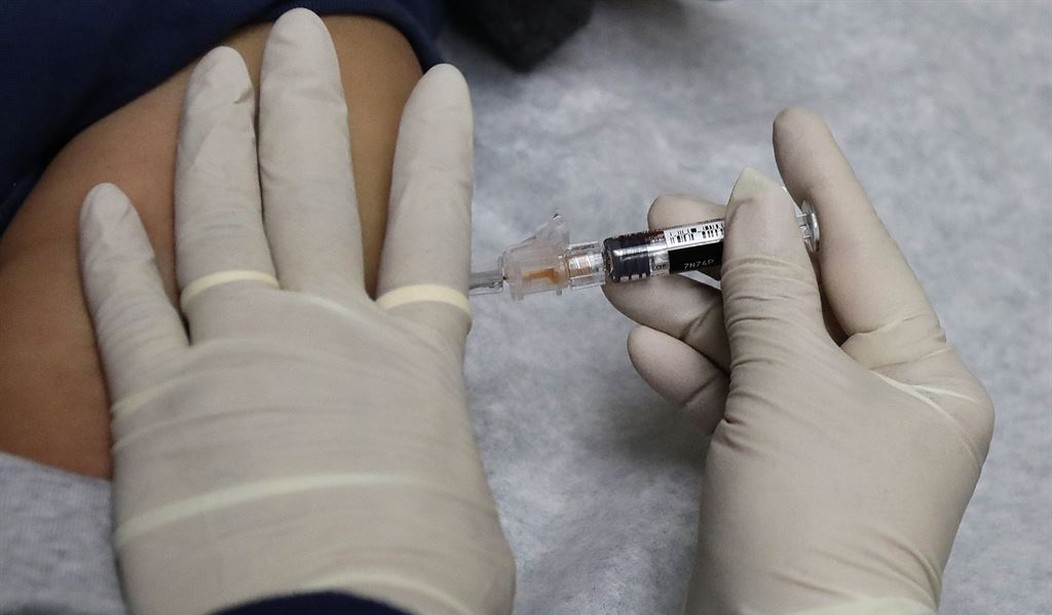
There are rays of hopeful news amid the demoralizing deluge of Coronavirus sadness, including some improving trajectories in some recently hard-hit sunbelt states, as well as real progress on several major vaccine candidates. The BBC reports, "a vaccine would normally take years, if not decades, to develop. Researchers hope to achieve the same amount of work in only a few months. Most experts think a vaccine is likely to become widely available by mid-2021, about 12-18 months after the new virus, known officially as Sars-CoV-2, first emerged," adding, "that would be a huge scientific feat and there are no guarantees it will work."
Among the most promising vaccine candidates -- currently in stage three trials, featuring thousands of people -- are offerings from Moderna/NIH, Pfizer/BioNTech, and AstraZeneca/Oxford, with dozens of others in various phases of development (China says it has a version approved for limited use, but the regime is not to be trusted). Early findings on the aforementioned 'big three' have been encouraging. But with so much attention understandably focused on "Operation Warp Speed," some may be ignoring a critical and related question: Will Americans rush out to get immunized as soon as a vaccine is officially deemed safe and effective enough to be widely administered?
Virtually since the beginning of the pandemic five months ago, much of America has hung its hopes on a coronavirus vaccine to beat the pandemic and get back to some version of normal life. And while some vaccine candidates may be getting closer, a new poll questions whether people will even take a COVID-19 vaccine...even if a safe and effective vaccine is available by year end and it was free, a new CBS News poll suggests there may not be takers, at least at first. The poll found that more than two third[s] of Americans, 70%, would either wait to see what happens when other[s] got the shot or would never get one. Fewer than one in three would get the vaccine right away... Curiously, only 27% of those most at risk for COVID-19, Americans over age 65, would get the vaccine right away. And liberals are more than twice as likely to get one immediately than conservatives.
I can't find a breakdown of the "wait and see" vs. "never take it" contingents, but I'd guess that there are a lot more people in the former category than the latter. Regardless, only around 30 percent of Americans say they'd promptly get vaccinated, at least for the moment. I think much of the hesitation relates not to hardcore "anti-vax" conspiracies, but rather the entirely reasonable concern that a brand new drug, rushed to market in the middle of a crisis, may have unknown or undesirable immediate or longer-term side effects. But as many millions of doses are being preordered (clinical trials are widespread and rigorous), a lot of people will need to be convinced to actually take them -- and this isn't a minor issue:
These are things the government needs to be thinking about now, @amprog had a report on it yesterday https://t.co/xSGD5Y7W8g https://t.co/TGGwQrrlxP
— Benjy Sarlin (@BenjySarlin) July 29, 2020
This is also a fair point on hypothetical behavior vs. actionable decisions:
I am in general skeptical of poll results about what people would do in hypothetical situations. I’m not sure people have great insight into their own future behavior. https://t.co/YHNZWJ4OkQ
— Josh Barro (@jbarro) July 29, 2020
3. In polls like these, people sometimes aren't very good at predicting their own future behavior under what for now is a hypothetical scenario. So it might be good look at empirical rates of vaccination instead to predict what % will ultimately be vaccinated.
— Nate Silver (@NateSilver538) July 29, 2020
People who may be very skeptical while speaking with a pollster today could come around rather quickly if credible experts and officials from across the ideological spectrum lead on the issue, assuring people that the vaccine is safe and effective and will help create enough herd immunity as to deliver us out of this nightmare. This comes pretty close to my thought process on the matter:
I think people are misconstruing this as an anti-vax thing. Hell, I won't buy a new phone or video game console until I see what problems the first wave of customers encounter. Things that aren't real world tested yet are intimidating. That being said I'd almost certainly do it. https://t.co/507j3qkR9w
— Noam Blum (@neontaster) July 29, 2020
If a Western (i.e. not Chinese) vaccine is FDA approved, and the science is sound, I'd be inclined to take it -- after the most vulnerable populations are prioritized for the first round of doses. What are your thoughts, and how strongly do you hold your current opinion on this?

Join the Conversation
VIP members get the ability to comment on articles.