
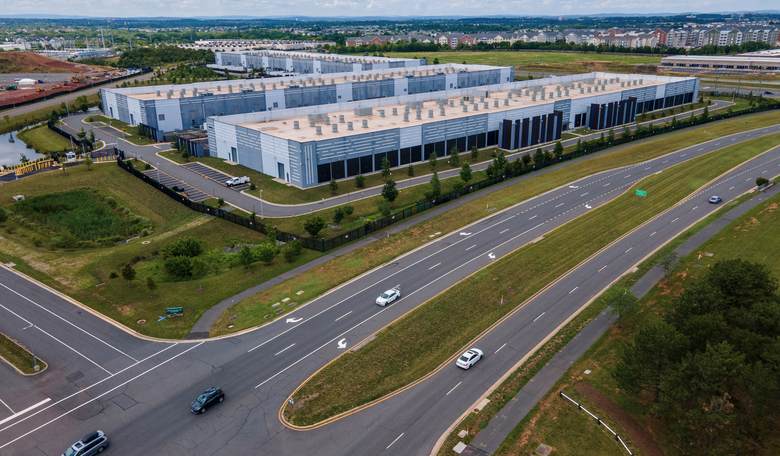
Earlier this month, one Maryland activist managed to kill a $5 billion data center planned for a mall that had sat abandoned and rotting for more than 20 years. The project would have supported 27,000 construction jobs and 1,600 permanent jobs, and generated over $45 million in annual tax revenue, including $13.7 million for Prince George's County, where she lives.
Now a deep dive from Pirates Wire into that activist, Taylor Frazier McCollum, raises an uncomfortable question: how did one person with little apparent expertise, a warped worldview, and backing from a group tied to a foreign adversary manage to derail such a beneficial project?
I did a deep dive into the viral Maryland anti-data center activist, Taylor Frazier McCollum. Highlights include: - “It’s not like a hyperscale data center is going to cure cancer,” she said. (In fact, AI is rapidly accelerating cancer research.) - “Money is, you know, a made-up concept,” she said as she celebrated killing a $5 billion investment into her county that's facing a $151 million deficit. - Only went viral after collaborating with a CCP-linked Marxist-Leninist group linked to pausing/stopping $23 billion in data center projects - She attended my pro-data center party in DC (at the invitation of a Vanity Fair reporter) Her very normal response: “I didn’t leave because I felt intimidated. I left because I was about to BURN ALL THAT SHIT DOWN!” - Wants a trampoline park at the site instead (there's already one 10 minutes away) - Has begun doing anti-Waymo activism in DC
— Jonas Du (@JonasYDu) November 23, 2026
McCollum's campaign was hailed by data center opponents at the time as a feat of grassroots organizing, but questions have since emerged about how it grew. Her petition gathered a mere 80 signatures over several months. It then reached 25,000 in a short time after a group linked to the CCP and tied to Neville Roy Singham picked it up.
Her understanding of the technology she opposes, and of the economics around it, is just as shaky. "It's not like a hyperscale data center is going to cure cancer," she said. But AI is already accelerating cancer research. Scientists use it to screen billions of candidate drug molecules in mere minutes, and doctors use it to catch more breast cancers in mammograms. All of that work runs on the computing power data centers provide.
She went on to claim that "A hyperscale data center from Amazon is purely there to track your shopping habits, to track your spending habits, to market and promote items to you."
In another instance, the single mother, who was evicted from her home after taking a pay cut, declared that "Money is, you know, a made-up concept," adding that “We buy into it every day, and we choose to say that this has value and that doesn’t have value, and to me, the environment has the highest and utmost value.”
Her grasp of what makes an infrastructure project truly beneficial is no better. She said she would rather see a trampoline park or another mall on the site of the already abandoned mall, which she argued would actually benefit people, unlike a data center. The result of her activism was not only the loss of a beneficial infrastructure project, but also the passage of several moratoria and new approval requirements that make developing data centers far more difficult in her county.
She has since moved on to anti-Waymo activism in Washington, D.C., claiming the cars are roaming surveillance pods.
But for all of this, it leaves us with yet another question: why is government willing to listen to people who are so out of their league? This is not just a victory for McCollum, but a loss for the county and its nearly one million residents. Just 2.5 percent of the county, the roughly 25,000 who signed her petition, was able to make it harder for everyone else to prosper.
The county will feel the cost for years. The $13.7 million in annual revenue that would have helped pay for schools, public safety, and other basic services is gone, along with 1,600 permanent jobs. The new moratoria and approval requirements tell every company weighing a major investment to build somewhere else which closes off other sources of tax revenue and economic growth that could have supported the county for decades.
The residents who pay for that never signed the petition or got a say.
The woman who protested the Maryland data center deserves criticism. But the outrage misses who's actually to blame: the government officials who *listened to her.* Activists will always complain. The real failure is Prince George’s County treating her like she has veto power.
— Billy Binion (@billybinion) November 23, 2026
Hysteria is never the proper way to pass policy, yet it has largely characterized the entire data center debate. This is not something the country can afford to lose to mass panic. It requires an honest conversation before anyone moves toward laws. History has always favored economic growth and new technology, and the data remains on the side of the pro-data center faction. Prince George's County is bound to learn the cost of ignoring both.