
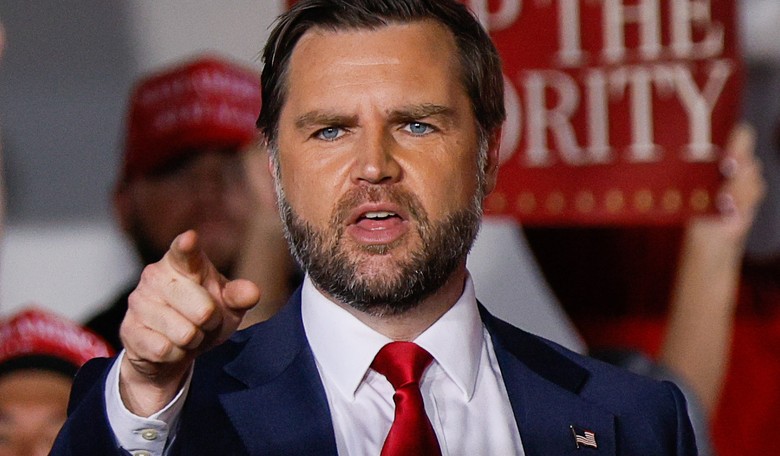
Late Monday, Vice President JD Vance sat down with Fox News’ Laura Ingraham to discuss everything from the midterm elections and China to his own political future and the Iran war. In particular, Vance laid out when he’ll decide whether to run for president, how he views the debacle that has become the Iran war, and where he, and his critics, fit into it.
First, the vice president told Laura Ingraham that he’ll decide whether to run for president in 2028 by next year, while other news outlets are reporting that his self-imposed deadline is the spring 2027.
🚨 JUST IN: JD Vance announces he will decide on a 2028 presidential campaign NEXT YEAR, and he will be "ALL-IN" on whatever that is "With the presidential campaign, there's a lot of infrastructure that you have to set up, fundraising, all that stuff. And so you can't declare a month before the Iowa caucus that you're going to run for president." "So I haven't made a decision. We'll figure it out sometime next year." 2028 is already heating up and it KICKED OFF right after the midterm blowout Other names floated include Marco Rubio and Ron DeSantis for who might launch a candidacy
— Eric Daugherty (@EricLDaugh) November 17, 2026
And Vance has a hefty set of variables to weigh. The Republicans’ midterm wipeout makes the fight for the presidency even harder than it otherwise would have been, especially in Texas, where the party’s losses make an Electoral College victory particularly difficult.
Vance has also been attempting to distance himself from President Trump on foreign policy. Famously an isolationist, he is reportedly seeking to build his own base from a coalition of “disaffected Trump voters.” But with his name so closely tied to the Iran war, Vance may want to avoid scrutiny over a decision many see as politically unpopular, especially amongst those on the New Right. Other contenders include Florida Governor Ron DeSantis, who wasted little time positioning himself for a presidential run after his state withstood the blue wave. Secretary of State Marco Rubio has also been floated as the heir apparent, though he has grown frustrated with questions about 2028.
Moving on to the Iran war itself, Vance challenged critics of the memorandum of understanding, for which he was the chief negotiator. He also blamed "neocons" and their hawkish tendencies for turning the war into the debacle it has become.
He began by casting himself as a heat shield for President Trump, accusing critics of being too cowardly to blame the president himself for the war's apparent failure. But it’s important to remember that the president’s advisers were split into two factions: those, including Vance, who advocated premature negotiations, and those like Secretary of War Pete Hegseth and Sec. Rubio who wanted to extend the air campaign until more objectives had been achieved. The president ultimately took the former’s advice, and what followed was precisely what was bound to happen when negotiating with a nation famously coy and untrustworthy at the bargaining table.
🚨 LMFAO! JD Vance just LAID IT STRAIGHT on people blaming him for the Iran MOU falling apart and losing the election on Iran: "It's people who want to criticize POTUS but, frankly, DON'T have the COURAGE to criticize the president! So they criticize the VP...I'm HAPPY to be a heat shield for [Trump]!" 🤣 The June Islamabad MOU, which Jared Kushner and Steve Witkoff also backed, fell apart within weeks after Iran went back to SHOOTING AT SHIPS Vance refuses to throw Trump under the bus! Iran is run by psychos.
— Eric Daugherty (@EricLDaugh) November 17, 2026
The vice president then went on to claim that “neocons” want this to be a forever war, something relatively few mainstream commentators or politicians have actually advocated. Instead, critics have argued that the bombing should have lasted longer or targeted more strategic locations, such as Kharg Island, before the U.S. pulled out entirely.
But of course, it’s easier to reach for the catch-all label of “neoconservatism” than to acknowledge mistakes made in trying to negotiate with terrorists. When all is said and done, the problem seems to lie with the isolationist push for peace rather than the military campaign, which showed promising signs up until negotiations began.
🚨 BREAKING: VP JD Vance just held NOTHING BACK on neocons who want to make Iran a forever war "The people who want it to become a forever war, they can attack ME all they want to because we signed up to not do this!" "There are going to be people who demand MORE, who want the war to go on indefinitely...[Trump] is NOT going to let this become a forever war!" "We are NOT going to allow this to become a 10 or 15 year commitment or frankly even a 2-YEAR commitment despite the fact that a lot of neoconservatives and a lot of other people want us to stay there forever." "We're not going to stay there forever. We promised we wouldn't." 🇺🇸 Good! Achieve victory and LEAVE, that's what we want The war began on February 28, so it's been going for about 8.5 MONTHS. America spent 20 YEARS in Afghanistan Iran is crippled now and it gets worse every day. No nukes, peace and lower fuel prices are the goal
— Eric Daugherty (@EricLDaugh) November 17, 2026
Vance has fiercely defended the MOU he negotiated just a few months ago, even though it failed to hold and achieved none of Operation Epic Fury’s stated objectives. Whether blaming “neocons” will win over the electorate remains to be seen. But it does little to answer the criticism of his own approach.
As military classicist Victor Davis Hanson argued in an essay last week, Trump’s foreign policy, and the approach that has dominated conservatism since 2016, has been Jacksonian: strike fast, strike hard, achieve the objective and get out. Until Iran, that approach had worked. But that departure came not in the willingness to use force, but in the rush to negotiate before the stated objectives had been achieved. Vance can blame the “neocons,” but the deal that failed was his.