
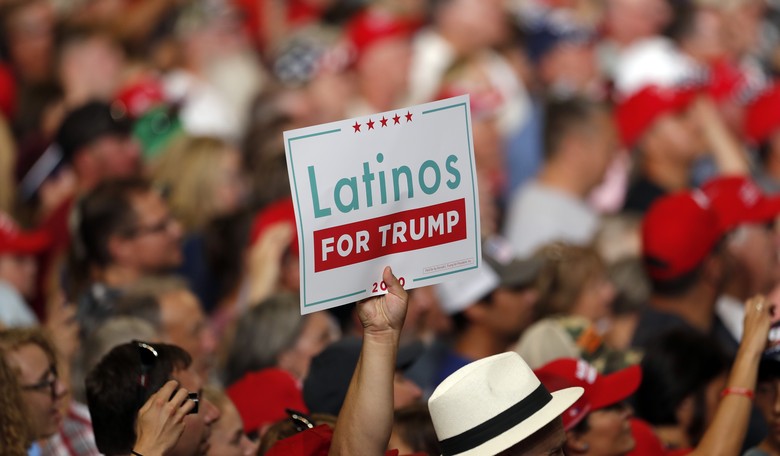
As Republicans reel from a devastating election night, many are scrambling to understand how the party lost so decisively. A blue wave swept the country Tuesday, even turning all of Texas blue for the first time since the 1990s. Now, exit polling is offering Republicans a closer look at the major demographic shifts that helped turn that wave into a tsunami.
Many Republicans have been quick to blame voters themselves, but that ignores the bigger problem, that groups President Trump won decisively in 2024 swung heavily toward Democrats. These weren’t small shifts either; they were massive swings among voters who had backed Republicans just two years earlier. If the party wants someone to blame, it should start with a bit of self-reflection for failing to live up to voters’ expectations.
The swings tonight among groups that swung right in 2024. https://t.co/MTOspsiyox
— Patrick Ruffini (@PatrickRuffini) November 4, 2026
According to preliminary exit polling data from an SSRS Voter Poll, Latino men shifted 33-points toward Republicans in 2024 before swinging 24 points back toward Democrats in 2026. Latinos overall moved 27-points right before shifting 20-points left last night, while Catholics followed a 25-point Republican swing with a 16-point Democratic reversal.
The biggest reversal came among voters ages 18-29, whose 13-point shift toward Republicans in 2024 was overwhelmed by a 35-point swing toward Democrats last night. Suburban voters swung 20 points toward Democrats after moving six points right in 2024, while Asian voters shifted 25 points left after moving 12 points right.
The losses also extended to groups often associated with the Republican base. Men shifted four-points toward Republicans between 2020 and 2024, then swung 11 points toward Democrats in the preliminary 2026 results. Voters without a college degree moved 11 points right in 2024 before shifting seven-points back left, while households earning $50,000–$99,999 followed a 20-point Republican shift with an 11-point Democratic reversal. Even rural and small-town voters moved 15-points right before swinging 11 points back toward Democrats.
The data comes from roughly 100,000 interviews nationwide. While the margins of error for national demographic estimates are reportedly under one percentage point, they’re larger for the smaller subgroups. The exact numbers may shift as the results are finalized, but swings this large are unlikely to disappear.
There’s room to debate the size of the shift, but the direction is clear: Americans actively chose Democrats yesterday.
As for what voters cared about in particular, other exit polling paints a clear picture. People have been quick to point the finger at Iran, especially isolationist types, and even Vice President JD Vance, who, it’s no secret, is not a fan of the Iran war. But the picture is a bit more complicated.
National exit (sample: 79,668) -- Importance of issues to your vote: GOVERNMENT CORRUPTION Crucial/Major - 90% Minor/No factor - 10% COST OF LIVING Crucial/Major - 89% Minor/No factor - 11% IRAN WAR Crucial/Major - 74% Minor/No factor - 26% IMMIGRATION ENFORCEMENT Crucial/Major - 73% Minor/No factor - 27% AI & DATA CENTERS Crucial/Major - 56% Minor/No factor - 44%
— Tim Alberta (@TimAlberta) November 4, 2026
The top issue, which might come as a surprise, was corruption, as the Trump administration has faced several corruption allegations. While that might not have been something Republicans focused on, 90 percent of the 80,000 people surveyed said it was a crucial or major factor in their decision. That was followed by 89 percent who cited cost-of-living concerns, 74 percent who cited the Iran war, 73 percent who cited immigration enforcement, and even 56 percent who cited AI and data centers.
By far the leading concern was kitchen-table issues, as Americans reel from affordability issues from gas prices, to groceries, to housing costs. It is unclear whether disapproval of the Iran war stems primarily from its effect on gas prices or whether Americans oppose it in principle. I would hazard a guess that it’s the former. But one thing is clear: for as much as Americans looked forward to President Trump’s agenda and promises going into 2024, it overwhelmingly appears that voters have had a problem with how it has played out.