







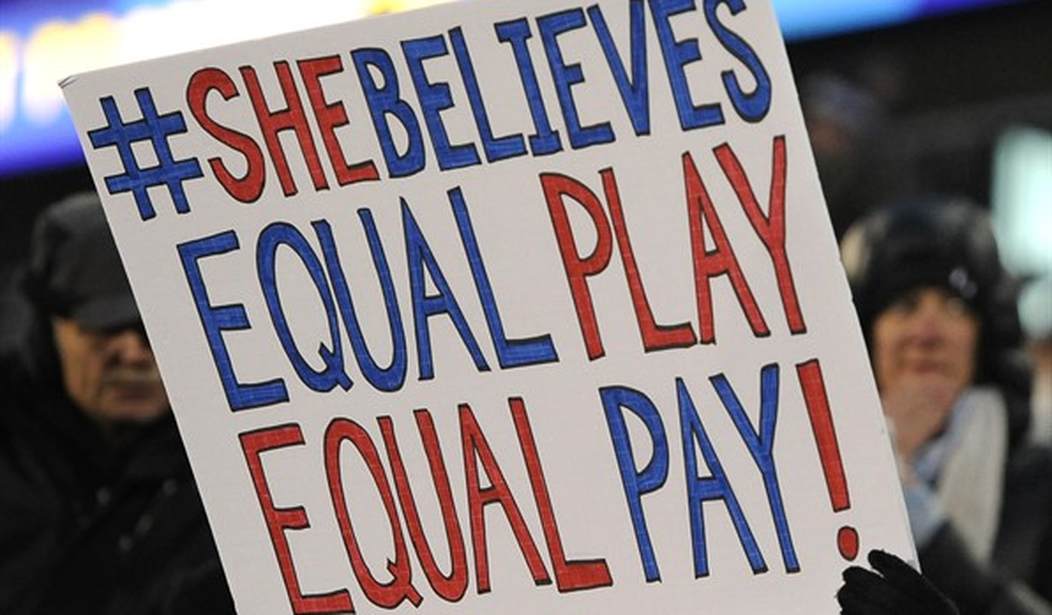
There is no gender pay gap. This is a simple truth hidden from generations of women because it contradicts the Left’s narrative about victimhood in the workforce. Without the pay gap, their gender-equity policy proposals are obsolete. However, data prove that career and lifestyle choices drive the differential between the average earnings of men and women. Change the choices, you’ll close the gap.
Equal Pay Day is as fabricated as the pay gap itself. As the fable goes, Equal Pay Day symbolizes how far into the year women must work to match men’s earnings in the previous year. In 2025, the faux holiday falls on March 25th. Coincidentally, this is during Women’s History Month, when we collectively celebrate the progress of American women.
According to the Bureau of Labor Statistics, women’s earnings were 83.6% of men’s in 2023. Put another way, women earn about 84 cents on the dollar that men earn. This 16-cent pay gap is commonly attributed to gender discrimination.
This a grossly misleading tactic to trick women into thinking that they are unfairly underpaid because of their sex. There’s more to the story. The BLS notes, “These comparisons of earnings are on a broad level and do not control for many factors that may be important in explaining earnings
When controlled for factors that impact paychecks (such as occupation, job level, experience, job title, education, hours worked, etc.), the pay gap disappears. Examining these choices reveals how preferences lead to very different outcomes between the sexes.
First, time. Men work full-time more than women (72% vs. 67%); women comprise a greater share of part-time workers. Also, men work more hours per day than women (8.3 hours on average vs. 8 hours). Even women employed full-time are more likely than men to say they would rather work part-time.
Next, education and field of study. While it’s true that women accumulate more post-secondary degrees than men, they opt for low-paying fields of study. According to the National Center for Education Statistics, women earned 62.8% of associate degrees, 58.5% of bachelor's degrees, 62.6% of master's degrees, and 57% of doctoral degrees. The degree gap between young women and men began in the mid-1990s and has only widened over time.
Degrees do not necessarily translate into wealth. Women predominantly major in fields that lead them into lower-paid occupations such as humanities, education, and social sciences; and they are underrepresented in higher-paying fields. Occupations with the largest shares of women include childcare workers, preschool teachers, administrative assistants, and medical and dental assistants. While these jobs may offer non-financial benefits such as satisfaction, enjoyment, alignment with interests, community service, and better working conditions, the tradeoff is in earnings. Students strike this bargain when they choose majors.
Third, and often overlooked, dangerousness. Overwhelmingly men take on dirty and hazardous jobs that also carry higher pay. Women accounted for just 8.5% of all work-related fatalities in the U.S. In two of the three most fatal jobs (logging and roofing), women comprised less than 10% of those workforces (9% and 4.1%, respectively).
Additionally, caregiving. Motherhood is the overarching motivator behind the choices women make. There’s virtually no pay gap for young workers. Single, childless women outearn their male counterparts. The wage gap begins to widen around age 25, likely due to choices about family roles.
Women disproportionately choose occupations and career tracks that are less demanding or offer more flexibility. In a 2017 New York Federal Reserve report, economists found that, on average, women are more willing to pursue jobs with greater work flexibility and job stability. Conversely, men are more willing to chase higher earnings growth. Furthermore, they concluded that preferences in college majors and job choices account for an astonishing 25% of the gender wage gap.
Even in high-paying medical practice, a study of career choices for aspiring doctors found that more female medical students were drawn to specialties offering lower workloads and low-risk work than male students. The preference for lifestyle over income attracted far more women to family medicine while men opted for orthopedic surgery.
Sex discrimination in employment and pay is wrong and already illegal, thanks to the Equal Pay Act (1963) and Title VII of the 1964 Civil Rights Act. More legislation or regulation from Washington will not fix what is not broken.
Yet, leftist policymakers have tried and failed to make women act more like men. Pay transparency legislation was passed in 2022 and still did not close the pay gap. The Paycheck Fairness Act, proposed each year, would only serve to enrich the pockets of trial lawyers—who are overwhelmingly male—as they chase class-action lawsuits.
Meanwhile, when employers are forced or shamed into proving that they do not pay men and women differently, they will be less likely to negotiate flexibility and other benefits that female employees value.
Tradeoffs are not punishments. Women who make choices that reflect their desire for motherhood, fulfillment, or other priorities over earnings are not being penalized. We must accept women’s employment preferences and acknowledge that an abundance of opportunities and choices signals real progress.
Patrice Onwuka is the director of the Center for Economic Opportunity at Independent Women and co-host of WMAL’s O’Connor & Company.


Join the Conversation
VIP members get the ability to comment on articles.