





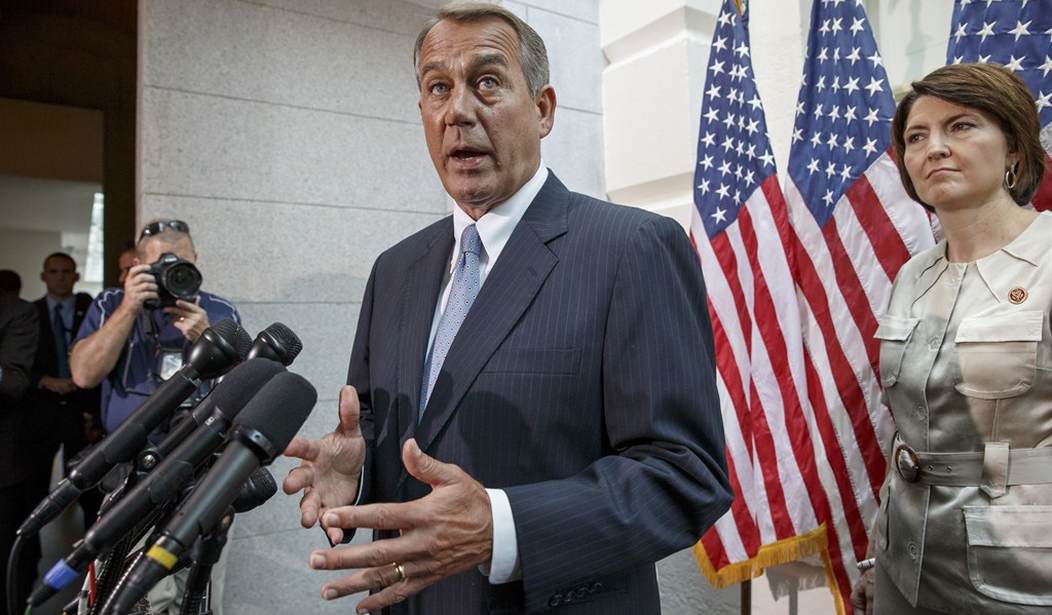
House Speaker John Boehner has had enough of executive usurpation of power. He announced this week that he will ask the House of Representatives to file suit against President Obama for ignoring laws the president doesn't like and for using agency rule-making, executive orders, memoranda and even simple letters to accomplish that on which the president can't get Congress to act.
When our framers wrote the U.S. Constitution, they envisioned a separation of powers between the three branches of government that would prevent any one branch from becoming all-powerful. Congress enacts laws that govern the nation, with the Senate advising and consenting on presidential appointments and ratifying treaties, and the House initiating bills to raise revenues. The president faithfully executes the laws, appoints officials to serve in executive and judicial roles with the advice and consent of the Senate, negotiates treaties, and acts as commander in chief. The judiciary interprets the Constitution and the laws passed by Congress and signed by the president.
This separation of powers has always caused conflicts, especially between the executive and legislative branches, each jealous of its own prerogatives. But Obama seems to have taken his assertion of executive power to a new level and exerted it in a broad range of areas. The president got his Affordable Care Act passed just as he wanted it, with no Republican input. But because the law was so complex and hardly anyone seemed to have read the whole thing before it went into effect, the president found it wasn't quite what he wanted. So he unilaterally adopted nearly two-dozen changes to the law without bothering to go back to Congress.
He's done the same thing on environmental law, immigration, education and drug enforcement. And of course, he ignored the clear obligation under the law to notify Congress before releasing any prisoners from Guantanamo, as he did last month when he released five high-ranking Taliban officials to obtain a captive U.S. soldier's release. In each case, the president and his appointees behaved as if they were entitled to do so because Congress wouldn't give them what they wanted the constitutionally established way.
Sure, passing legislation is messy and requires both compromise and cooperation -- neither of which is a strong suit for Obama or some Republicans in Congress. But our system of government requires it -- and when the system breaks down or a president simply flouts it, real harm occurs. This is not a political problem but a real assault on our form of government.
Boehner is right to attack the problem by taking the House's constitutional grievances to the courts. Democrats, predictably, are claiming the suit is a desperate gesture by a do-nothing Republican-controlled House. But it's nothing of the sort. These clashes have come up before -- and they were settled in ways that we don't blink an eye at but were very controversial at the time.
Take the landmark Marbury v. Madison case in 1803. The specifics of the case are less important than the principle the case established, namely judicial review of the constitutionality of laws written by Congress. Chief Justice John Marshall wrote the opinion, which stated: "an act of the legislature, repugnant to the Constitution, is void. This theory is essentially attached to a written constitution, and is consequently considered by this court, as one of the fundamental principles of our society."
A future U.S. House of Representatives v. Obama case may establish a similarly dramatic precedent: Just because you're president and elected by a majority of American voters doesn't mean you get to pick and choose which of the laws passed by Congress you want to enforce. It is no less repugnant that Obama believes he has the power to change law with a mere stroke of the pen.



Join the Conversation
VIP members get the ability to comment on articles.