







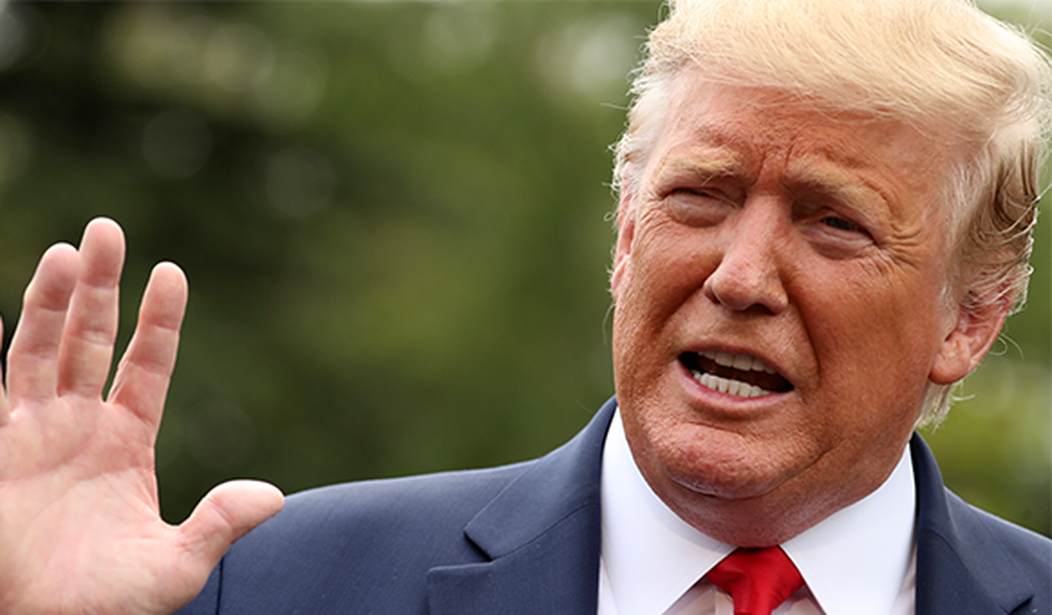
Early Monday morning, Donald Trump tweeted: "94% Approval Rating in the Republican Party, a record. Thank you!"
Where the president got this specific number remains a mystery. Recent polls by YouGov put his GOP approval roughly 10 points lower, and Gallup, which has tracked Trump's popularity since he took office, puts him at 88 percent.
But I suppose we shouldn't be surprised that Trump used his Sharpie to round up his score. He's deeply invested in being -- or at least claiming to be -- the most popular Republican president in history. In July of 2018, he announced: "I am the most popular person in the history" of the GOP. "Beating Lincoln," Trump added. "I beat our Honest Abe."
For what it's worth, polling in the 1860s wasn't exactly reliable. But even if Trump's oft-repeated 94 percent number were accurate, and even if it beat Lincoln's ratings, it still wouldn't beat George W. Bush's 99 percent after the Sept. 11 attacks.
Why the president feels the need to embellish is already a well-spelunked psychological rabbit hole. But even ignoring his exaggerations, he is consistently hitting in the mid- to high 80s with Republicans in polling, which demands a question: Why are his actual numbers so high?
George W. Bush's 99 percent might offer some insight. Americans generally rally around a president during a war or national crisis. But members of the president's own party in particular can be counted on to fall in line.
The Atlantic's Ronald Brownstein argues that the key to understanding the president's standing with Republicans is that Trump is behaving like a wartime president, but the enemy is "Blue America." Trump's almost daily references to "treason" and enemies of the people may be driven by his own narcissism and persecution complex, but they resonate with a share of the electorate that believes the cultural war really is tantamount to a cold civil war.
While Trump has made it worse, this dynamic is not new. He is more the beneficiary (and exacerbator) of the polarized landscape than the creator of it. Party identification has been declining for Democrats and Republicans alike, but for those who cling to the label, the label has more meaning than it used to.
Until around 2000, it was normal for self-identified Republicans and Democrats to criticize presidents of their own parties, because people didn't cling to partisan identity nearly as fiercely. The Bill Clinton impeachment battle was a foretaste of where we are. But even during the polarized presidency of George W. Bush, partisan dissent and defections were fairly common. Existential partisanship intensified under Barack Obama's presidency, on both the right and left.
The wartime atmosphere Trump has established encourages partisans to overlook faults with their own side more than ever, because in the zero-sum logic of war, any dissent is seen as providing aid and comfort to enemies who would be worse if they gained power. Perhaps counterintuitively, Trump's myriad and manifest flaws actually intensify the effect. The need to justify your support makes it impossible to acknowledge any shortcomings at all. When Stuart Varney of Fox Business recently refused to admit that Trump ever lies, it was as if he understood that once you pull that thread a little, there's no telling where the unraveling will stop.
The irony is that the need to provide unwavering support for the president of your party is a direct function of the unwavering hostility from the president's critics. This is why polls may not be as reflective of reality as we often think. If you talk to pollsters, they will tell you that many voters understand how polls can be used as weapons and don't want to give the "enemy" any satisfaction.
Indeed, as I've argued before, there's a rough parallel with Republican support for Bush during the Iraq War. Many Republicans knew that the war wasn't going well but nonetheless supported Bush because he was a wartime president and they loathed his critics more than they disapproved of his performance. They'd be damned if they were going to give some pollster ammunition against the commander in chief. A similar dynamic explains Obama's rock-solid support among Democrats. They hated -- or feared -- Obama's enemies too much to abandon him, even if they had misgivings about him.
Both examples may shed some light on what's in store for Trump in the future. Support for Bush and the war alike started to plummet as he headed for the exit. One of the defining currents of the Democratic primaries is the base's disappointment with Obama's accomplishments, even as his personal approval remains high.
It may be that once Trump is no longer the commander in chief in the war against Blue America, the ardor of his troops will give way to a better understanding of the price the GOP paid on his watch.

Join the Conversation
VIP members get the ability to comment on articles.