





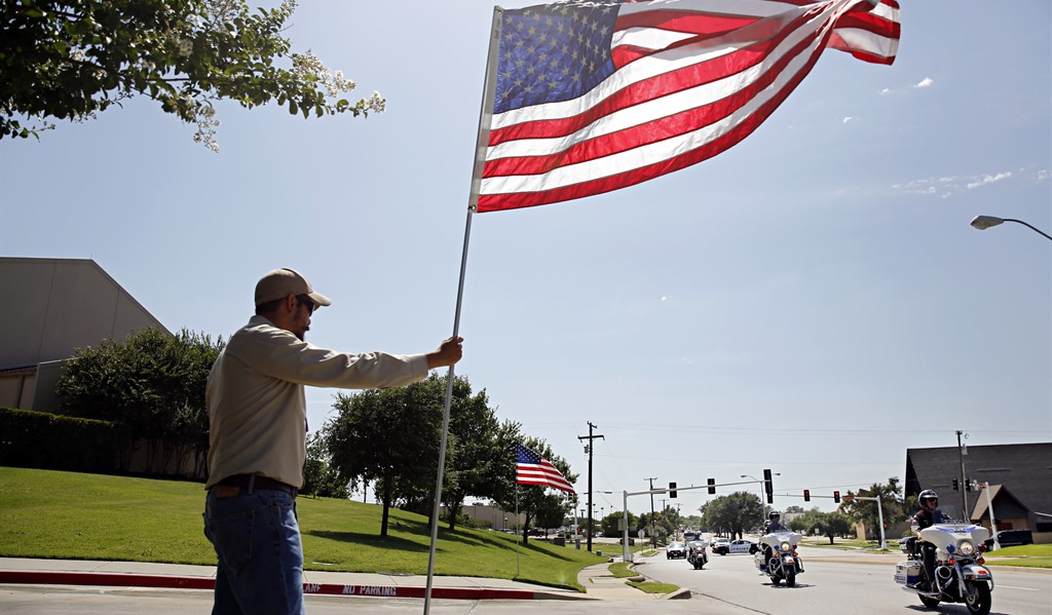
As he accepted the Republican Party’s presidential nomination at its national convention in Cleveland, Ohio last week, Donald Trump proclaimed himself the “law and order candidate,” urging attending party insiders to back him because, “Our convention occurs at a moment of crisis for our nation.”
During the speech, Trump said government law enforcement officers (LEOs) were particularly endangered in today’s contentious environment, saying “an attack on law enforcement is an attack on all Americans.”
Instead of making policy based on feelings, it’s important to formulate policy that’s based on reality. Contrary to what politicians such as Trump may tell voters to whip up emotions and secure votes, little evidence exists to suggest life in America is becoming more violent for everyday citizens or for government law enforcement officers.
In 1995, the Federal Bureau of Investigations’ (FBI) Uniform Crime Reporting Program (UCR), a statistics initiative first devised by the International Association of Chiefs of Police in 1929 to reliably collect and collate crime statistics on a national level, reported 1,798,785 violent crimes committed across the nation, which had at the time a population of 262.8 million Americans. This amounts to about 685 violent crimes per 100,000 people.
Of those nearly 1.8 million violent criminal acts that year, about 58 percent were larcenies or thefts, and fewer than 0.2 percent—practically a rounding error—were murders.
Nineteen years late, despite what the talking heads on television tell voters, crime has actually become less common. Using statistics from 2014, the last full UCR report, 1,165,383 violent crimes were committed in a country with 318.8 million residents. This works out to be about 366 crimes per 100,000 individuals, a 46.6 percent free fall compared to the statistics reported just two decades earlier.
If there’s no war on everyday Americans, what about the so-called war on cops?
In July, criminals in Dallas used a peaceful rally about police-community relations as cover to attack government law enforcement officers, murdering five and injuring seven others. Things seem to be getting worse—at least, according to politicians. But a hard look at the numbers reveals they don’t match up with the rhetoric.
In 1995, 94 out of 187 government LEOs deceased in the line of duty were killed as a result of violent criminal actions, or about 52 percent of LEO deaths, according to data from Officer Down Memorial Page, “a non-profit organization dedicated to honoring America’s fallen law enforcement heroes.”
This means about four police officers per 10 million people were attacked and killed by criminals.
In 2015, 56 out of 130 LEO fatalities were related to violent crime, accounting for a total of 43 percent of all LEO deaths.
In terms of total population, the widespread attacks on law and order, about which politicians such as Trump have warned us, claimed only about two LEO lives per 10 million people.
Why do politicians say things are getting worse if things are actually getting better? Because reporting the facts is boring, and boring news does not translate into ad revenue and advertisement sales.
Our political leaders are also incentivized against reporting the truth, because reporting how Americans are objectively safer today than in any other time in history might lead voters to conclude libraries full of government regulations and armies of government employees were not the cause for the Pax Americana so many people seem to unknowingly inhabit.
Lawmakers and politicians are incentivized to focus on the problems of life and propose more government, more policies, and more politics as the solutions.
Instead of believing reports of the impending social apocalypse at face value, people need to research the facts and decide to enjoy the imperfect-but-improving world as it is. Pledging fealty to messianic politicians claiming to be here to save us from ourselves is not the answer.


Join the Conversation
VIP members get the ability to comment on articles.