





Poland and Israel are embroiled in a diplomatic crisis, the worst between the two countries since the Cold War ended 30 years ago.
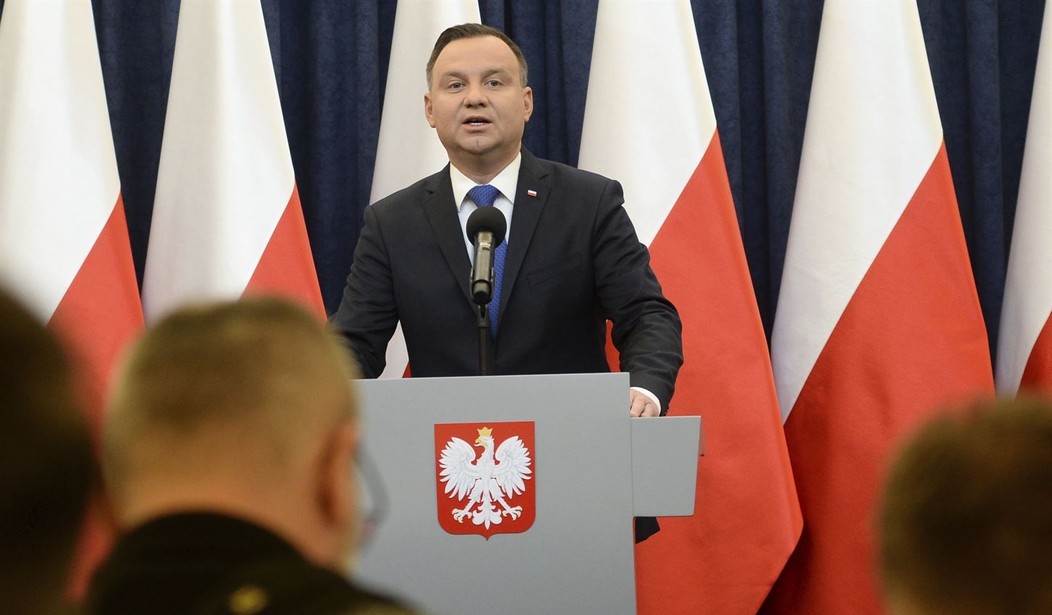
The furor was ignited by a bill — passed by the Polish parliament and signed Tuesday by President Andrzej Duda — that makes it a crime to suggest that Poland was "responsible or co-responsible" for atrocities committed during the Nazi era. Israel and the United States have condemned the law, under which any claim that the Polish population collaborated in the Holocaust or crimes against humanity is punishable with imprisonment. The legislation was propelled by Poland's dominant Law & Justice Party, which says it wants to "safeguard" history from assertions that Poles were complicit in the German genocide.
But some Poles were complicit. However unwilling Poland may be to squarely face the demons of its past, it cannot evade painful historical questions by passing laws to punish those who raise them.
Poland was Ground Zero in the Holocaust. It was where the Germans built Auschwitz, Treblinka, and other industrial-scale death camps, and where they murdered 90 percent of Poland's pre-war Jewish population, by far the largest in Europe. Millions of non-Jewish Poles also died at Nazi hands. In the occupation that followed Germany's invasion of Poland in September 1939, Poles were starved and enslaved with brutal ferocity. Under terrible conditions, Poles fought valiantly against the Nazis; during the 1944 Warsaw Uprising alone, more than 200,000 Polish civilians died.
But if Poland suffered grievously under the Nazis, many Poles also inflicted grievous suffering.
German commanders recruited Polish police and railway workers to guard ghettos and deport Jews to the killing centers. Individual Poles betrayed or hunted down Jews in hiding "and actively participated in the plunder of Jewish property," notes the US Holocaust Memorial Museum in Washington. "There were incidents, particularly in the small towns of eastern Poland, where local Polish residents ... carried out or participated in pogroms and murdered their Jewish neighbors." Among the most notorious cases was the 1941 massacre in the town of Jedwabne. Poles there massacred 1,600 of their Jewish neighbors, locking them in a barn and burning them alive.
In Israel, where communal memories of Poland's deep-rooted antisemitism still run deep, the proposed Polish law has been fiercely condemned. Prime Minister Benjamin Netanyahu decried it as a "distortion of the truth, the rewriting of history and the denial of the Holocaust." Israeli parliamentarians retaliated with their own legislation, a bill making it a crime to minimize or deny the role of collaborators during the Holocaust. Journalists and politicians in both countries have gotten hot under the collar, with Poles and Israelis accusing each other of bigotry, ignorance, and malice.
All this is profoundly distressing, for several reasons.
First, laws criminalizing any historical point of view are odious. That goes as much for Israel's ban on Holocaust denial as for Poland's ban on discussing Holocaust complicity. Free societies have no business punishing opinion or argument, not even those that are vile or ludicrous.
Second, there are elements of truth on both sides of this controversy. Poles rightly wince at ahistorical references to "Polish death camps" — those hells on earth were Nazi death camps, erected by Germans on Polish soil. They point out properly that many Poles took tremendous risks to save Jews from death. But it's also true that many more Poles murdered, robbed, and viciously deceived Jews. Even Poland's president, on a state visit to Israel last winter, admitted as much, declaring that such people had "expelled themselves from the Polish people."
Worst of all, though, is the mounting danger of a breach in the friendship between Poland and Israel.
After Communism fell, many Poles went out of their way to repudiate the country's past antisemitism, and Poland has become one of Israel's most important European friends. Warsaw has defended Israel against pressure to pejoratively label products made in the West Bank. It abstained from the UN condemnation of America for recognizing Jerusalem as Israel's capital. Countless Israeli students and soldiers have made pilgrimages to Poland, and the two countries' governments have cultivated a close strategic partnership.
The unquiet ghosts of the past cannot be silenced, but they must not be allowed to poison the Polish and Israeli present. Israel and Poland need each other. They don't need this ginned-up crisis, and the longer it persists, the worse for all concerned.



Join the Conversation
VIP members get the ability to comment on articles.