





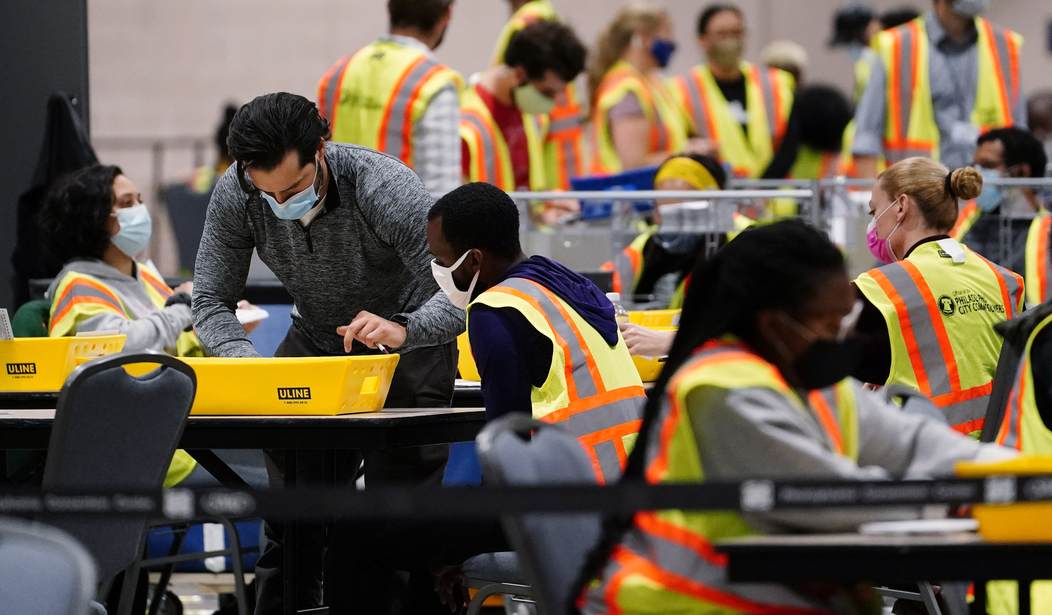
It’s been nearly six weeks since the election and electoral votes in swing states are in flux. Texas, joined by at least 17 other states, sought to sue Pennsylvania, Michigan, Wisconsin, and Georgia for unconstitutional changes to 2020 election Laws. The U.S. Supreme Court, however, ruled that Texas has no standing.
Texas and fellow litigants had a legal precedent from seven weeks ago. On October 26, 2020, the U.S. Supreme Court rejected a bid by a 5 to 3 margin from Wisconsin Democrats "to extend the deadline for counting mail-in ballots received after Election Day."
Apart from all the squabbles, legal wrangling, and controversy, what makes Pennsylvania, Michigan, Wisconsin, Georgia, Arizona, and Nevada conducive to election fraud and criminal activity, and less so in Florida, North Carolina, or Ohio?
Concentrated Population Centers
Examining the population centers of the six states still in question, something unmistakable and rather remarkable emerges.
Here are the largest populated cities in the Commonwealth of Pennsylvania: Philadelphia (1,591,800), Pittsburgh (294,860), Allentown (122,623), Erie (94,619), Reading (88,521), Scranton (77,218), Bethlehem (76,370), Lancaster (59,392), Levittown (51,726), and Harrisburg (49,301). So, in adding up the numbers, Philadelphia’s population outflanks the nine next largest cities combined. In short, the state is top-heavy and by concentrating fraudulent activities in Philadelphia, a political party could swing the state to their candidate.
In Michigan, Detroit/Wayne County has a population of 1,749,343 people and Oakland County has a population of 1,257,584 people, versus Macomb (873,972), Kent (656,955), Genesee (405,813), Washtenaw (367,601), Ingham (292,406), Ottawa (291,830), Kalamazoo (265,066), and Livingston County (191,995). Detroit, lying in Wayne County and Oakland County are the premier population centers in the state, hence ripe for election fraud.
In Wisconsin, Milwaukee County, with 945,726 people, surpasses all other counties, including Dane County/Madison (546,695), Waukesha (404,198), Brown (264,542), Racine (196,311), Outagamie (187,885), Winnebago (171,907), Kenosha (169,561), Rock (163,354), and Washington (136,034). Flip enough votes in Milwaukee and Dane counties and you flip the entire state.
Here’s More
In Georgia, Atlanta and Fulton County are the most heavily populated with 1,063,937 people, followed by Gwinnett (936,250), Cobb (760,141), DeKalb (759,297), Clayton (292,256), Chatham (289,430), Cherokee (258,773), Forsyth (244,252), Henry (234,561) and Hall (204,441). So, where is the most bang for your fraudulent buck?
In Arizona, traditionally a deep red state, Maricopa County, which encompasses Phoenix, has 4,485,414 people. Compare that to Pima County (1,047,279), Pinal (462,789), Yavapai (235,099), Yuma (213,787), Mohave (212,181), and the remaining counties, each of which have a population under 200,000 people. Finagle the vote in Phoenix, and you can flip all of Arizona.
In Nevada, Clark County, which includes Las Vegas, has a population of 2,266,715, which exceeds the population of the other 16 counties combined. Rig the vote count in Clark County to rule the state.
Why Not Florida, Ohio, or North Carolina?
Looking at Florida, Miami-Dade County has 2,751,796 residents, versus the counties of Broward (1,935,878), Palm Beach (1,471,150), Hillsborough (1,381,627), and Orange (1,323,598). In other words, Florida’s population is more balanced, with no true focus for election fraud.
North Carolina works almost the same. Wake County, encompassing Raleigh, has 1,111,761 people. Mecklenburg County, encompassing Charlotte, has 1,110,356 people. No other counties compare, but the overall people are fairly scattered throughout the state.
In Ohio, the balance is more evident. Franklin County, home of Columbus, has a population of 1,310,300 compared to the counties of Cuyahoga/Cleveland (1,243,857), Hamilton/Cincinnati (816,684), Summit (541,918), and Montgomery (532,331). Where could one focus to flip the state? Realistically, nowhere.
Lastly, did other states, that have seldom been cited, experience notable election fraud? For now, no one knows, and few are even looking. In Minnesota, Minneapolis/St. Paul has the largest population by far. In Virginia, Fairfax County and counties near D.C. represent the bulk of the population. Any election malarkey in Minneapolis/St. Paul and in Northern Virginia can flip their respective states to one candidate or another.
So, why are Pennsylvania, Michigan, Wisconsin, and Georgia, as well as Arizona and Nevada, hotbeds of election controversy?” Considering population dispersal, all six are ripe for election fraud.


Join the Conversation
VIP members get the ability to comment on articles.