







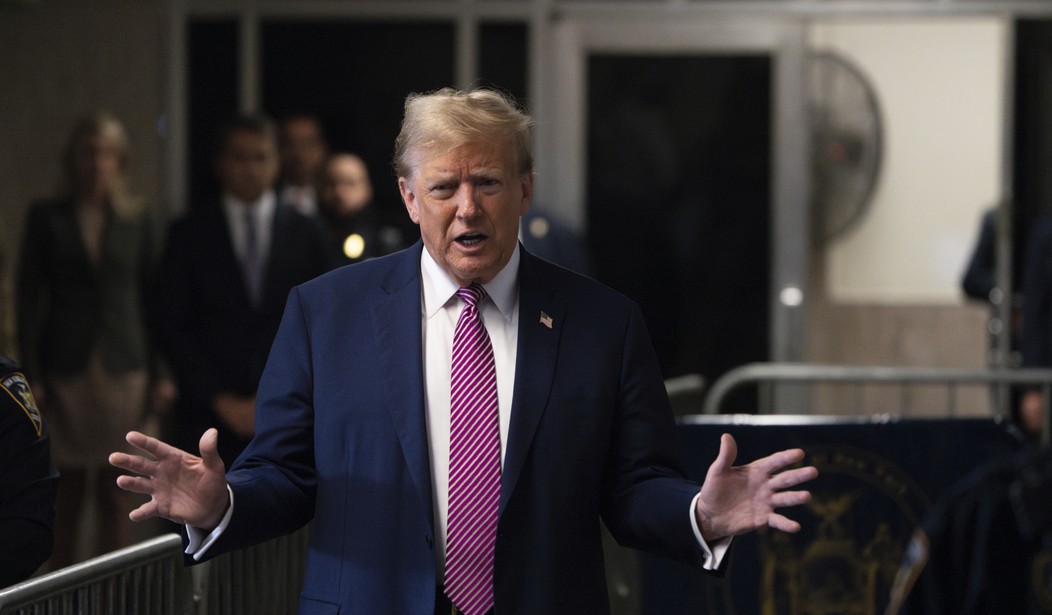
When Congress impeaches and removes a federal official, the Constitution says, "the party convicted shall nevertheless be liable and subject to indictment, trial, judgment and punishment, according to law." While you might think that clause means impeachment and removal do not preclude criminal prosecution, former President Donald Trump's lawyers say it means a former president can be prosecuted for abusing his powers only after he is impeached and removed.
That is the improbable crux of the argument the U.S. Supreme Court is considering this week in the federal case that charges Trump with illegally trying to remain in office after he lost the 2020 presidential election. If the court accepts Trump's claim that he "enjoys absolute immunity from criminal prosecution for his official acts," it will be endorsing the proposition that presidents can escape accountability for crimes, no matter how egregious, provided they avoid conviction in the Senate based on the same conduct.
One way for a president to forestall that result is to commit crimes toward the end of his term in office. Trump, for example, was impeached for inciting the 2021 Capitol riot, but he was no longer president by the time the Senate weighed the case against him.
Many Republicans -- including Majority Leader Mitch McConnell (R-Ky.), who had castigated Trump for his reckless behavior before and during the riot -- argued that it was not proper for the Senate to try a former president. Explaining his vote to acquit Trump, McConnell noted that the former president could still be held civilly or criminally liable for his role in the violent assault that interrupted congressional ratification of President Joe Biden's victory.
"We have a criminal justice system in this country," McConnell said. "We have civil litigation. And former presidents are not immune from being held accountable by either one."
Trump's lawyers say McConnell was wrong about that. Their argument also implies that Richard Nixon was wrong to worry he might face criminal prosecution after resigning from office amid the Watergate scandal.
Nixon resigned after articles of impeachment were proposed but before the House voted on them. By Trump's reasoning, he was free and clear of criminal liability at that point. Yet Gerald Ford, Nixon's successor, granted him a pardon "for all offenses against the United States" he may have committed as president, and Nixon accepted that pardon.
According to Trump, a president can avoid prosecution by leaving office before the Senate can convict him or by hiding his crimes well enough that they are not discovered until after he leaves office. And since the impeachment judgment clause is not limited to presidents, it would seem, so could "all civil officers of the United States," contrary to the historical practice of prosecuting former federal officials who were never impeached.
Although there is no textual basis for treating former presidents differently in this respect, Trump argues that protection of executive power demands special leniency for them. Otherwise, he warns, the threat of frivolous, politically motivated prosecutions would have a paralyzing impact on presidential decisions.
As Manhattan District Attorney Alvin Bragg's legally dubious case against Trump shows, that threat is not entirely fanciful. Yet presidents have managed to do their jobs for many years despite this risk, undermining Trump's claim that "a denial of criminal immunity would incapacitate every future President."
A federal judge and a unanimous appeals court panel already have rejected Trump's immunity claim. During oral arguments in January, D.C. Circuit Judge Florence Pan explored the implications of that claim by asking whether a president who "ordered SEAL Team Six to assassinate a political rival" but "was not impeached" could be prosecuted for that crime.
According to Trump's position, the answer was clearly no: If that hypothetical president resigned immediately after the assassination order came to light, for instance, he could literally get away with murder. When a legal argument yields results as alarming as that, there is probably something wrong with its premises.


Join the Conversation
VIP members get the ability to comment on articles.