







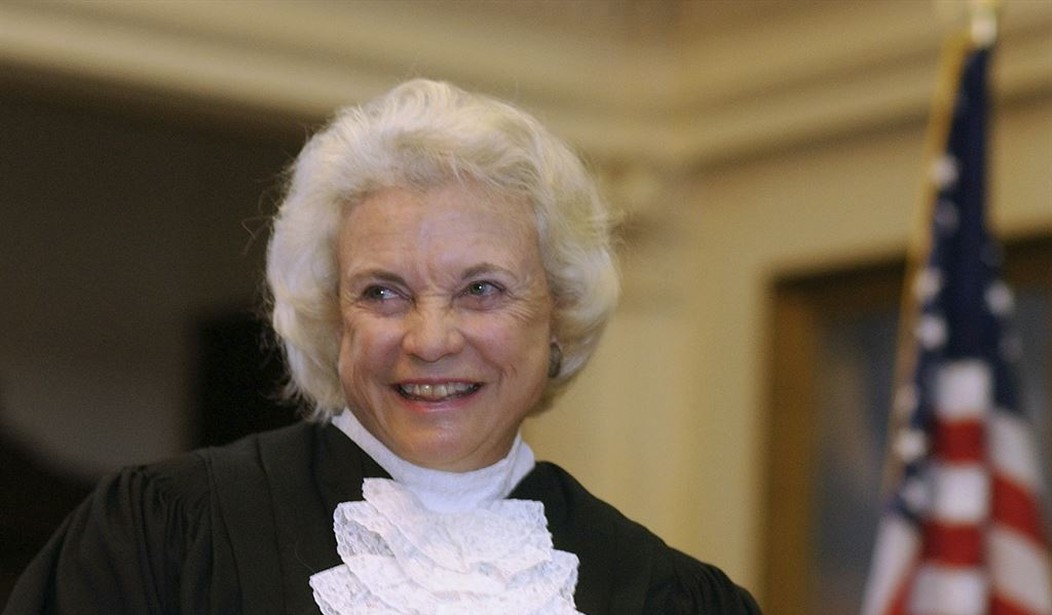
The month before Justice Sandra Day O'Connor announced her retirement in 2005, she dissented from Supreme Court decisions in two cases that illustrated the twin perils of local tyranny and federal overreach. O'Connor, who was appointed to the Court by Ronald Reagan in 1981 and died last Friday at 93, eloquently explained why property rights are especially important for people with little political influence and how state autonomy allows policy experiments that promote progressive as well as conservative goals.
In Kelo v. New London, nine owners of homes in that Connecticut city challenged the use of eminent domain to take their property in the name of economic development. The five-justice majority agreed with the city that transferring property from one private owner to another can qualify as "public use" under the Fifth Amendment's Takings Clause when it is expected to create jobs and boost tax revenue.
O'Connor's dissent began with a 1798 quote from Justice Samuel Chase, who cited "a law that takes property from A. and gives it to B." as an example of legislation that is "contrary to the great first principles of the social compact." Because the majority "abandons this long-held, basic limitation on government power," O'Connor warned, "all private property is now vulnerable to being taken and transferred to another private owner" who plans to "use it in a way that the legislature deems more beneficial to the public."
As a result, "the specter of condemnation hangs over all property," O'Connor wrote. "Nothing is to prevent the State from replacing any Motel 6 with a Ritz-Carlton, any home with a shopping mall, or any farm with a factory." She added that "the beneficiaries are likely to be those citizens with disproportionate influence and power in the political process."
While Kelo involved a constitutional limit on local power, Gonzales v. Raich involved a fundamental constraint on the federal government: It cannot exceed the powers specifically enumerated in the Constitution. Two Californians, Angel Raich and Diane Monson, argued that Congress had done that by purporting to criminalize their medical use of homegrown marijuana, which was allowed by state law but forbidden by the federal Controlled Substances Act.
Although Raich and Monson's conduct was neither interstate nor commercial, the six justices in the majority nevertheless held that it could be reached under the power to regulate interstate commerce. "If the Court always defers to Congress as it does today," O'Connor wrote in her dissent, "little may be left to the notion of enumerated powers."
That principle, O'Connor noted, is crucial to protecting "historic spheres of state sovereignty from excessive federal encroachment" and preserving "the distribution of power fundamental to our federalist system of government." That system, she emphasized, "promotes innovation" by allowing states to experiment with new policies that might prove worthy of emulation.
Although O'Connor was on the losing side in both of those cases, her positions were partly vindicated by subsequent political developments. The Kelo decision inspired many states to enact laws aimed at discouraging eminent domain abuse, and California's experiment in marijuana reform has spread to three dozen states, most of which allow recreational as well as medical use.
Since 2014, congressional spending riders have barred the Justice Department from interfering with the implementation of state medical marijuana laws. And in practice, the department, under both Democratic and Republican administrations, also has tolerated state-licensed businesses that serve recreational consumers.
Still, the conflict between state and federal law at the center of Raich persists two decades later, continuing to handicap marijuana businesses by subjecting them to punitive taxation and limiting their access to financial services. And as George Mason law professor Ilya Somin notes, "many states still have few constraints on eminent domain abuse."
Respect for federalism and property rights, in short, remains largely aspirational. But O'Connor's parting dissents at least pointed us in the right direction by explaining why these putatively conservative principles deserve a defense across the political spectrum.


Join the Conversation
VIP members get the ability to comment on articles.