


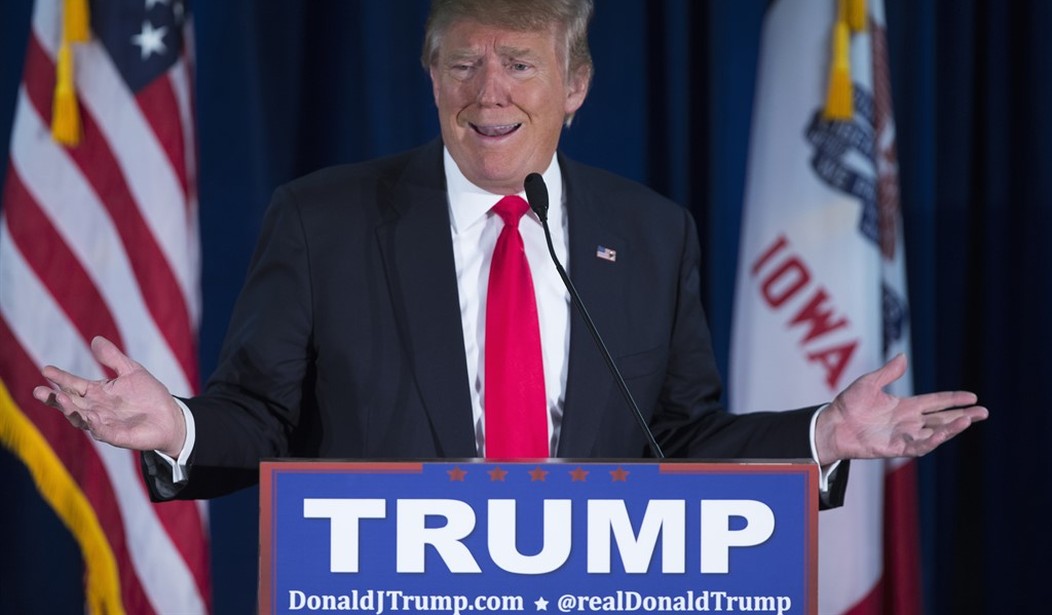
One can only hope that the Trump phenomenon will bring into the sunlight several fictions, most, but not all, of which GOP boosters have been promoting for years.
The first is that there are two fundamentally opposed forces within the Republican Party: “the Establishment” and “conservatives,” “anti-Establishmentarians,” or “outsiders.”
In reality, the conflicts that beset the GOP are internecine battles within one political establishment. There is no “anti-Establishment.”
Nor is Trump an “anti-Establishment” outsider. Trump has been peddling and receiving political influence for years courtesy of both Republican and Democrat politicians alike. Few “outsiders” have had so many “ins” with the establishment as has Trump.
Of course, if it is nonsense to identify Trump as an “anti-Establishmentarian”—and it is—then it is doubly nonsensical to suggest that Senators Cruz, Rubio, and Paul, or Governors Christie, Kasich, Bush, and Huckabee are “anti-Establishment.”
A true outsider, like you or I, wouldn’t be able to come within miles of a presidential race while campaigning as a Republican or Democrat.
Third, Trump’s Republican critics continually charge that unlike, say, Jeb Bush or Marco Rubio, Trump is not an authentic “conservative.” Now, this allegation is true as far as it goes: Trump is not a conservative. But because the allegation doesn’t go far at all, it may as well be a lie.
While Trump is not a conservative, neither are his GOP rivals and accusers.
In fact, unless being a proponent of an activist, omnipotent government that exists to spread “liberal democratic” values around the globe is necessary for being a “true conservative,” Trump is arguably more conservative than Jeb Bush, Marco Rubio, Ted Cruz, and virtually all of the other Republican contenders.
And this gets us to our next, and probably most important, myth to be exposed.
For decades, the so-called “conservative movement” has been largely a neoconservative movement. Neoconservatives have been remarkably successful in convincing millions and millions of Americans both that they are conservative and that the Republican Party and conservatism are one.
The truth, though, is that neoconservatism is no form of conservatism at all. The conservative movement that took flight nearly 70 years ago consisted of multiple strains, it’s true, but it was exemplified in many respects by Russell Kirk, the man without whose labor William F. Buckley says it is “inconceivable” that there ever would’ve been any such movement.
Kirk was a conservative in the vein of Edmund Burke, the 18th century Irish Parliamentarian who is widely regarded today as “the patron saint” of conservatism. Kirk was painfully aware of the differences between conservatism and neoconservatism, noting that the two were different in kind.
Conservatives in the mold of Kirk favored a wide dispersion or decentralization of power and authority—what is commonly referred to as “states’ rights.” They opposed all attempts at “leveling,” all redistributive schemes designed to alleviate “inequalities.” Yet it isn’t just utopian domestic visions for which conservatives like Kirk had no use. They disdained idyllic foreign policy plans as well. Hence, before he died in 1994, Kirk denounced the first President Bush’s decision to invade Iraq.
Clearly, between classical conservatives and neoconservatives there is a chasm. Yet it isn’t just that neoconservatives and conservatives disagree. Upon appropriating the conservative label, a move that involved an exercise in repackaging the likes of which wouldn’t be seen again until “gay rights’” advocates redefined marriage, neoconservatives did their best to see to it that conservative voices would no longer be heard—at least not within the Republican Party.
That’s right: Sarah Palin and others misspeak when they simply say that “the Establishment” is not conservative. The referent here—neoconservatives—are anti-conservative.
That this giant in the history of the American conservative movement is never mentioned in any “conservative” media outlets today proves that Kirk has been flushed down the memory hole. However, it isn’t just Kirk who has been “purged” from the (neo) conservative movement.
Trump’s meteoric rise stemmed principally from his tough talk on immigration—an issue that now ranks in no small measure of importance for Americans. Ann Coulter, Trump’s most vocal and visible of nationally recognized supporters, has also been superb in highlighting the disaster that is our immigration policy.
Yet for well over 20 years, Peter Brimelow, a one-time associate of Buckley and contributor to National Review, has been writing and speaking tirelessly on this very issue. A veteran when it comes to telling hard, politically incorrect truths, Brimelow’s work is second to none in this arena. Indeed, it is no exaggeration to refer to him as a pioneer.
But Peter Brimelow has long been expunged from “the conservative movement.”
Paul Gottfried is a scholar of European intellectual history and the American conservative movement. He too was friends with Buckley at one time, as well as a contributor to NR.
Yet that was then, this is now. Paul too has been purged.
The late Joseph Sobran, who at one time was a protégé of a sort to Buckley and a brilliant essayist, found himself unceremoniously ejected from the “conservative” movement, as did the now deceased Samuel Francis (who, remarkably, Rush Limbaugh, to his credit, recently defended on his radio show).
John Derbyshire, a witty, talented polymath, wrote regularly for National Review until just a few years ago when he too was abruptly sacked for a racially incorrect article (that he wrote for another publication).
This list of extraordinarily intelligent, perceptive, and courageous old right thinkers who have been exiled by the self-appointed gate-keepers of “the conservative movement” is hardly exhaustive.
And now neoconservatives continue to presume to tell the rest of us who is truly conservative and who isn’t.
If any of the foregoing fictions will crumble to pieces during this most atypical of election seasons, hopefully it will be the fiction that the self-declared guardians of the “conservative movement” are conservative.





Join the conversation as a VIP Member