





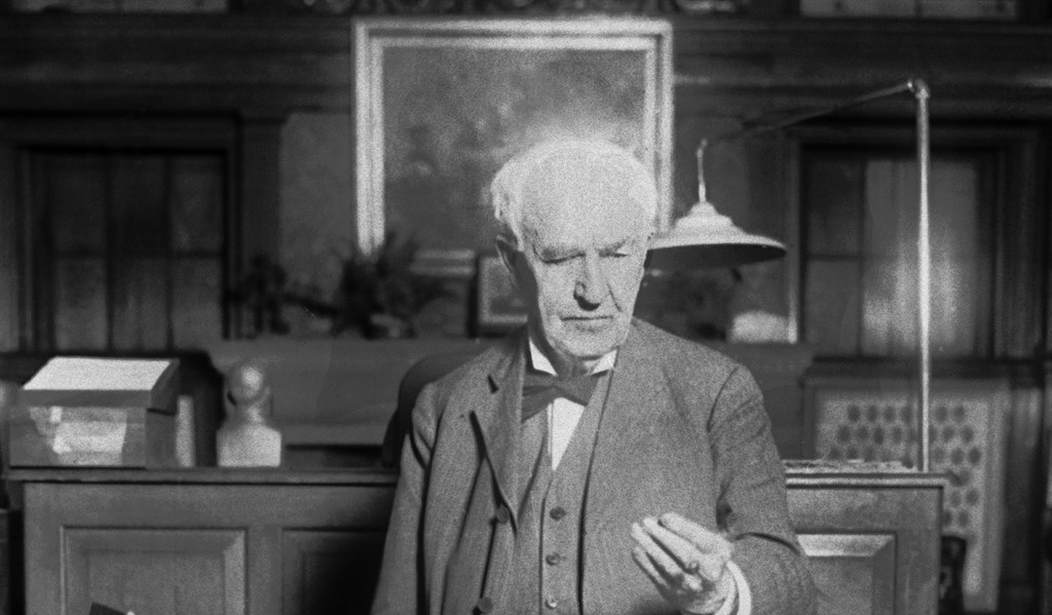
October 21 is the anniversary of Thomas Edison’s invention of the first workable lightbulb. If we want more lightbulbs shining above our heads, symbolizing new human-enhancing ideas in our minds ready to be made real, then we should mark this date as Human Achievement Day. We have a Labor Day, Veterans Day, Memorial Day, and even an Earth Day, and we should be celebrating human achievements, too!
First, a Human Achievement Day would raise our consciousness about the incredible world in which we live—a world we often take for granted—and how it came about. Imagine students giving class reports on which inventors and innovations most improved their lives over the prior year or explaining to their classmates the origins of the equipment in their classrooms.
Edison tested 6,000 filaments before finding one that kept the lightbulb glowing. He didn’t consider these 6,000 failures, but rather as successes in eliminated materials that didn’t work!
In 1906, a publishing company found temperature variations in its facility caused printing equipment to expand or contract subtly, making it difficult to keep the machines properly aligned for the multistage printing process. Willis Carrier solved the company’s problem by inventing the air conditioner. It was later picked up by Depression-era movie theaters and stores to bring in customers. The air conditioner, of course, eventually brought comfort to all our homes.
We’re still living in the age of the communications and information revolution. Kids should reflect on how 50 years ago, computers were giant, costly mainframes used only by large, well-financed businesses and research centers. What technological breakthroughs, combined with the entrepreneurial visions of Steve Jobs, Bill Gates, and many others led to the laptops and smartphones we all have today that, despite their small size, dwarf the power of their hulking ancestors?
Imagine future students playing the “If not for” game: “If not for the nanotech material in a replacement kidney, my mom would spend more time—and money we don’t have—on a dialysis machine than with us.” “If not for his brain implant and artificial eyes, my dad would be blind.” “If not for the discovery of the nature of my illness by an artificial intelligence, I’d still be sick.” “If not for the genetically engineered cells that cured my cancer, I’d be dead.”
Second, a Human Achievement Day would focus our minds on the foundations of achievement. We should recognize that wishing won’t make achievements come to be. We achieve great feats because we use our minds and reason to understand the natural world, our imaginations to see that a better world is possible, and we apply our knowledge toward entrepreneurial actions to create a better world.
Achievement requires liberty to act, a free-market system in which all individuals—an Edison, Carrier, Jobs, Gates—can pursue a vision without seeking permission from government, their neighbors, or anyone else; though they are, of course, free to convince their neighbors to join them in promising enterprises.
Third, a Human Achievement Day could banish today’s cultural pessimism and polarization, replacing it with optimism and a unity in committing to the future world as it can and should be. Imagine celebrations in every city and town. Imagine fairs in local parks highlighting local enterprises. Imagine local media interviewing business folks and passersby about “What achievements of yours gave your life purpose and make you proud?”
This vision speaks to a broader understanding of “achievement,” because we’re all achievers, whether nurturing a child to maturity or business to profitability, writing a song, poem, business plan or dissertation, laying the bricks to a building, designing it, or arranging for its financing.
Today, exponential technology promises a tomorrow of unimagined prosperity, with our lives longer and healthier, and with opportunities to realize our every rational dream. But that future is endangered because of the failures of our schooling system to provide the learning and training individuals will need to create it and the failure of our doomsaying culture to make us aware that such a future is even possible.
It’s time to change all this and to institute a Human Achievement Day to nurture the achiever in all of us!


Join the Conversation
VIP members get the ability to comment on articles.