







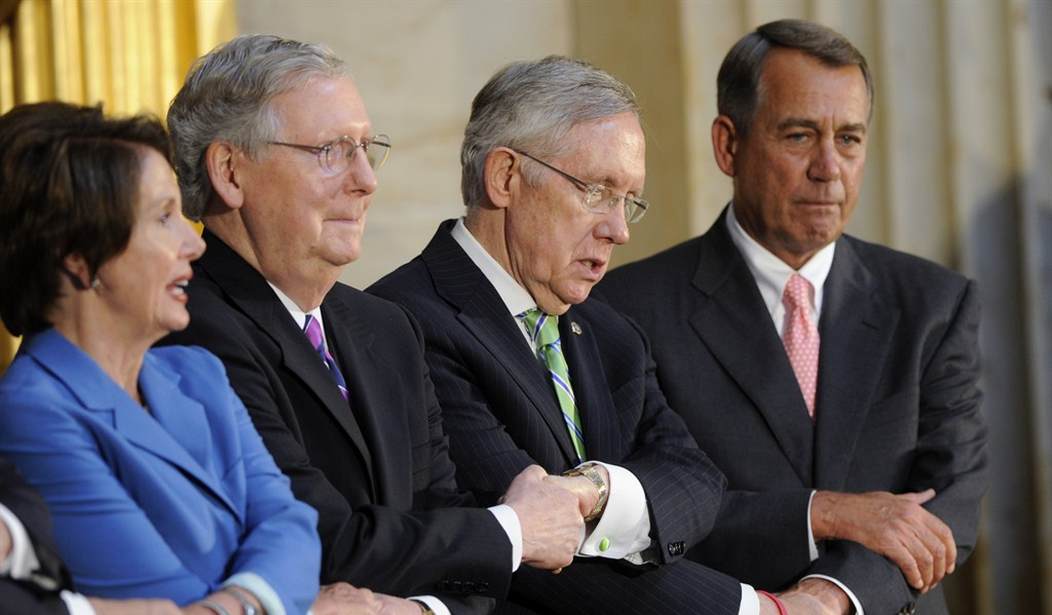
House Speaker John Boehner recently shocked many of us when he announced that he is planning a lawsuit against the president for abuse of power. Many Americans feel that a harmonious working relationship between the branches of government has been seriously compromised in recent years. But when Alexis de Tocqueville visited America in 1831 to perform an in-depth analysis of the American phenomenon, he was impressed with our well-structured divided government and its separation of powers.
The writings of the founders of this nation certainly referenced the Bible frequently, but they also paid homage to the writings of Charles de Secondat, Baron de Montesquieu, who wrote prolifically about political theories. One of his most well-known works is "The Spirit of the Laws." In this book, he eloquently argues for the concept of separation of powers.
That argument seems to emanate from the Bible's book of Isaiah, 33:22, which states, "The Lord is our judge (judicial branch), the Lord is our lawgiver (legislative branch), the Lord is our King (executive branch)." Certainly this system of government has worked well for us in the past, helping to establish the United States of America as the most powerful nation the world has ever known within a relatively short period of time.
In order for a divided government to work, each branch must respect the other two branches. There always have been and always will be squabbles between the branches, but the big problem now is that the executive branch has decided to ignore anyone with whom it disagrees, including Congress.
Nowhere was this blatant disregard of Congress more clearly manifested than in President Obama's inappropriate "recess" appointments of three people to the National Labor Relations Board. He redefined the word "recess" in order to appoint individuals who might have a difficult time obtaining congressional approval.
This administration seems to have a penchant for redefining words to make them conform to its ideology. Obviously, if an individual can redefine anything anytime he wants to, he can manipulate virtually any situation into a favorable position for himself. If he is clever and no one notices, he can fundamentally change the foundational fabric of a society.
Passing a law in the usual legitimate fashion and then unilaterally changing that law is another thing this administration seems to cherish. Obamacare is a prime example of this tactic. For example, it would be like a ruler and his council passing a law against the growing of Brussels sprouts, much to the pleasure of his constituents. He then discovers that his favorite brother, who lives in Province A, is the largest farmer of Brussels sprouts in the region and is also his biggest financial supporter. He then unilaterally amends the law to exclude Province A, much to the displeasure of the populace, about whom he cares nothing. The point is that it is inconsistent with fairness to establish rules and then change them in the middle of the game without the consent of the other participants.
This article and many others could be spent detailing all of the instances that support the argument for executive branch overreach, but the truly important thing is to begin asking ourselves how we can reestablish a truly cooperative and harmonious balance of power aimed not at the enhancement of one political party or the other, but rather at providing life, liberty and the pursuit of happiness for the people. This is clearly what the people want, as indicated by their voting to put a liberal president in the White House and a conservative majority in the House of Representatives. The people of this country are not comfortable with runaway government in either direction.
Some will say that previous presidents issued even more executive orders than Obama. In some cases, this is true, but it is not the number of executive orders that is important. Rather, it is the effect of those orders, how they impact society and what precedents they set. When something is clearly wrong, citing a previous misdeed by someone else does not serve as adequate justification. This is like the kid who gets in trouble for hitting someone and says, "He hit me first." Because there is so much childish behavior in Washington, perhaps government officials need the same explanation as the children who fight: No one should be hitting anyone, and we should divert that energy to understanding the nature of the conflict and resolving it.
Civil conversations obviously would go a long way toward helping us as a nation to solve our problems. However, as Saul Alinsky said, "Never have a conversation with your adversary, because that humanizes him, and your job is to demonize him." This is why we see so much name-calling and finger-pointing these days, which is antithetical to our success as a nation.
When the pendulum swings once again to the right, it is vitally important that people with common sense govern according to the Constitution and in a way that respects the separation of powers. There can be no picking and choosing of laws to enforce, and no favoritism. The only special-interest group that should be considered is the American people.

Join the Conversation
VIP members get the ability to comment on articles.