








I’ve shared BIS and OECD data showing that the United States has a bigger long-run fiscal burden than Europe.
That’s a bit of a strained comparison since “Europe” includes fiscally responsible countries such as Switzerland and Estonia, but also soon-to-be failed states such as Greece and France.
But the one common theme, as I explain in this interview for Fox Business News, is that nations get in trouble because they violate Mitchell’s Golden Rule. In other words, the burden of government spending climbs faster than the private sector’s ability to finance it.
It was almost an afterthought, but I also made a very important point about the risks of using bad monetary policy to finance government spending.
Sort of the same story told more humorously by this special Ben Bernanke toilet paper. Or this video from Bernanke’s childhood.
Which is quite a shame since paper money in the western world was a creation of the private sector and only became a vehicle for bad policy once it was monopolized by the state.
What’s the Best Way of Achieving Good Fiscal Policy?
The half-joking response to the question in the title of this post is that policymakers should look at what’s happening in poorly run jurisdictions such as California, France, Illinois, and Greece – and then do just the opposite.
In other words, steer clear of punitive class-warfare tax rates and make sure to control the burden of government spending.
But there’s an even simpler rule that is very correlated with good fiscal policy, at least at the state level. Governments should not impose income taxes.
If you look at this map from the Tax Foundation, you’ll notice that there is a heavy overlap between the 10 states with the lowest overall tax burdens and the 9 states (Alaska, Florida, New Hampshire, Nevada, South Dakota, Tennessee, Texas, Washington, Wyoming) that don’t have income taxes.
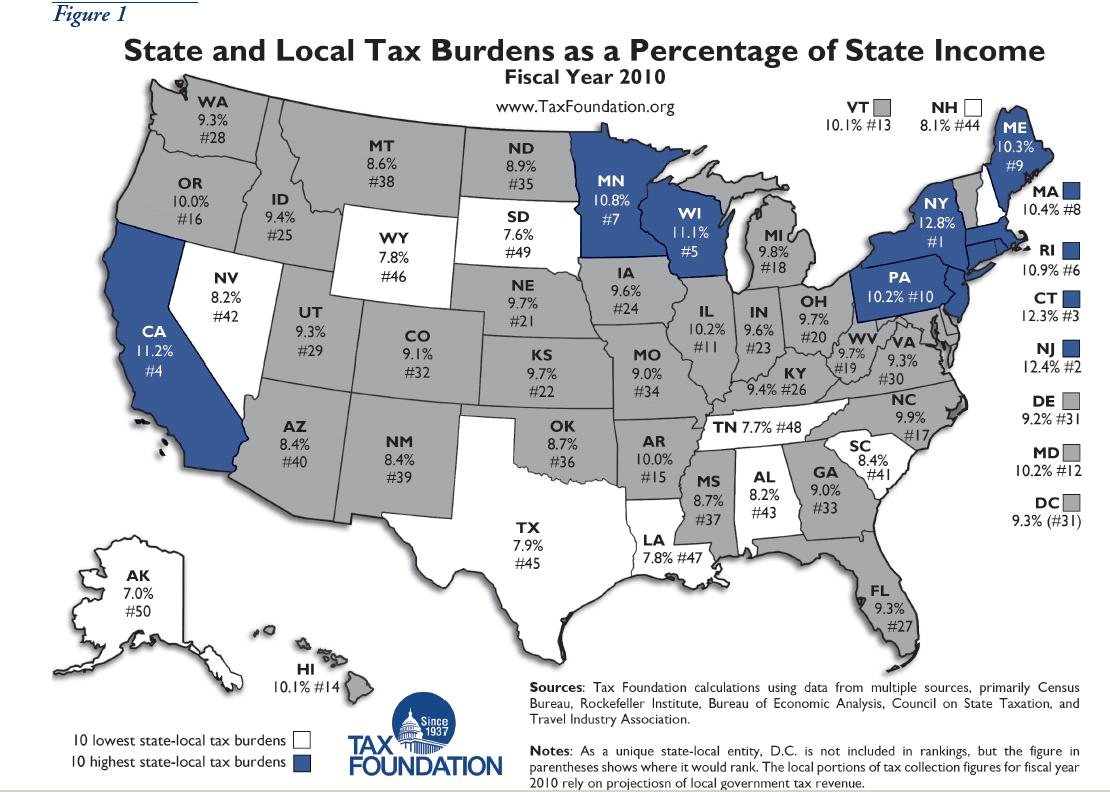
More specifically, 7 of the non-income tax states are among the 10 states with the lowest tax burdens. Only Florida and Washington are outside the top 10.
It’s also worth noting that some of the states with the most “progressive” income tax systems are well represented on the list of the 10-worst states – including California, New York, New Jersey, Maine, and Rhode Island.
One important implication of this data is that proponents of limited government should never give politicians a new source of revenue, which is why fighting the value-added tax is one of my main priorities (and why advocates of small government should be worried not just about Obama winning re-election, but also worried about Romney winning).
P.S. New Hampshire and Tennessee impose income taxes on certain forms of capital income, so they are only probationary and tenuous members of the no-income-tax club.
P.P.S. Politicians from Illinois will probably complain that they didn’t make the 10-worst list, but they shouldn’t be too worried. The Tax Foundation was looking at 2010 data and Illinois almost surely will be closer to the bottom when the 2011 data gets released and includes the impact of the midnight, end-of-session, post-2010 election tax hike imposed by the state’s kleptocrat politicians.
P.P.P.S. For a humorous – but accurate – perspective on the VAT, take a look at these clever cartoons (here, here, and here).



Join the Conversation
VIP members get the ability to comment on articles.