






Editor's Note: This column quotes and contains references to sexually explicit books and content that some readers may find offensive.
As the 2025-2026 academic year concludes, parents and children are looking forward to summer vacation. Books, projects, and recommended reading are no longer top of mind.
But America’s largest library membership association will be hard at work. Celebrating its 150th anniversary of advocacy, the American Library Association (ALA)—the self-proclaimed “
There is only one problem: The ALA’s enemy is a boogeyman. Who is censoring librarians? Who opposes the freedom to read?
Last I checked, Americans can buy Adolf Hitler’s "Mein Kampf," Marquis de Sade’s "120 Days of Sodom," and Lisa Ann’s latest autobiography on Amazon. Schools and libraries are filled with controversial texts—from "American Psycho" to Mao’s “Little Red Book.” And that is a good thing: Books are essential sources of knowledge, allowing us all to expand our horizons.
But that isn’t the ALA’s endgame. Its advocacy work is focused on promoting sexually inappropriate content—for minors. Therein lies the fundamental battle at America’s schools and libraries. ALA activists and ALA-backed librarians are fighting for kids to read explicit material, and parents are rightly objecting. Parents aren’t censoring books; they are arguing that kids shouldn’t be prescribed pornography.
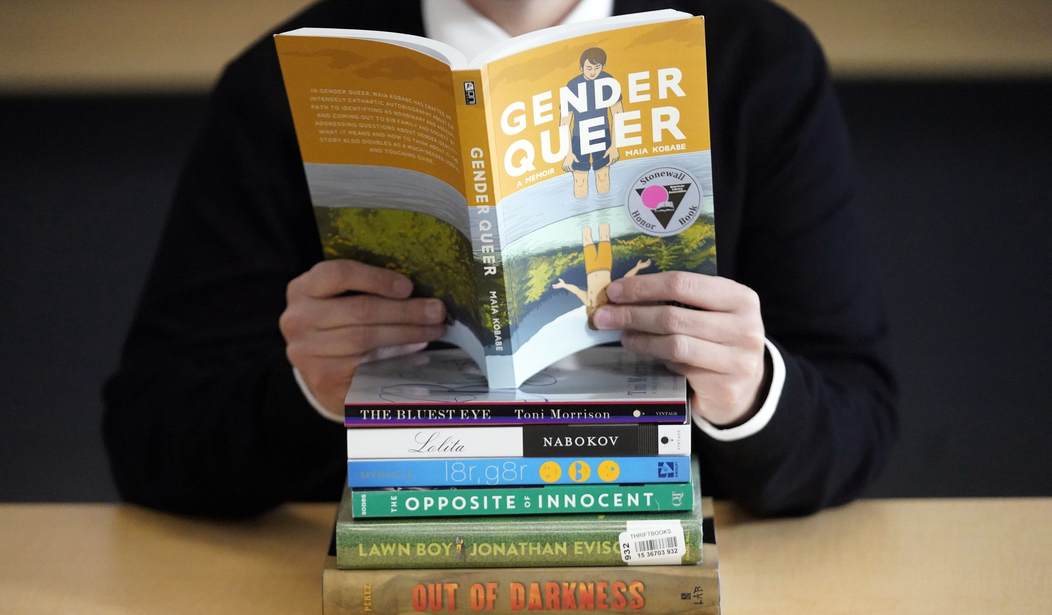
And no, “pornography” isn’t a stretch. Here is one example of a “banned book,” according to the ALA: "Gender Queer," written by Maia Kobabe (who goes by the pronouns e/em/eir). The book introduces kids—with explicit pictures—to concepts like breast and vagina removal, gay and lesbian porn, bullet vibrators, fingering, handjobs, and blowjobs to boot.
Here is another example: "All Boys Aren’t Blue" by LGBTQIA+ activist George M. Johnson, who discusses lube, masturbation, and oral sex at length. Quote: “I put some lube on, and I got him on his knees.”
Here is yet another: "Let’s Talk About It," which shows readers how to insert butt plugs and access fetish porn websites. (The pictures are easily accessible online, but I don’t encourage it.)
Yes, let’s talk about it. These books are so graphic that newsrooms have to issue editor’s notes for reader and viewer discretion. Activists mobilize under the guise of increased “access to diverse reading materials,” which I firmly support. Diverse education is critical to childhood development.
But the common conception of “diverse” is not the ALA’s definition. In 2023, the ALA changed the definition to blatantly include sexually explicit content. Deborah Caldwell-Stone, then-director of the ALA’s Office for Intellectual Freedom, publicly vowed to reframe books that are “sexually inappropriate for minors and promote them as diverse materials.”
Parents aren’t just randomly up in arms about summer reading. They are opposing sexually explicit books for minors. And they are not objecting to their sale; they are contesting their status in an elementary school library.
Do we hand out copies of "Playboy" to kids? What about Pornhub passwords for fifth graders? Sex sells, and it is selling all over the place. But there is clearly a time and place, as most parents believe. Indeed, 70 percent of Americans are concerned that school-age children are being exposed to sexual material that is not age-appropriate. Even more (81 percent) oppose sexually explicit books being promoted in elementary schools.
Backlash against ALA-recommended books isn’t growing because parents suddenly hate free speech or America is suddenly a theocracy; it’s because the ALA is recommending books that are increasingly beyond the pale.
Current ALA president Sam Helmick (they/them) recently wrote, “I imagine the president of ALA in 2076 looking back at us today.” That president will think, “What have we done?”
ALA librarians aren’t wise to make enemies of parents, but such is the status quo. The ALA is doubling down on the elimination of parental rights in its 150th anniversary, offering legal and financial support for librarians to take on parents who dare to complain. ALA allies are calling stories of porn in schools “false,” refusing to mention "All Boys Aren’t Blue," "Gender Queer," "Let’s Talk About It," and other evidence to the contrary.
These are not grassroots efforts. The ALA receives millions of dollars from the Mellon Foundation and other nonprofit donors to mobilize against parents. It’s no coincidence that ALA librarian Amanda Jones, who sued me in federal court after criticizing the ALA for child grooming, recently met with Mellon Foundation fellow Carla Hayden.
Jones made the latest Time 100 list and “starred” in the 2025 film "The Librarians" after promoting books like "Gender Queer" and blaming their critics for being too white. In her words: “I think a modern school librarian pushes things like graphic novels and audiobooks and social justice.” Anonymous donors seem to agree, flooding her GoFundMe page with four- and five-figure gifts.
Now is not the time for parental complacency. The ALA’s agitprop machine is well-funded and well-oiled, and our kids’ futures are at stake. When the ALA pushes porn, we need to push back. This school year may be over, but our fight is just beginning.
Dan Kleinman is the owner of SafeLibraries educational services. He is also executive director of the World Library Association, an alternative to the American Library Association.
Editor's Note: Do you enjoy Townhall's conservative reporting that takes on the radical Left and woke media? Support our work so that we can continue to bring you the truth.
Join Townhall VIP and use promo code FIGHT to receive 60% off your membership.
Join the Conversation
VIP members get the ability to comment on articles.