





Editor's Note: This column was co-authored by Garion Frankel.
It's been a very long time since the public education system's monopoly on American schooling has been this weak.
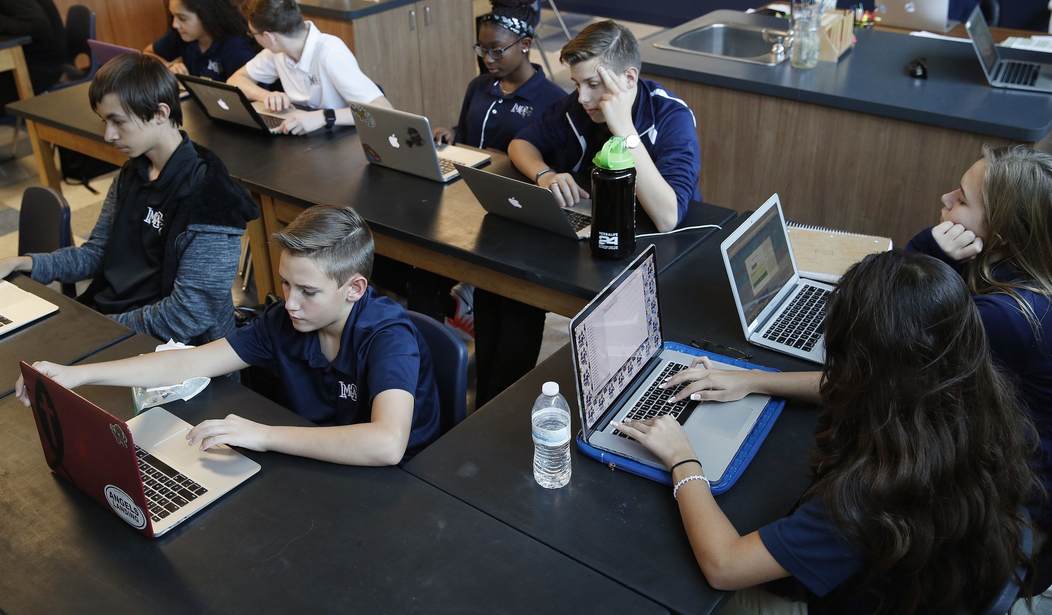
Tennessee recently became the 14th state to establish a school choice program with universal eligibility, and others, like Texas and South Carolina, may follow later in the year. Choice programs have led to dramatic expansions in educational options — microschools, virtual schools, co-ops, classical schools, and more now serve more than one million American families. They have also freed families to educate their children at home. Parents now homeschool about 6% of the school-aged population, compared to just 2.8% in 2019.
But while most proponents of educational freedom laud these accomplishments, there are naysayers as well. Cultural critic James Lindsay argues that school choice is a "trap" that will lead to the "Marxification" of private education. Robert Bortins, the CEO of Classical Conversations, a prominent homeschool curriculum provider, believes similarly. Former actress and prominent homeschooling advocate Sam Sorbo asserts that public education is tantamount to "child abuse" and that educational choice programs will ultimately replicate these abuses in the private sector. Underlying all these arguments is a pervasive fear of "statism" — the idea that school choice is a Trojan horse for the government attacking dissenting families.
These concerns, however, are unfounded, and miss the point entirely. Every state has a role in funding K-12 education, and it is unlikely that this role will go away soon. Instead, if people want to subvert the government's domineering role in education, they should embrace policies that promote educational freedom, such as school choice.
Critics who oppose school choice on the grounds of expanding liberty are making perfect the enemy of the good. Educational choice programs create a competitive marketplace that shifts power away from the government and into the hands of families. Nearly 70 years ago, Milton Friedman recognized this when he proposed school choice as a necessary first step toward reducing state control over education in his seminal essay The Role of Government in Education. Friedman wasn’t alone either — the great British philosopher John Stuart Mill made similar observations a century before.
Nevertheless, opponents will argue that despite funding being in parents' hands, any money from the government will have strings attached that suppress the operations of alternative schooling models. Yet, the reality is that most educational choice programs are designed with robust protections to safeguard educational autonomy. For example, Arizona's ESA legislation explicitly states that a school "shall not be required to alter its creed, practices, admissions policy or curriculum."
In fact, the increase in educational choice is likely to protect alternative education models in the long run by establishing a broader coalition of families directly invested in educating their children any way they see fit. Moreover, even if families were concerned about governmental overreach in their private schooling due to school choice, participation is voluntary, meaning any family can simply opt out of the program. Homeschoolers need not be concerned either — a recent study found no instance in which educational choice programs increased regulations on homeschooling families. In some states, homeschool regulation has actually decreased over time after choice entered the picture.
School choice doesn't just benefit families looking for individualized education options with less government control for their students; it also shrinks the size of the state by providing tremendous savings for taxpayers. For instance, according to a recent study from EdChoice analyzing 48 programs from their inception through fiscal year 2022, it is estimated that state and local taxpayers saved an estimated $19.4 billion to $45.6 billion. So, if educational choice is a Trojan horse for more state control over education, it certainly isn't doing a good job of centralizing economic affairs.
Fortunately, school choice is not a Marxist plot to increase the role of the state in education. Rather, it is a necessary step for redesigning an entrenched system that has never allowed families to have their rightful seat at the table. Indeed, the true threat to educational freedom is to allow the government schooling monopoly to go unchecked. Expanding school choice ensures that families, not bureaucrats, shape the future of education.
Garion Frankel is a PhD student in PK-12 educational leadership at Texas A&M University. He is a Young Voices emeritus, and his articles have appeared in outlets like Newsweek, USA Today, and the Houston Chronicle. Follow him on X @FrankelGarion.
Cooper Conway is a Research Assistant for the Fiscal Research and Education Center at EdChoice, a 501(c)(3) nonprofit, nonpartisan organization working to advance educational freedom and choice for all students as a pathway to successful lives and a stronger society.. Follow him on X @CooperConway1.


Join the Conversation
VIP members get the ability to comment on articles.