





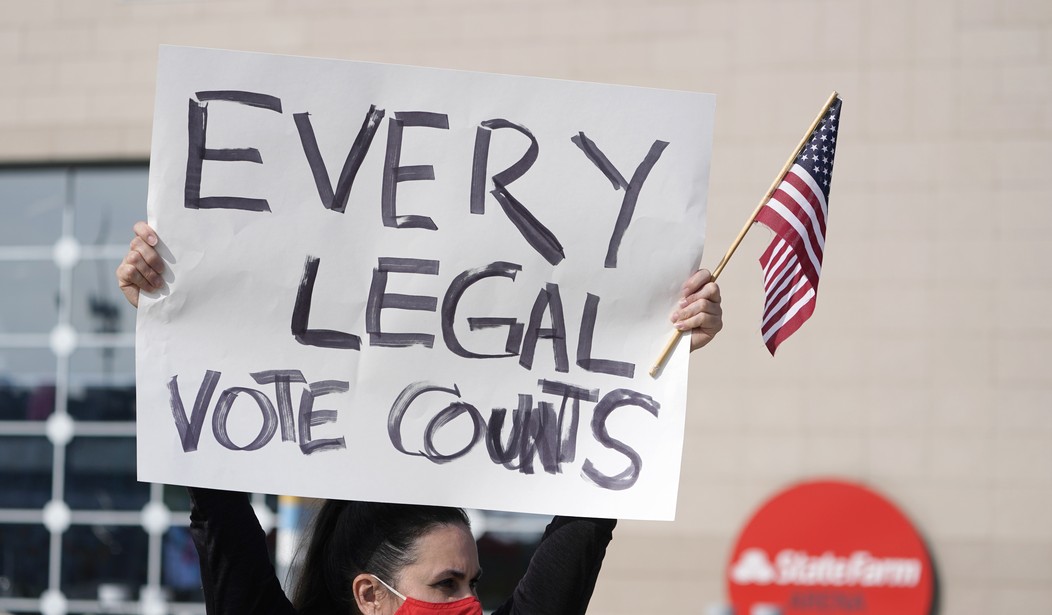
In the months leading up to the 2020 election, several states instituted measures to eliminate commonsense guardrails designed to prevent mail-in voting malfeasance. At the time, many election experts questioned the wisdom of doing this, positing that it would likely lead to widespread voter fraud. We now know that these concerns were warranted, as a new poll conducted by Rasmussen Reports and The Heartland Institute gives credence to those who were worried that the mailing of tens of millions of ballots could result in rampant voter fraud.
Here are a few of the key takeaways from the poll: 21 percent of mail-in voters admitted that they filled out a ballot for a friend or family member; 19 percent of mail-in voters admitted that a friend or family member filled out a ballot on their behalf; 17 percent of mail-in voters admitted that they voted in a state where they are no longer a permanent resident; and 17 percent of mail-in voters said they signed a ballot for a friend or family member with or without his or her permission.
Well before the 2020 election, it was generally accepted across the political spectrum that mail-in voting was less secure than in-person voting. In 2005, former President Jimmy Carter and former U.S. Secretary of State James Baker issued a report titled, “Building Confidence in U.S. Elections,” in which they noted that mail-in voting “increases the risk of fraud” and “absentee balloting…has been one of the major sources of fraud.”
Three years later, The New York Times ran an article titled, “Error and Fraud at Issue as Absentee Voting Rises,” which similarly concluded that “votes cast by mail are less likely to be counted, more likely to be compromised and more likely to be contested than those cast in a voting booth.”
Even NPR admitted in mid-2020 that “Mail-in voting…is fraught with potential problems.”
Arguably, the biggest problem associated with mail-in voting that played out on a grand scale in the 2020 election is the fact that states mailed out tens of millions of ballots based on notoriously inaccurate voter registration rolls.
In 2012, the Pew Center on the States analyzed state voter registration rolls and found, “Approximately 24 million—one of every eight—voter registrations in the United States are no longer valid or are significantly inaccurate. More than 1.8 million deceased individuals are listed as voters. Approximately 2.75 million people have registrations in more than one state.”
Likewise, the Carter-Baker report found, “a substantial number of Americans are registered to vote in two different states.”
During the 2020 election, several states, including many closely contested battleground states, sent mail-in ballots or ballot request forms automatically to all registered voters, which could then be sent back or inserted into unobserved drop boxes.
In recent elections, including the Democrat primaries in 2020, mail-in ballots have been rejected at a rate of approximately 20 percent, typically due to lack of signature verification and other issues. In the 2020 general election, less than 1 percent of mail-in votes were rejected, calling into question the veracity of mail-in votes across the board.
In the 2020 election, 46 percent of voters cast ballots by mail. However, the proportion of Democrats who voted by mail dwarfed Republicans. According to the Pew Research Center, 58 percent of Biden voters voted by mail compared to 32 percent of Trump voters. This is significant because it means that Biden received a much larger overall share of likely fraudulent ballots than Trump than did. We know that Biden’s margin of victory was razor-thin in many of the battleground states, which means it is more than likely that duplicity regarding mail-in ballots played a pivotal role in Biden winning the Electoral College.
Proving voter fraud after the fact, especially pertaining to mail-in ballots, is nearly impossible. But, the circumstantial evidence combined with the results of this poll indicate that the 2020 election was not the safest and most secure in American history, which has been the talking point from the mainstream media over the past three years.
With the 2024 election less than one year from now, and a Trump versus Biden rematch appearing more probable by the day, state legislatures ought to make election integrity efforts a priority when they reconvene in January. Fortunately, states like Florida and Georgia have already done this, providing an excellent model for other states to follow.
Chris Talgo (ctalgo@heartland.org) is editorial director at The Heartland Institute.

Join the Conversation
VIP members get the ability to comment on articles.