
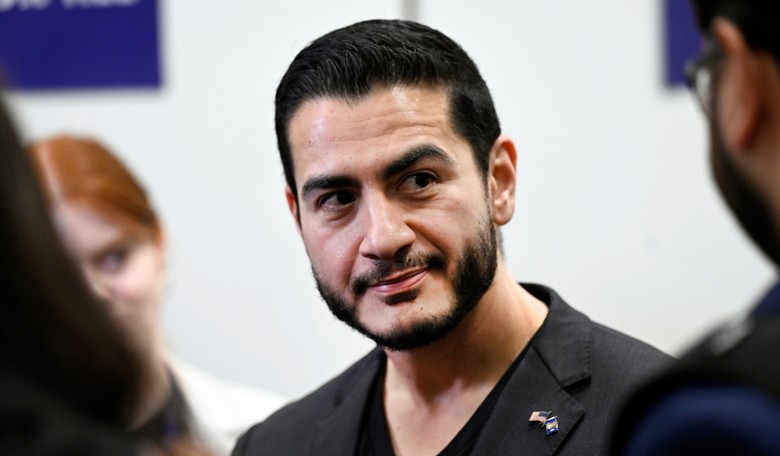
Con man Abdul El-Sayed has lied about many things during this campaign. He's lied about being a physician (he's never been licensed and has never treated a single patient); he's lied about letting Americans keep their private insurance under his Medicare for All scheme, and he's lying about the One Big Beautiful Bill.
This morning, El-Sayed posted on X about the OBBB, parts of which go into effect tomorrow in Michigan. But he's lying about the bill and what it does, and misleading voters in the process.
Tomorrow, on October 1, the biggest transfer of wealth from the working class to the wealthy hits a critical milestone. Many of the provisions from the Big Ugly Bill will go into effect, harming hundreds of thousands of Michiganders in order to create tax cuts for the richest…
— Dr. Abdul El-Sayed (@AbdulElSayed) September 30, 2026
"Tomorrow, on October 1, the biggest transfer of wealth from the working class to the wealthy hits a critical milestone. Many of the provisions from the Big Ugly Bill will go into effect, harming hundreds of thousands of Michiganders in order to create tax cuts for the richest people in America," he wrote on X, before making several claims.
So let's fact-check what El-Sayed said versus reality.
Claim #1: "Medicaid and SNAP have been cut to deliver $4.5 trillion in tax cuts primarily for billionaires and corporations."
FACT-CHECK: Yes, October 1 is an important implementation date. That's when Michigan Medicaid eligibility changes for certain non-citizens take effect, but Medicaid work requirements don't begin until January 1, 2027.
As for changes to the SNAP program, the federal share of SNAP administrative costs drops from 50 percent to 25 percent, making states responsible for 75 percent of the costs. SNAP changes in Michigan began rolling out in March 2026, and even earlier in some counties. It's misleading to say October 1 is the day that Medicaid/SNAP cuts hit.
As for the tax provisions, $4.5 trillion is not handed to billionaires and corporations. This relates to the deficit effect. A large portion of the One Big Beautiful Bill extends individual provisions of the 2017 Tax Cuts and Jobs Act that would have expired, along with provisions involving taxes on tips, overtime, and seniors, as well as the Child Tax Credit and small businesses.
Claim #2: "Michigan is set to lose $2-3 billion annually in federal Medicaid and SNAP funding."
FACT-CHECK: This claim is unsourced. Numerous savings come from requiring states to check eligibility more frequently, which prevents payments for people who are deceased, enrolled in multiple states, or are otherwise ineligible. Savings also come from changing state financing mechanisms as well as imposing work or community engagement requirements on certain expansion adults. The Senate Finance Committee describes those program-integrity and sustainability measures as "common sense reforms."
Claim #3: "The changes in this bill will eliminate tens of thousands of energy and manufacturing jobs in Michigan due to lost investment."
FACT-CHECK: The claim that "tens of thousands" of jobs will be eliminated comes from climate/clean energy advocacy analyses rather than CBO or Michigan government employment forecasts. The IRA clean-energy credits distorted investment by subsidizing favored technologies and exposed U.S. supply chains to China. The House Ways and Means Committee says the law eliminates approximately $500 billion in green-energy subsidies and imposes restrictions to prevent Chinese-controlled companies and supply chains from receiving U.S. tax credits.
Claim #4: "Michigan hospitals will lose $6 billion in Medicaid payments by 2036."
FACT-CHECK: This estimate comes from an industry source, the Michigan Health & Hospital Association. The law also establishes a $50 billion Rural Health Transformation Program, half of which the Senate Finance Committee says is distributed equally among approved states and the other half according to a CMS formula that considers factors including rural populations and rural facilities. If all 50 states participate, each would receive $100 million annually for five years.
Claim #5: "Over 200K Michiganders are set to lose healthcare."
FACT-CHECK: This is a state projection that misses important context. Michigan's FY2027 budget materials say roughly 200,00 Michiganders will lose health coverage once Medicaid work requirements, more frequent redeterminations, and other eligibility changes are fully implemented. But that does not mean 200,000 Michiganders lose coverage on October 1. The biggest Medicaid requirement changes take effect on January 1, 2027, and that should not be interpreted as 200,000 being involuntarily thrown off Medicaid despite remaining eligible. The law requires certain able-bodied expansion adults to complete 80 hours of work or other qualifying activities per month. It will strengthen eligibility verification and focus Medicaid on those who need it most: children, pregnant women, seniors, people with disabilities, and other vulnerable populations.
Claim #6: "211,000 Michigan households will suffer from SNAP cuts. Nearly 121,000 Michiganders have already lost their SNAP benefits."
FACT-CHECK: These reductions are phased in rather than occurring on October 1. The 121,000 figure is attributed to the Michigan League for Public Policy, from a July 2026 advocacy event and the group Families Over Billionaires. A decline of 121,000 participants does not prove they were removed because of H.R. 1.
Claim #7: "Energy bills across Michigan will go up by a total of $8.7 billion by 2034."
FACT-CHECK: El-Sayed's claim is based on a national estimate by Energy Innovation. Another Michigan-specific figure of $8.7 billion floating around refers to projected energy savings through 2050 under clean-energy policies, not an H.R. 1 increase through 2034.
Mike Rogers called El-Sayed a con man, and that's correct. Because once again, Abdul El-Sayed is lying to and misleading Michigan voters about the One Big Beautiful Bill and the much-needed reforms to our social welfare programs.