
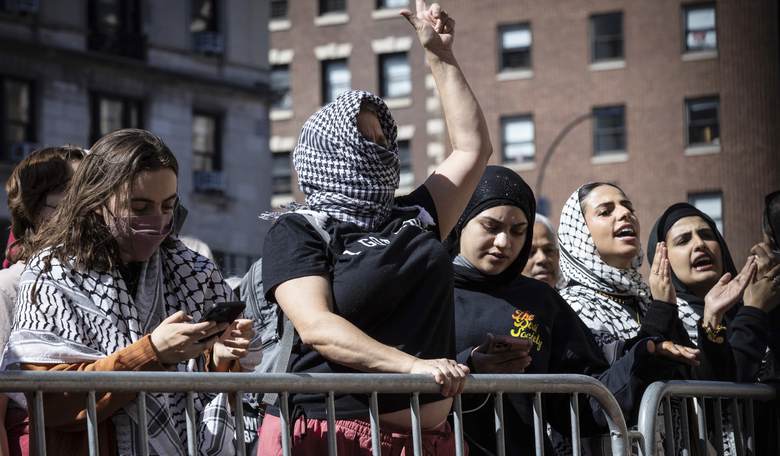
It is not every day that a spokesman for a terrorist organization lectures the United States about affordable healthcare. But when it happens, it raises an unavoidable question: Why does an actual terrorist sound so much like a liberal college student?
During a Tuesday press conference, a spokesman for Iran’s Islamic Revolutionary Guard Corps (IRGC) blasted the United States over its alleged failure to provide adequate healthcare to Americans. It is a remarkable accusation from a regime that has spent decades terrorizing its own population, sponsoring violence abroad, and suppressing anyone at home reckless enough to demand basic rights. Yet the statement is not as random as it first appears.
Follow the rhetoric back far enough, and the connection becomes clear: authoritarian regimes have learned to exploit the West’s willingness to publicly confront its own flaws, repeating those critiques until American self-examination becomes propaganda for governments responsible for some of the world’s most egregious violations of human rights and human dignity.
🇺🇸🇮🇷 An IRGC spokesman attempting to make Americans feel bad about America:
— Mario Nawfal (@MarioNawfal) September 29, 2026
"America still does not have a comprehensive public health-care system.
I heard from one of the people living in America that if someone has an accident in the street, they may not have the money to…
"In the United States, there is still no well-equipped medical system that can treat people in need. I have heard from a resident of the United States that if someone has an accident, there is no money in the streets to pay for an ambulance to take them to the hospital. This is a sign for a wealthy country that the rulers of that country are not really in the minds of their people. Their priorities are their own livelihood and other issues that you know better than me."
This is obviously rich coming from a spokesman of a regime who killed tens of thousands of its own citizens during a crackdown earlier this year. But unfortunately, this is not an exception. It is what happens when institutions like the United Nations or International Criminal Court place authoritarian regimes on the same moral stage as Western democracies.
China and Russia, for example, have permanent seats on the Security Council and veto power. That means regimes with no meaningful tolerance for dissent can exercise extraordinary influence over global diplomacy while lecturing Western countries about their failures. Western representatives regularly criticize their own countries and allies over healthcare, racism, and other failures because those issues are openly debated and, at least theoretically, can be fixed.
Unlike Western democracies, China, Russia, Iran, and North Korea are rarely subjected to comparable scrutiny, and when criticism does emerge, they deny, deflect, censor, or punish it. That contrast has given authoritarian governments a weapon. They seize on every acknowledged American or European failure and present it as proof that free societies are uniquely corrupt, racist, imperialistic, or cruel, while their own far greater abuses remain obscure.
That message does not remain inside the United Nations chamber. It filters into Western universities, activist circles, and social media, where many young people absorb a warped moral hierarchy: the United States is portrayed as exceptionally evil because its failures are documented, debated, protested, and endlessly dissected, while authoritarian states appear less objectionable, because they never admit to them.
That is the inversion behind the question of why an IRGC spokesman can sound so much like a liberal college student. It is not merely that Iran is borrowing Western progressive rhetoric. It is that a generation of Westerners has been taught to treat self-criticism as evidence of national guilt, while authoritarian silence is considered evidence of innocence.
This is exactly what Iran is doing: seizing on an issue likely to draw cheers from American leftists and international activists, then wielding it as a moral weapon against the United States rather than acknowledging, much less addressing, its own regime’s tyranny, violence, and murderous intent.