





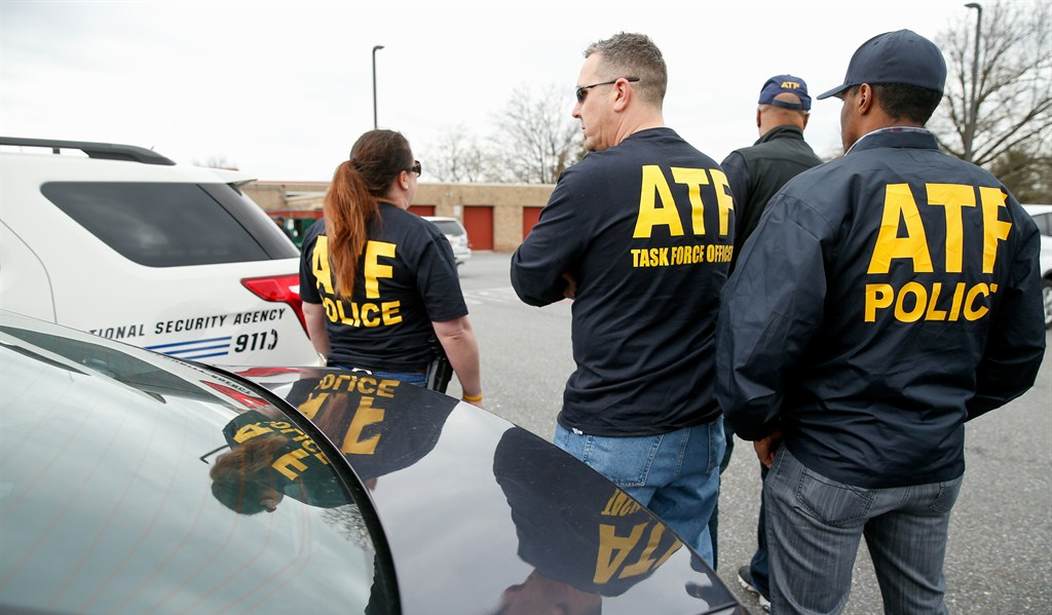
The Bureau for Alcohol, Tobacco, Firearms, and Explosives has been the source of ire on the right, especially since their most recent proposal to ban green tip AR-15 ammo, which is commonly used. It was done under the guise of “law enforcement safety,” though if anyone bothered to read FBI crime statistics, rifles are rarely used in crimes, let alone green tip ammo being used to target police officers. After the failed ban attempt, ATF Director B. Todd Jones decided to resign and take a job with the NFL.
Now, a report from the left-leaning Center for American Progress says that federal law enforcement agency should be scrapped and merged into the FBI (Milwaukee Journal Sentinel):
The U.S. Bureau of Alcohol, Tobacco, Firearms and Explosives, charged with enforcing the nation's gun laws and regulating the firearms industry, has been so hobbled by high-profile operational failures, internal dysfunction and external limits on its authority that the agency should be eliminated and merged into the FBI, a new report concludes.The report, by the left-leaning Center for American Progress, comes in the wake of a bill by U.S. Rep. Jim Sensenbrenner (R-Wis.) that seeks to dissolve the agency and move its law enforcement and gun industry regulatory functions into the FBI and other agencies.
The bill and the report are the latest in a series of efforts, from both sides of the political spectrum and even by veterans of the ATF, to reform or eliminate the agency. In July, a Government Accountability Office report on the ATF described an agency trying to redefine itself while struggling with high personnel turnover and internal problems.
…
The report's authors interviewed more than 50 current and former ATF personnel, and retired Supervisory Special Agent Mark D. Jones advised the authors. The report's argument boils down to this: The vital job of keeping guns out of the hands of criminals is too important to leave to a weakened, embattled agency like the ATF.
"ATF, as it currently exists, suffers from substantial weakness that compromises its ability to effectively combat gun crime and regulate the firearms industry, and a new director or piecemeal changes cannot fully solve these problems," the report concludes. "It is time to consider a major reboot of how these issues are addressed at the federal level and for an overhaul of the federal law enforcement agencies responsible for doing so."
…
The report's proposal to fold the ATF into the FBI differs in at least one significant way from Sensenbrenner's bill.
Sensenbrenner's proposal would keep the prohibition against the ATF publicly sharing data about how many crime guns are sold by gun dealers. The new report says those limits hinder law enforcement's ability to enforce gun laws. Gun rights groups have pushed hard to get those limits and keep them in place.
An earlier Journal Sentinel investigation revealed how those and other special rules created by Congress protected corrupt crime gun dealers and allowed them to escape ATF punishment by shifting its ownership.
Gun control and gun rights groups both came out against Sensenbrenner's proposal last year. The National Rifle Association didn't have a comment on Sensenbrenner's bill last year, but the NRA made it clear recently that the group is against dissolving the ATF. Jennifer Baker, an NRA spokeswoman, said the problem with the ATF is not where it is located.
"The Obama administration has only contributed to ATF's dysfunction by politicizing the agency to advance its gun control agenda," she said. "No matter where the ATF is located, nothing will change until we get a president who respects the Second Amendment."
In 2011, the ATF became involved in a highly embarrassing scandal where they simply lost track of 1,400 weapons intended to track the dealers and buyers of these illegal arms sales with Mexican drug cartels. It failed miserably–and a Border Patrol agent, Brian Terry, was murdered with one of the lost weapons. And, unlike Operation Wide Receiver, which was smaller in scope, Mexican law enforcement officials were virtually kept in the dark on Fast and Furious. Reportedly, the Mexican government was working closely with the ATF on Wide Receiver. It should also be noted that while both operations had their problems, Receiver never involved the death of the Border Patrol agent.
In a more recent fiasco, the ATF has reportedly been targeting the mentally challenged for gun violations, disproportionally arresting minorities, and leaving their government-issued firearms in sewer grates, on top of cars (and then driving away), public bathrooms, and other venues. The ATF refuses to release the protocols for agents regarding keeping their firearms in their vehicles since it will leave them open to robbery. Nevertheless, an ATF spokesperson could not say if the weapons that were lost, but later recovered, were used in any crimes in the interim period in which they were out of the government’s possession.
In another moment of sheer incompetence, the agency left behind highly sensitive information about undercover agents when they conducted a 10-month storefront sting operation last year. And, by highly sensitive, I mean just some stuff like the names of the agents, their vehicles and the cell phone they used. No big deal, right?

Join the Conversation
VIP members get the ability to comment on articles.