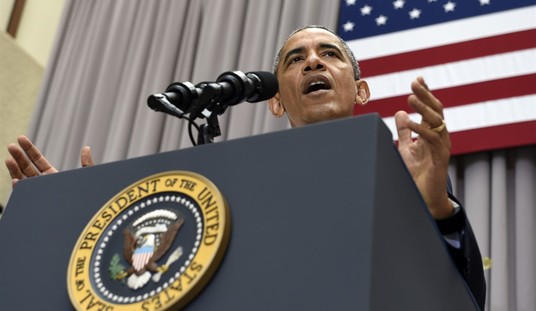
Even though President Obama threatened to veto this bill hours before it passed the House of Representatives because he considers it to be “an assault on a woman’s right to choose” and “a direct challenge to Roe vs. Wade,” this is nonetheless still very good news for the pro-life community. Politico reports:
The House Tuesday passed a bill that would ban most abortions nationwide after 20 weeks. The most far-reaching abortion legislation in the House in a decade, it was passed 228-196 mostly along party lines.
The vote is largely symbolic: The bill will be dead on arrival in the Senate. And the White House has already threatened to veto the“fetal pain” legislation, which is based on the controversial assertion that a fetus can feel pain at that stage of development.
But Rep. Trent Franks (R-Ariz.), the bill’s sponsor, didn’t find that discouraging. He pointed to the last time Congress passed a bill of this scope, the Partial-Birth Abortion Ban Act of 2003. That bill fell short and faced court battles before it finally became law.
“I think if you hearken back to partial-birth abortion … everybody said you know, it’s not constitutional, it can’t pass, it can’t go anywhere, and it took time to do that and it even had to succeed a presidential veto. But it eventually did,” Franks said.
Meanwhile, the Pro-Life Susan B. Anthony List released the following statement:
“Congress has taken an important first step toward making sure we stop abortionists like Kermit Gosnell and his horrific abortion clinic and procedures. The House listened to the overwhelming majority of Americans, men and women, who instinctively recoil at the dehumanizing and degrading practice of late-term abortion,” said Marjorie Dannenfelser, President of the SBA List. “This pro-woman, pro-science, Constitutional bill deserves an immediate vote in the U.S. Senate. It’s simple: children capable of experiencing unimaginable pain from abortion must be protected across the country.
“The big abortion industry cannot defend late-term abortions. Americans are disturbed by the callous nature of this practice, the disgusting clinic conditions in Pennsylvania, Delaware and other states, the 330,000 abortions Planned Parenthood of America performs every year as it receives half a billion in taxpayer dollars, and the repeated harm women experience as a result of their exploitation. Women and the unborn deserve better than abortion, and making late-term abortions illegal is a simple step in that direction. Votes have consequences. Congress should take note we're pulling together our 2014 target list tonight.”
For what it’s worth, according to a recent Gallup poll, 80 percent of Americans believe third trimester abortions should be illegal.
This is one of the strangest and most bizarre stories I’ve read about in a while:
New England Patriots owner Robert Kraft revealed the real story behind a 2005 meeting with Vladimir Putin, during which the Russian president pocketed his Super Bowl ring, worth more than $25,000. Kraft, at the time, claimed the diamond-encrusted bauble was a gift, but he now admits Putin stole it, and the White House intervened when he demanded it back.
Kraft explained the incident happened while Sandy Weill and other business execs were in St. Petersburg. “I took out the ring and showed it to [Putin], and he put it on and he goes, ‘I can kill someone with this ring,’ ” Kraft told the crowd at Carnegie Hall’s Medal of Excellence gala at the Waldorf-Astoria.“I put my hand out and he put it in his pocket, and three KGB guys got around him and walked out.” …
But Kraft really wanted the 4.94-carat bauble back, he said Thursday, admitting he’d gotten a call from the George W. Bush-run White House, saying, “‘It would really be in the best interest of US-Soviet relations if you meant to give the ring as a present.” (In fact the Soviet Union had collapsed 14 years earlier.)
But, Kraft said, “I really didn’t [want to]. I had an emotional tie to the ring, it has my name on it. I don’t want to see it on eBay. There was a pause on the other end of the line, and the voice repeated, ‘It would really be in the best interest if you meant to give the ring as a present.’ ” The ring is now reportedly kept in the Kremlin library.
So when Vladimir Putin isn’t scaring children or vacationing shirtless or lecturing the United States government about civil liberties, he’s stealing Super Bowl rings? What a guy! I’m not exactly sure what’s worse: the fact that his thuggery runs so deep that he literally stole an American citizen’s personally engraved, $25,000 Super Bowl ring or that the United States government politely yet forcefully told Mr. Kraft to kiss it goodbye because they didn’t want him damaging “U.S.-Soviet” relations, or whatever. Stunning.
By the way, if the ring is actually sitting in the Kremlin library these days, good luck trying to convince anyone in the Obama administration to help get it back. That ring is long gone.
UPDATE: Hold up. He didn't actually steal it? Via CNN:
That's the way Putin sees it, the president's spokesman said Sunday."What Mr. Kraft is saying now is weird," Dmitry Peskov said. "I was standing 20 centimeters away from him and Mr. Putin and saw and heard how Mr. Kraft gave this ring as a gift."
The 4.94-carat ring is in the Kremlin's library, where all official state gifts are kept, he said. It is worth more than $25,000, according to multiple reports from 2005.
A Kraft spokesman said Sunday the story is a humorous anecdote that Kraft "retells for laughs."
"He loves that the ring is at the Kremlin and, as he stated back in 2005, he continues to have great respect for Russia and the leadership of President Putin," said Stacey James, a spokesman for The Kraft Group.
Either way, the ring isn't coming back. Good thing Kraft has more than one.
For the first time in eight years, former President George W. Bush’s favorability ratings are no longer underwater, according to a recent Gallup study:
Julian Zelizer, a professor of history at Princeton University, explained why his numbers are slowly rising in a CNN op-ed last Thursday:
The most obvious reason is that the passions for presidents -- both good and bad -- tend to go down after they leave office. Americans turn their attention to the new boss and to new issues, and the focus of their sentiment shifts elsewhere. This is particularly true in our heated political times when voters become so polarized on their feelings about a leader -- feelings that can become most intense as we approach the elections.
Another factor has to do with what the successor does in office.
Much of the controversy that surrounded Bush had to do with his national security policies. The war in Iraq caused a huge controversy with many Americans feeling the president had gone into an unnecessary war based on false evidence. By the second term, many Americans were also upset with some of the tactics the administration had used to pursue terrorists, such as interrogation.
But President Barack Obama, who campaigned as a critic of these policies, ended up leaving many of the programs in place and actually becoming more aggressive on certain fronts, such as the use of drone strikes. Obama has given these controversial policies a certain bipartisan imprimatur that has dulled the anger that existed toward Bush.
Zelizer also notes that Bush’s decision to stay out of the spotlight is contributing to his public rehabilitation. Nonetheless, he explains, one shouldn’t dwell on these numbers for too long: positive approval ratings are by no means permanent -- and can shift in an instant if “polls are tallied at a moment when a president resonates with the politics of the moment.” Meanwhile, archival records oftentimes change the way posterity views presidential administrations. In fact, he says, this is precisely why we remember Dwight Eisenhower and Ronald Reagan in more favorable terms. Perhaps, then, when Bush’s archival records do become fully available to the general public, future generations will be less inclined to judge him as harshly as some Americans do today. That’s what the president himself is hoping for, I suspect, although whether or not that actually happens remains to be seen.
One question conservatives no doubt have asked themselves time and again over the last seven months is: Why did the Republican presidential ticket lose in 2012? And there are many different reasons, of course – perhaps too many to name in this space – but here is what the Wisconsin congressman himself had to say on this subject at the Faith and Freedom Coalition last Friday (via Politico):
Rep. Paul Ryan (R-Wis.) said Friday that he and Mitt Romney lost in November in part because they were arguing against the “empty promises” of the not-yet-implemented Obamacare law.
“This was the challenge that Mitt Romney and I had in this last election … we had to argue against the promise and the rhetoric of President Obama,” he said in a speech at the Faith & Freedom “Road to Majority” conference in D.C. “The great soaring rhetoric, all of the empty promises.”
“Remember in his first two years, he passed his big program, but he didn’t implement his program,” he continued, referring to Obamacare. “Now, in his second term, we’re seeing it implemented — and it’s pretty darn ugly.”
Ryan said Obamacare is an “assault” on Americans’ freedoms and gives too much power to the government.
One can’t help but wonder: If the presidential election was in November 2013, instead of last year, would the outcome have been markedly different?
Given all the scandals that have surfaced recently and the truly worrisome news about Obamacare’s implementation, an election fixated on “binders full of women” and “Big Bird” narratives seems utterly fatuous and anti-climactic at this point.
That being said, while learning from the past can be instructive, dwelling on it usually isn’t. And wishful thinking is invariably a fruitless endeavor. Therefore conservatives and Republicans, instead, should be focusing on determining what the GOP and its supporters should be talking about now in order to win elections in the future.
Ryan, for his part, hit the nail on the head when he referenced Obamacare’s expensive and onerous regulations, and how the not-yet-fully-implemented monstrosity is already crushing low income families. Remember, this was a piece of legislation only Democrats supported. Republicans thus would be foolish not to highlight Obamacare’s resounding unpopularity – and remind the public exactly how it became law.
Speaking at the Faith and Freedom Coalition on Saturday, former Republican vice presidential candidate Sarah Palin made the case that the U.S. should not intervene in Syria until the American public elects a new president. The Hill reports:
Former GOP vice presidential candidate and Alaska governor Sarah Palin told a Washington audience Saturday that the U.S. should not get involved in the Syrian civil war.
Palin argued that the U.S. should not intervene in any Middle East conflict as long as President Obama remains in office.
“Until we have a commander in chief who knows what he is doing....let Allah sort it out!” she told the Faith and Freedom Coalition.
The statement shows how far Palin has drifted from former running mate Sen. John McCain (R-Ariz.), who is the chief Senate proponent of U.S. military action to help the Syrian rebels.
This week, the White House announced it had concluded that Syrian President Bashar al-Assad had used chemical weapons against the rebels, thereby crossing a “red line.” Obama has now decided to arm select elements of the Syrian rebellion.
Palin also used her speech to blast the “good ole boys” in Congress and she advised them to follow the lead of freshman Sen. Ted Cruz (R-Texas), a Tea Party darling.
We're all likely to hear more from the former governor in the days to come. As Katie reported earlier this week, Governor Palin has officially rejoined Fox News as a contributor.
For what it’s worth, the Gallup findings can be summed up thusly:
Americans' confidence in Congress is not only at its lowest point on record, but also is the worst Gallup has ever found for any institution it has measured since 1973. This low level of confidence is in line with Americans' low job approval of Congress, which has also been stuck below 30% for years.
The divided Congress, with Democrats controlling the Senate and Republicans the House, is likely part of the reason for the low levels of confidence rank-and-file Democrats and Republicans express, and is tied to Americans' frustrations with Congress' inability to get much done.
Of course, I highly doubt America’s palpable disenchantment with members of Congress will change any time soon. Many of us will just keep sending the same representatives back to Washington -- as we do every election cycle -- and all the big issues of our time will continually be ignored. But perhaps these historic numbers will serve as a wake-up call for our elected officials. Then again, Congress’ approval ratings have been so low for so long one wonders if they’ll even notice.
Edward Snowden swore an oath not to divulge classified information. He did anyway, of course, and seems to have no moral qualms about doing so. On the other hand, the intelligence he leaked to the Guardian was deeply unsettling and should send chills up the spines of every American who uses modern technology – although I suspect most people would agree they’d rather know they’re being snooped on than be kept in the dark.
Regardless of which side of the traitor/hero divide you find yourself in alignment, one thing is absolutely clear: the public at large doesn’t really know what to make of this guy…yet:
Some 23 percent of those surveyed said former National Security Agency contractor Edward Snowden is a traitor while 31 percent said he is a patriot. Another 46 percent said they did not know.
Snowden, 29, revealed last week that the NSA is monitoring a wide swath of telephone and Internet activity as part of its counterterrorism efforts.
"I'm neither traitor nor hero. I'm an American," Snowden told the South China Post, an English-language newspaper in Hong Kong, in an interview published on Wednesday.
U.S. authorities have said they are weighing possible criminal charges against Snowden, who was an employee of Virginia-based consultant Booz Allen Hamilton when he leaked documents indicating the NSA's surveillance of Americans is much broader than had been disclosed publicly.
In the Reuters/Ipsos poll, 35 percent of those surveyed said Snowden should not face charges while 25 percent said he should be prosecuted to the full extent of the law. Another 40 percent said they did not know.
No one disputes that Snowden is “an American” by definition (even though it’s unlikely he’ll return to the United States anytime soon unless extradited). But is he a “traitor,” as House Speaker John Boehner recently asserted? If he isn’t -- and he very well might not be -- why on earth did he tell a Chinese newspaper that the U.S. is conducting cyber operations against universities in Hong Kong and the nation of China? I know this isn’t exactly “news” -- but how does disclosing this kind of information not harm the national security interests of the United States? Well, it does seem to, as Allahpundit explained this past week:
[H]is whole point in his Guardian interview with Greenwald, though, was that he’s not out to hurt American interests, merely to clue his fellow citizens into something the government’s doing to them that should concern them. Yakking to a Chinese paper about U.S. cyberespionage proves that that’s not quite true. He’s also out to embarrass the U.S. by revealing stuff that’ll raise tensions with other nations, even if the stuff he’s revealing is supported by most Americans.
It’s not quite clear to me what the motivations here are quite yet. Is he a disgruntled former government employee who’s trying to “stick it” to the man? Or is he a patriotic citizen speaking truth to power -- hell bent on making his government accountable to its citizens? Perhaps it’s a combination of the two -- or perhaps I’m wrong on both counts. Either way, it’ll be interesting to see what’s really going on inside this man’s head as more information becomes available to us.
Here’s a rare piece of good news emanating from the halls of Congress: the great abolitionist, Frederick Douglass, will be honored with his very own statue in the U.S. Capitol next week.
I remember the first time I stepped inside the U.S. Capitol building. Not only was I beguiled by its inescapable charm and beauty – a place that all Americans should visit at least once – but the statesmen who line its halls reminded me of America’s inherent greatness. It is fitting, then, that a statue of Frederick Douglass will finally be placed inside this American pantheon of heroes. After all, even a cursory glance at his writings and speeches – on slavery, emancipation, freedom, and opportunity – cannot help but inspire awe at the sheer genius of the man. And to learn he was born in the most deplorable and depressing of circumstances only adds to his greatness.
What has always fascinated me about Frederick Douglass is that he was one of the first and most vocal supporters of arming black soldiers during the Civil War. Adamantly opposed to colonization – namely, the platform to ship blacks back to Africa or other “settlements” outside the United States – Douglass argued that slaves in America and free blacks deserved to stay. It was, after all, their birthright. What’s more, he argued, only by bearing arms and joining the war effort could blacks hope to change public opinion and improve race relations in post-bellum America. This strategy subsequently paid off: Abraham Lincoln, during his final public address, suggested that some black union soldiers should be granted voting rights – a pronouncement that perhaps got him killed and which was inconceivable when he first got elected. Of course, he had (along with his fellow citizens) seen firsthand their bravery and heroism on the battlefield – and this changed everything. It is possible then to plausibly argue that Frederick Douglass not only provided the intellectual foundation for emancipation through his writings and speeches, but ultimately helped bring the war to a speedier conclusion with his lobbying efforts.
Speaker John Boehner said during his remarks that Frederick Douglass was “one of the greatest Americans and voices for freedom” in our nation’s history. I agree. And hopefully now, when visitors tour the Capitol Building and see his statue, they’ll be reminded of what he accomplished – and if they don’t know – they will ask.
H/T: Yahoo! News
The Massachusetts Senate special election is approximately fourteen days away, and despite the inescapable fact that the Commonwealth is one of America’s bluest battlegrounds, political newcomer Gabriel Gomez is ostensibly cutting into his opponent’s double digit lead.
Democratic Rep. Edward Markey holds a narrowing lead over his Republican rival, former private-equity executive Gabriel Gomez, in the Massachusetts special election race, according to a new Suffolk University Political Research Center poll released Monday.
Among 500 likely voters, about 44% plan to vote for Mr. Markey in the June 25 special election, compared with 36% for Mr. Gomez, the survey found. That’s less support than Mr. Markey had in a Suffolk University poll in May, when 52% of likely voters said they planned to vote for him, while 35% leaned toward voting for Mr. Gomez.
Many voters in the Democratic-leaning state have yet to make up their minds. When asked in the most recent survey whom they would vote for if they were currently in the voting booth, 51% said they were still undecided, 18% said they would vote for Mr. Markey and 23% said they would choose Mr. Gomez.
Those “undecideds” will almost certainly determine the outcome of the race. Given the make-up of the electorate (after all, Republicans comprised roughly 11 percent of all registered Massachusetts voters in 2012), Gomez will need to attract large pluralities of independents and left-leaning Democrats to have a fighting chance. But can he do it? My hunch is that winning isn’t necessarily a bridge too far -- not least because political observers predict voter turnout will be way down given the nature and timing of the election. Remember, Scott Brown’s successful Senate run in 2010 was only possible because (a) his opponent ran a lackluster and lazy campaign and (b) many Democrats who consistently vote in presidential election cycles opted to stay home. This latter scenario -- should it come to fruition again -- is perhaps the most important factor in determining who will win on June 25.
Meanwhile, despite Ed Markey’s numerous missteps and blunders -- and there seems to be quite a lot lately -- the longtime congressman is a seasoned political operative who understands how to win elections. In other words, he’s no Martha Coakley -- despite a number of seemingly apt and relevant comparisons. In fact, he’s a liberal ideologue from a state that (ahem) loves electing liberal ideologues. And while Gabriel Gomez is indeed a quintessential, moderate Republican with an inspiring life story, he’s running for office in a state where no less than sixty percent of the electorate voted for President Obama in 2012. Thus the odds are not really in his favor to win -- not by a long shot. But if he does win somehow, and he very well could, it will most likely be because of his opponent’s own failures and mistakes. Put another way, this race is Ed Markey's to lose.
But the question is, will he?
If the president hopes to pass comprehensive immigration reform this year -- or any other legislative initiative, for that matter -- he’s going to need all the help he can get. Thus perhaps it’s not too surprising that he’s reportedly heading up to Boston next week to campaign for Congressman Ed Markey -- the liberal Senate hopeful vying to succeed John Kerry in the United States Senate:
President Barack Obama will travel to Boston next week to lend his support to the Democratic candidate in a special Senate race in Massachusetts.
Obama will be in Boston on Wednesday to give a boost to Rep. Ed Markey, a Massachusetts Democrat. That's according to two Democratic sources, who weren't authorized to discuss Obama's plans ahead of the official announcement and spoke on condition of anonymity.
While in Boston, Obama will attend a morning fundraiser for Markey at Copley Plaza.
Obama endorsed Markey last month, calling him a "passionate and effective champion for middle class and working families." And last week first lady Michelle Obama campaigned for Markey in Massachusetts.
The Boston Herald first reported Obama's trip. The special election to replace former Sen. John Kerry is on June 25.
Rep. Markey has been in Congress since the mid-1970s. He’s a venerable presence in that esteemed body with a long and -- shall we shall -- “progressive” voting record to show for it. Indeed, when recently asked by a reporter if he could remember a single instance when he bucked his party’s leadership and refused to vote for a tax increase, he couldn’t. “I will get back to you on that,” he intoned. Of course, as a tax-and-spend liberal, he’ll feel right at home in the Massachusetts Senate delegation should he win -- an outcome that seems exceedingly likely these days. But Gabriel Gomez, a former Navy Seal and successful businessman, isn’t taking anything for granted or giving up -- and might just shock the political world if he somehow pulls out an upset win on June 25.
To that end, here’s his most recent campaign ad, which shows Gomez introducing himself to voters and disseminating his message. It was paid for by the NRSC: