







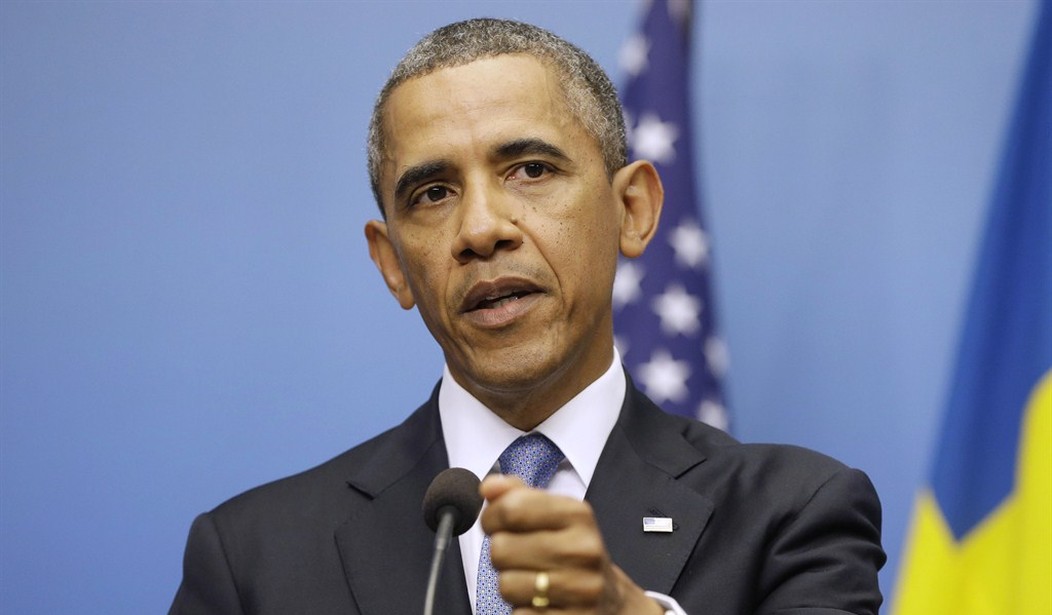
President Obama's on-and-off-again planned American attack on Syria is nothing new. Besides its five declared wars, America has a habit of intervening all over the world.
Even apart from clandestine CIA operations, and even after the unhappy end of the Vietnam War, we have attacked lots of countries and non-state militias.
The roll call of recent American military interventions is quite astounding: Cambodia, Iran, Libya, Lebanon, Grenada, Panama, Liberia, Iraq, Haiti, Somalia, the former Yugoslavia, Zaire and Afghanistan.
Even the notion of Past American isolationism is a myth. In the four years between 1912 and 1916 alone, the U.S. sent troops into Cuba, Panama, Honduras, Nicaragua, Mexico, the Dominican Republic and Haiti.
Even those busy years of intervention were not novel. Since our infancy, the U.S. military has been constantly engaged. In another four-year period between 1812 and 1816, America fought the British, the French, the Spanish and the North Africans.
Some of these deployments were effective, either furthering American and allied interests or serving a common humanitarian purpose. Greece was saved from communism after World War II. Saddam Hussein was forced out of Kuwait and ultimately Iraq. Dictator and drug-dealer Manuel Noriega was deposed from Panama. At other times, our periodic undeclared wars just made things worse.
With President Obama contemplating bombing Syria, is there any guide from the past about whether yet another attack is wise or silly?
Sometimes the president sought congressional approval (e.g., both Bushes in the two Iraq wars). At other times he attacked without authorization (Clinton in the Balkans). Obtaining a U.N. resolution seemed wise before the first Gulf War, but proved impossible in the Balkan bombing.
After Vietnam and the passage of the War Powers Act, it was more likely for a president to seek congressional authorization, but again not always. Reagan, like many others, bombed the Libyans and invaded Grenada without asking Congress.
Sometimes the undeclared interventions cost Americans tens of thousands of lives (Korea and Vietnam). But often, very few were killed (Panama and Grenada). The interventions could last just a few days, as when Clinton sent missiles and bombs into Afghanistan, East Africa and Iraq, or years on end like the costly ground fighting in Afghanistan, Iraq and Vietnam.
Our supposed motives varied widely -- whether revenge (bombing Libya or Afghanistan), enforcing U.N. resolutions (Korea), the prevention of genocide (Serbia), humanitarianism (Somalia), helping allies (Vietnam), regime change (Iraq and Libya), protecting U.S. commercial interests (Central America) or harming foreign efforts (Grenada).
If we collate all the interventions since the Marines invaded Tripoli in 1804, a certain pattern emerges. The more clearly defined and decisive the intervention, the more likely it was judged successful.
In addition, making progress or winning outright was essential to ensuring public support.
Even disastrous and ill-thought-out interventions that accomplished nothing or made things worse, such as President Ford's 1975 attack in Cambodia, President Carter's failed Iran rescue mission (1980) or Ronald Reagan's intervention in Lebanon (1982-'83) did not cause lasting popular outrage -- given that setbacks were brief and the operations quickly ended.
In contrast, any war that drags on and costs thousands of American lives -- whether in Afghanistan, Iraq, Korea, the Philippines or Vietnam -- proves unpopular, even when they sometimes succeed in deposing tyrants and putting something better in their place.
In this regard, we should not expect much good from bombing Syria, given the difficulty to sort out the various insurgents and our loud prior announcements of limiting the use of force.
To the degree we are not willing to insert ground troops, it is more likely both that we won't accomplish much and won't get trapped in a quagmire.
It is wiser to obtain congressional approval, and the more foreign allies that join the better. Having a clear objective, a sound methodology and a definition of victory is essential, whether in big or small interventions.
But so far the president can't decide on the real objective in Syria, much less how to obtain it. Is the goal the elimination of WMDs, the punishment of Bashar Assad for using these weapons, restoring the president's credibility after unwisely issuing red lines, immediate U.S. national security interests, the removal of Assad himself or help to the insurgents?
If the president neither obtains congressional approval nor makes the attempt to go the U.N., the attack will probably be unpopular abroad -- even more so without any allies or American public support.
Finally, promising in advance that whatever we do will probably be short and limited will make it likely that, if it fails, it will be forgiven and forgotten -- and if deemed successful, it will have little, if any, lasting, strategic effects.

Join the Conversation
VIP members get the ability to comment on articles.