


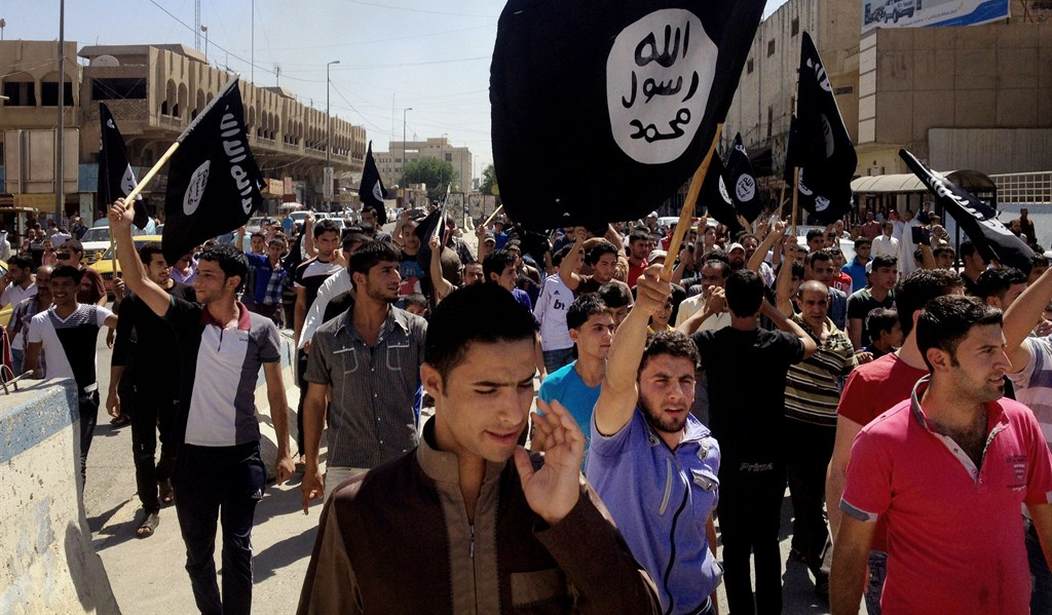
No reasonable person can dispute that the terrorist organization that now calls itself the Islamic State -- and that the administration usually calls ISIL -- is a force for evil and enemy of the United States.
The question is: What policies are most likely to stop -- or minimize to the greatest degree possible -- the damage this terrorist group can do to Americans and our friends?
To answer this question rationally, U.S. policymakers must take into account certain facts. These include: 1) The group the administration now calls ISIL existed before the U.S. invaded Iraq in 2003 and was involved in murdering an American before then. 2) It survived an eight-year U.S. occupation of Iraq and the death of its founding leader. 3) It has a broader base in the Islamic world today than before the 2003 invasion.
Twelve years ago, when then-Secretary of State Colin Powell presented the U.S. case against Saddam Hussein to the U.N. Security Council, part of his argument focused on a terrorist named Abu Musab al-Zarqawi, whom he said was in Iraq and whose group had been involved in the 2002 murder of a USAID official stationed in Jordan.
On June 5, 2008, the Senate Select Committee on Intelligence, then chaired by Democratic Sen. John D. Rockefeller IV, published a report entitled "Whether Public Statements regarding Iraq by U.S. Government Officials Were Substantiated by Intelligence Information." The report accepted that Zarqawi was in Iraq but not that al Qaeda had a "cooperative relationship" with Saddam's regime.
The committee said: "Postwar information supports prewar assessments and statements that Abu Musab al-Zarqawi was in Baghdad and that al-Qaida was present in northern Iraq."
However, the committee said: "Iraq and al Qaeda did not have a cooperative relationship. Saddam Hussein was distrustful of al-Qaida and viewed Islamic extremists as a threat to his regime, refusing all requests from al-Qai'da to provide material or operational support."
Recommended
The State Department Country Reports on Terrorism 2013 summarized the trajectory -- and name changes -- of Zarqawi's terror group in the years before and after the 2003 U.S. invasion.
"In the 1990s, Abu Musab al-Zarqawi, a Jordanian-born militant, organized a terrorist group called al-Tawhid wal-Jihad to oppose the presence of U.S. and Western military forces in the Islamic world and the West's support for and the existence of Israel," said the State Department.
"In late 2004," it said, "he joined al-Qaida (AQ) and pledged allegiance to Usama bin Laden. After this, al-Tawhid wal-Jihad became known as AQI. Zarqawi traveled to Iraq during Operation Iraqi Freedom and led his group against U.S. and Coalition Forces until his death in June 2006. In October 2006, AQI publicly re-named itself the Islamic State of Iraq ... "
"In April 2013," said the State Department, "AQI's leader Abu Bakr al-Baghdadi declared the group was operating in Syria and changed its public name to the Islamic State of Iraq and the Levant."
Nor did ISIL stop there.
"Particularly concerning has been the spread of ISIL beyond Syria and Iraq," Lt. Gen. Vincent Stewart, director of the Defense Intelligence Agency, said in the DIA's Worldwide Threat Assessment published last month. "With affiliates in Algeria, Egypt, Libya, the group is beginning to assemble a growing international footprint that includes ungoverned and under governed areas."
"ISIL has increased its presence and influence in Libya, particularly in Darnah, where it has begun establishing Islamic institutions," said the threat assessment.
Some now suggest the U.S. needs to put combat forces back into Iraq to defeat ISIL. But if U.S. forces on the ground are what it would take to eradicate ISIL, would we not need to put them into Syria and Libya, too, where ISIL has also established itself.
If an eight-year U.S. occupation of Iraq could not permanently eradicate the terror group Zarqawi started more than 15 years ago, how long would we need to occupy ISIL-ridden regions now to make sure we got the job done this time?
Having removed Saddam Hussein, we were unable to establish a new secular order in Iraq that was capable of suppressing militant Islamic radicalism -- even when we had military forces on the ground in that country for eight years. Having helped remove Gaddafi in Libya, without putting troops on the ground, we were also unable to establish a new secular order capable of suppressing militant Islamic radicalism.
One thing is clear: It should now be our policy to support -- not destabilize -- secular Middle Eastern and North African regimes that resist, for their own reasons, militant Islamic radicals.






Join the conversation as a VIP Member