


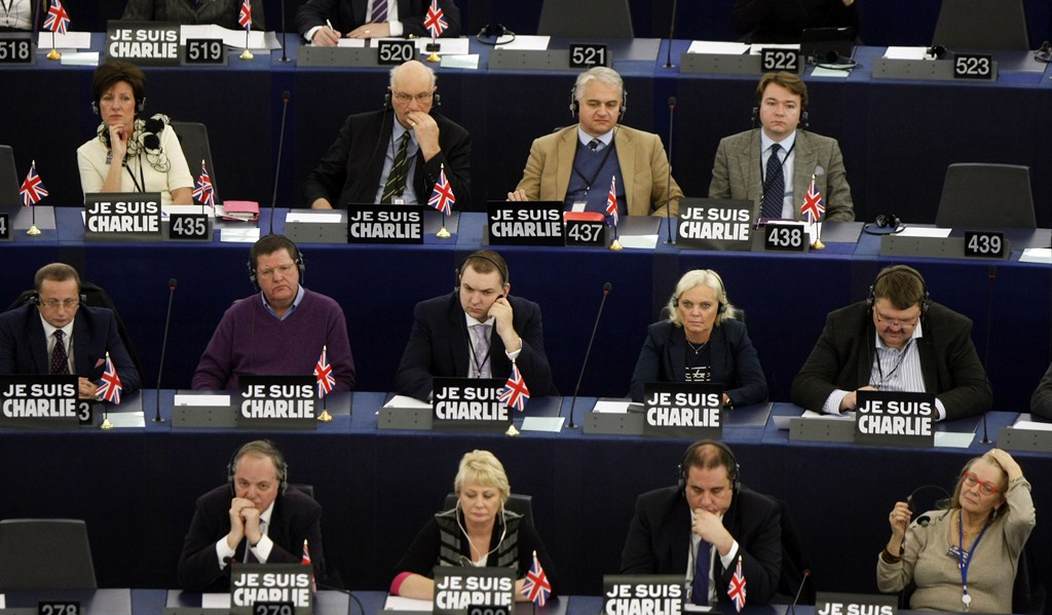
In the wake of last week's massacre at the satirical weekly Charlie Hebdo, perpetrated by men who saw death as a fitting punishment for the crime of insulting Islam, these were stirring words. If only they were true. Sadly, France and other European countries continue to legitimize the grievances underlying the barbaric attack on Charlie Hebdo by endorsing the illiberal idea that people have a right not to be offended.
It is true that France does not prescribe the death penalty for publishing cartoons that offend Muslims. But under French law, insulting people based on their religion is a crime punishable by a fine of _22,500 and six months in jail.
In addition to religion, that law covers insults based on race, ethnicity, national origin, sex, sexual orientation or disability. Defamation (as opposed to mere insult) based on any of those factors is punishable by up to a year in prison, and so is incitement to discrimination, hatred or violence.
In 2006, the Paris Grand Mosque and the Union of French Islamic Organizations used the ban on religious insults to sue Charlie Hebdo and its editor at the time, Philippe Val, over its publication of three cartoons depicting the prophet Muhammad, including two that had appeared in the Danish newspaper Jyllands-Posten the previous year. Although Charlie Hebdo won the case and Val escaped prison, the potential for such inquiries inevitably has a chilling effect on freedom of expression.
Since the mid-1980s, French courts have rejected religious-insult complaints against books (including Salman Rushdie's novel "The Satanic Verses"), movies (including "The Last Temptation of Christ"), movie posters (including one for "The People vs. Larry Flynt"), and written and oral commentary (including novelist Michel Houellebecq's 2001 description of Islam as "the stupidest religion"). They have been more receptive to complaints about a billboard lampooning "The Last Supper," a newspaper essay on the purported connection between Catholic doctrine and the Holocaust, and remarks by the actress Brigitte Bardot and the comedian Dieudonne M'bala M'bala, whose show was recently banned as anti-Semitic.
The point is not that the government has done a bad job of distinguishing between legitimate art or commentary and gratuitous offensiveness. In a free society, that is simply not the government's job. When courts are asked to draw this line, artists and commentators must try to anticipate whether their work will pass muster, which promotes self-censorship.
Worse, this system teaches people that the use of force is an appropriate response to words and images that offend -- a principle that is poisonous to free speech and conducive to violence. Since the French government has announced that offending the wrong people by saying the wrong thing in the wrong context can be treated as a crime, it would not be surprising if some people, convinced that their rights had been violated and that they could not count on the courts to vindicate them, resorted to self-help.
Other countries that criminalize "hate speech," including Germany, the Netherlands, the U.K., Sweden and Canada, are likewise sending a dangerous message that offending people with words or images is akin to assaulting them with fists or knives. Instead of facilitating censorship by the sensitive, a government truly committed to open debate and freedom of speech would make it clear, in no uncertain terms, that offending Muslims (or any other religious group) is not a crime.
Sacrilege may upset people, but it does not violate their rights. By abandoning that distinction, avowed defenders of Enlightenment values capitulate to the forces of darkness.








Join the conversation as a VIP Member