


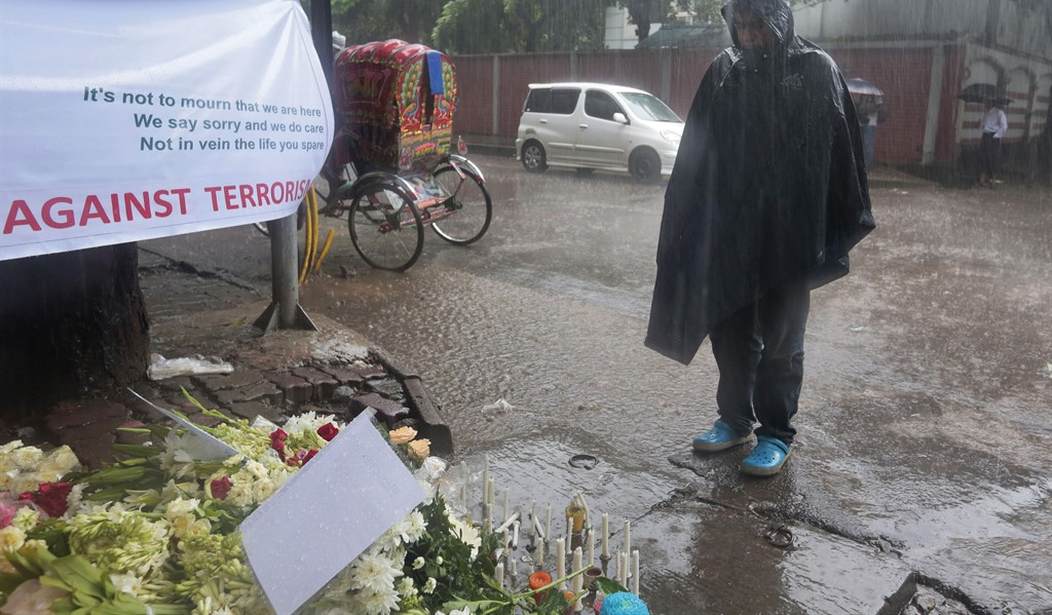
Over the past ten months, there have been more than 30 terrorist attacks in Bangladesh. In recent days, an Italian aid worker was gunned down as he went for a jog. Also shot to death was a Catholic priest. Two Hindu priests and a Buddhist leader were stabbed and hacked to death with machetes -- the same fate meted out to Bangladeshi-American writer Avijit Roy last year. Bangladeshi gay activists, secular bloggers and academics have been murdered as well.
Journalists, diplomats and human rights activists have paid scant attention. Despite being home to more than 160 million people, making it the world’s eighth largest nation and the third largest Muslim-majority country, Bangladesh can seem a bit of backwater compared to other places in the terrorist crosshairs, e.g. Turkey, the U.S., France, Belgium, Israel, Jordan and of course Syria and Iraq.
But last Friday, Bangladesh finally made the front pages when six militants shouting “Allahu akbar” took hostages at the Holey Artisan Café in a cosmopolitan neighborhood of Dhaka, the nation’s capital. According to a communiqué from the Islamic State, the attack was aimed against “the people of the Crusader countries.” Yes, to these self-styled holy warriors, foreign aid workers and investors are 21st century Knights Templar.
On Saturday, 100 Bangladeshi commandos stormed the restaurant. They found that 20 hostages -- including Japanese development consultants, Italian businessmen, and an American college student, Abinta Kabir -- had already been murdered “mercilessly by sharp weapons,” according to Army Brig.Gen. Nayeem Ashfaq Chowdhury.
The Daily Star, a Bangladeshi newspaper, reported that the terrorists had applied a religious test: They asked the hostages to recite from the Koran; those who couldn’t perform were tortured.
In the end, the commandos managed to rescue 13 hostages. As for the terrorists, five were killed and one was arrested. All have now been identified as young, well-educated Bangladeshis from affluent families – not victims of poverty, lacking prospects and hope. They had reportedly been communicating with Islamic State operatives in the Middle East.
Recommended

Two policemen also lost their lives in the assault. It could have been worse. General Chowdhury told reporters: “We have recovered a huge cache of IED explosives and AK-22 assault rifles.”
“What kind of Muslims are these people?” Bangladesh Prime Minster Sheikh Hasina asked in a television address just after the bloodletting ended. I suspect she knows the answer: They are Islamic supremacists, sworn enemies of America and the West, believers in jihad as the overriding religious obligation of Muslims, fanatics eager to kill and be killed in pursuit of power and the dream of building a new caliphate.
The attack followed by just a few days the suicide bombing at Istanbul’s international airport that killed 45 people. Why are Muslim terrorists targeting Muslim-majority countries? In part, because they intend to “cleanse” these countries of despised “infidels.” In part, to show the locals whom they need to fear and obey.
As for the Muslim leaders of these countries, they are viewed by the jihadis as either insufficiently devout (Sheikh Hasina last month arrested 120 suspected militants) or lacking “correct beliefs” (Turkish President Recep Tayyip Erdogan, though closely linked to the Muslim Brotherhood, has been pursuing rapprochement with Israel and Russia).
Is a war taking place within Islam? Actually, multiple wars have been fought with the Islamic world throughout its 1,400-year history. In Syria and Iraq, day in and day out, Sunni jihadis battle Shia jihadis. In Pakistan, Sunni extremists frequently attack the Shia minority and the government has ruled the Ahmadi sect heretical. In Sudan, the black Muslims of Darfur continue to be persecuted by the country’s Arab rulers.
Bangladesh itself was born of intra-Muslim conflict: Originally the eastern territory of Pakistan, the Muslim state carved out of India as the sun set on British Empire’s in the wake of World War II, it eventually rebelled against severe discrimination by West Pakistanis – fellow Muslims, to be sure, but ethnically, culturally and linguistically quite distinct.
West Pakistan responded brutally, massacring millions. As many as 10 million refugees fled to India. With strong support from India -- in particular, from Maj. Gen. J.F.R. Jacob, a Jewish Indian military hero (who died in January at 92 years of age) – the Pakistani army was forced to back down and Bangladesh became an independent nation in 1971.
As for the global conflict between Islamic radicals and moderates, it’s hardly a fair fight. Case in point: Two weeks ago in Karachi, Amjad Sabr was gunned down by the Pakistani Taliban. Like his father before him, he had been a famous and beloved entertainer who sang Qawwali devotional music, an ancient Sufi Muslim tradition.
However, to the Pakistan Taliban, al Qaeda and the Islamic State, the Sufi interpretation of Islam – mystical and at this point in history tolerant – is pure heresy. And, in their view, heretics deserve only death.
What are the million of Sufis in Pakistan, Africa and other parts of the world to do? How can such Muslims defend themselves? If the U.S. were leading a serious, concerted and multifaceted offensive against Islamic radicalism, jihadism, Islamism – call it what you will – such Muslims could be important and useful allies.
Instead, however, the US is waging a half-hearted campaign against “violent extremism” driven by “grievances.” President Obama has turned his back on both Iranian and Syrian dissidents. He insists that religious faith and terrorism are in no way linked. Might the next administration take a more robust and strategic approach to combating Islamists? It’s possible but were I an anti-Islamist Muslim I don’t think I’d bet my life on it.
Clifford D. May is president of the Foundation for Defense of Democracies (FDD) and a columnist for the Washington Times. Follow him on Twitter @CliffordDMay







Join the conversation as a VIP Member