



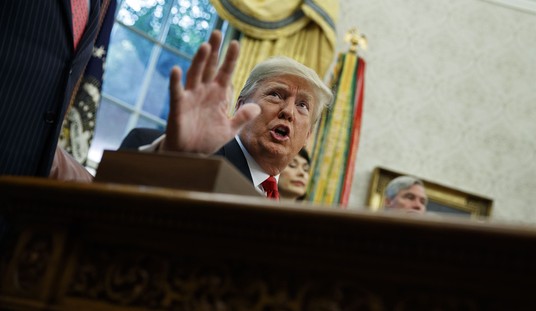
Trump's pivot consisted of two phone calls, one with Taiwan's president and the other with the president of the Philippines.
The explicit topics discussed matter, but the critical fact is that Trump spoke with the Asian leaders. Taking the personal calls sends a diplomatic message. In Taipei and Manila, it is a message of reassurance and support. Taiwan, the Philippines and several other Asian nations confront a China pursuing increasingly militant and expansionary policies in the South China Sea and northeast Asian littoral.
Beijing had a different take on Trump's conversations -- particularly his chat with Taiwan. The Chinese government appeared to be shocked. Beijing regards Taiwan as a province of China, not a separate country. China insists on a "One China" policy. Since the U.S. recognized the Communist regime in Beijing as China's government, American presidents have deferred to Beijing's wishes and avoided overt contact with Taiwan's leaders.
Trump isn't president -- not yet. His phone calls, however, indicate he may not practice "business as usual."
Trump's decision to speak with Taiwan's president should be what I'll call an "expected surprise." Surprise is a component of Trump's "art of the deal." (Advice to Beijing: Go brush up on Sun Tzu's "Art of War.")
Frankly, China's Communist government has earned a mild shock or two, perhaps two dozen mild shocks.
President Barack Obama's "Asia pivot" gave Beijing a mild and overdue shock. The term "Asia pivot" served as Obama Administration shorthand for shifting American strategic focus from the Middle East to East Asia.
The Reagan Administration foresaw China's rise to regional power status. Every subsequent administration has sought to peacefully manage the complex and intricate U.S.-China relationship. Obama Administration officials concluded that East Asia's economic vitality and China's growing power made the region the world's key geo-political theater.
Moreover, friction with Beijing was increasing. In the 1990s, China began asserting its claims to the South China Sea with muscular displays of military and economic power. Beijing reinforced its naval presence in the region and began an artificial island construction program.
That's right -- creating land in a sea zone. China's neighbors argue Beijing's program amounts to conquest with concrete braced by steel, and they're right. The concrete transforms what international law calls "sea features" into fake islets big enough to support airfields for combat aircraft. These man-made islets become immobile aircraft carriers.
In this decade, the territorial grabs became more persistent and more threatening (particularly to Vietnam and the Philippines). So the Obama Administration's pivot emphasized reallocating military resources to the region and strengthening diplomatic and economic ties with smaller Asian nations confronting China's "slow imperialism."
China claims sovereignty in the South China Sea from its mainland to what Beijing calls the "nine-dash line." This boundary line dips south for hundreds of kilometers from China's southern coast to near the island of Borneo. Beijing's gargantuan claim puts it in direct conflict Malaysia, Indonesia and Singapore as well as Vietnam and the Philippines.
Action stirs reaction. These nations are slowly forming a de facto anti-Beijing alliance. The de facto alliance, however, is fragile without U.S. support.
The U.S. has certainly provided the southeast Asians with rhetorical support. Washington has strengthened its security ties with the Philippines and begun providing Vietnam with some security assistance. The U.S. has also quietly but firmly sided with Japan in its maritime territorial conflicts with China.
However, Beijing and the rest of the world took notice when the Obama Administration failed to back up its Syrian "red line" threat and its feeble response to Russia's February 2014 invasion and annexation of the Crimean peninsula. The Obama Administration appeared feckless and weak. In the summer of 2014, China increased its aggressive actions in the South China Sea. The smaller nations wondered if the U.S. would support them if China "Crimea-ed" their territory.
Trump's phone calls -- as well as his campaign promises to pursue "fair" trade -- tell China that the incoming administration understands both "art of the deal" and "Art of War."






Join the conversation as a VIP Member