






The partisan divide in the United States, unsurprisingly, has widened.
In a survey conducted by the Pew Research Center, when it comes to the issues of government helping the poor, racial discrimination, immigration, and how the United States can best achieve peace, the differences between the Republican and Democratic parties are night and day.
According to Pew:
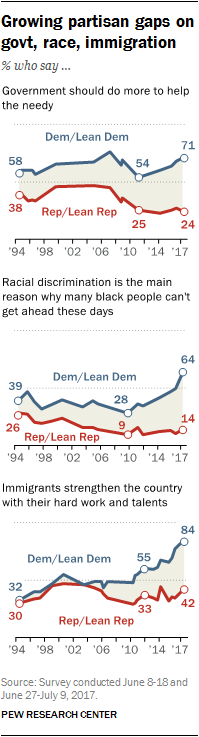
Across 10 measures that Pew Research Center has tracked on the same surveys since 1994, the average partisan gap has increased from 15 percentage points to 36 points.
While many saw President Barack Obama as the "divider-in-chief," and while partisanship reached an all-time high during his time in office, during President Trump's first year in the Oval Office the partisan gap has only grown.
This partisan gap has not widened because the opinions of both parties are moving in opposite directions, however. Rather, Republican opinion on certain issues has only changed slightly if not at all compared to the exponential changes seen in Democratic opinion.
Seventy-one percent of Democrats believe the government should do more to help the needy even if it means the government incurs more debt while 24 percent of Republicans hold the same opinion. Over the last six years, Democratic opinion on the issue has grown by 17 percent while the Republican view decreased by one percent.
These results can explain the partisan divide over health care policy as one party believes in more government spending and a larger federal government to provide the needs of people, while the other tends to support decreases in government spending and believes in a smaller government which gives more power to the states and individuals to help Americans.
As with the division over health care policy, the same can be seen with immigration policy as 84 percent of Democrats say that immigrants strengthen the country while 42 percent of Republicans hold the similar view. Both parties, though the Democratic party has far outpaced the Republican Party, have had a better outlook on the contributions of immigrants to the country since 1994.
See the graphs below.
Due to this partisan divide, finding bipartisan support when it comes to the issues of health care and immigration is going to be virtually impossible, as was seen with the several failed attempts to repeal and replace Obamacare. With a Republican president in office, Republican voters may feel comfortable with the direction in which the country is heading. At the same time, Republicans, primarily those in the Senate, may want to get their acts together to pass legislation supported by Republican voters as President Trump has shown the willingness to go after members of his own party as well as work with Democrats. President Trump is a president who will play the political game with both sides of the aisle if he has no other choice, and whatever he accomplishes with one side of the aisle will be far different than what could have been with the other.

Join the Conversation
VIP members get the ability to comment on articles.