





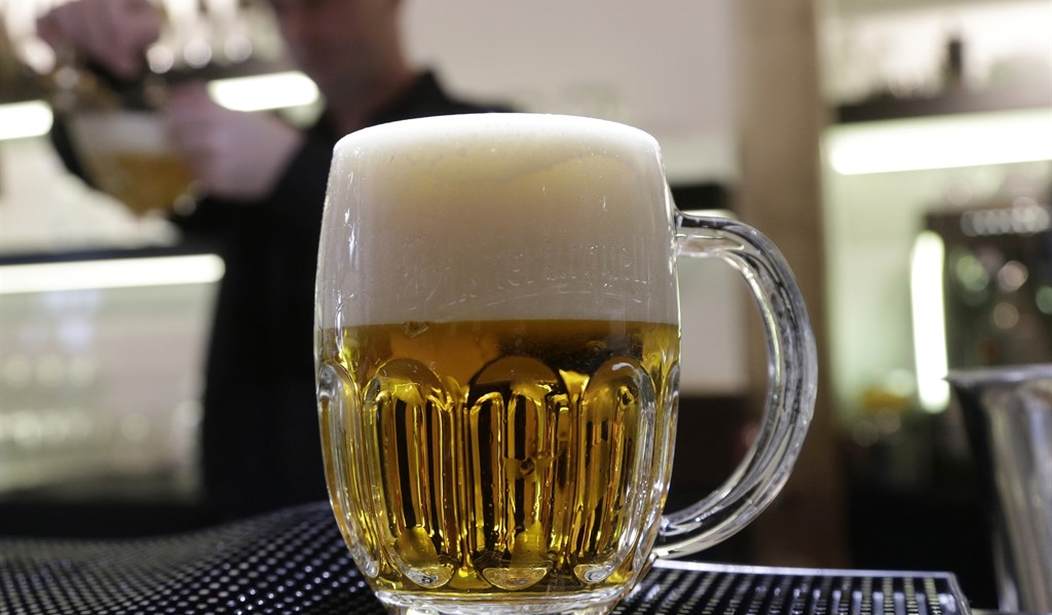
Qatar has been slammed for pulling one of the biggest bait and switches of this century, reneging at the last minute on its agreement to allow beer sales in and around stadiums at the Budweiser-sponsored 2022 World Cup.
"Well, this is awkward," Budweiser's official Twitter account said in response to news of the reversal in a now-deleted tweet.
FIFA president Gianni Infantino sought to downplay the development, telling “livid” fans they’ll “survive” without drinking “for 3 hours a day.”
Making matters worse, the decision only affects ordinary fans since FIFA officials and VIPs can still drink in $30,000+ luxury suites.
But the beer debacle has overshadowed a much more significant issue with the games: Qatar’s abysmal human rights record.
Questions are being raised over how the Muslim country won its bid to host the games given it was completely lacking in the infrastructure necessary to host a large tournament. In creating it, however, Qatar essentially used modern-day slavery.
An estimated 2.9 million people live in Qatar. Only 380,000, or 13%, are Qatari citizens. Qatar’s citizenry is exceptionally wealthy, thanks to the country’s state-owned natural gas company and the rest of the world’s reliance on that natural gas. Qatar emits more carbon dioxide per capita than any other country on the planet.
Most everyone else in Qatar — the vast majority of the population — is desperately poor, forced to work, left to suffer. Many are South Asian migrant workers from Nepal, Sri Lanka, India and Pakistan. They come to Qatar in an attempt to make a little bit of money for their families back home, even though they know going in that the odds are stacked against them from the get-go. They often have to take out loans for exorbitant, illegal recruitment fees (bribes, really) just to pay their way to Qatar for work. If they die in Qatar, their families are burdened with their debt. Rolling Stone reported on one such case, in which a starving Nepalese widow named Manju Devi says she got on her hands and knees and begged loan sharks to forgive her family’s $10,000 debt after her husband died in Qatar of a heart attack, a common occurrence due to the excessive work in the excessive heat.
Qatar’s ruling class absolves itself of responsibility for the labor conditions of major infrastructure projects — including the construction of World Cup venues — by using contracting firms that, until a few years ago, were bound to essentially zero labor laws and no oversight. As a result, the laborers in Qatar are something closer to slaves or indentured servants. They have almost no rights and little recourse when they’re mistreated. They’ve been commanded to work terrible hours, with breaks only enforced in the middle of the afternoon to prevent too much of the workforce from dying off due to the Middle East’s brutal heat. They sleep and eat in overcrowded worker colonies. They have reported being physically and verbally abused by unforgiving bosses. They're fed terrible food. They're encouraged to push through obvious injuries. They're constantly victims of wage theft. They have a hellish time leaving Qatar of their own volition, because their passports are held hostage by contracting firms. (SFGATE)
How many slaves have died will likely never be known, but estimates put the number around 6,500 - a far cry from the 37 Qatari officials claim. But death isn't the only tragedy from construction.
Countless other migrants have been maimed by their work on rushing the stadiums up. A recent Time Magazine feature revealed the treatment of one such migrant, Surendra Tamang, a man from Nepal. Tamang arrived in Qatar in 2015 with high hopes for his construction gig. By October 2021, he had extinguished his usefulness to Qatar and was sent back home. He arrived at a Nepal hospital “in debilitating pain, both his kidneys had given out, wrecked by working long hours of hard labor in punishing heat, according to his doctor.” As Tamang told Time, “I used to have dreams.” He’s 31 and will likely be on dialysis for the rest of his life. (SFGATE)
As the SFGATE report goes on to note, the government's "treatment of slaves is the story" and the only one that matters about the 2022 World Cup, which it calls "diabolical, unconscionable, truly evil" and "irredeemable, from start to finish, no matter what happens next."
People are more pissed about this than the untold number of Nepalese slave workers that died at a rate of *one per day* while building these soccer stadiums.
— Jesse Marshall (@jmarshfof) November 18, 2022
44 Nepalese workers died from June 4 - August 8. https://t.co/P15VYfK9V6
People are outraged that the Qataris banned beer in the stadiums but they don't care about the fact that those stadiums they're seated in were built by actual slaves.
— Jordan Schachtel @ dossier.substack.com (@JordanSchachtel) November 21, 2022

Join the Conversation
VIP members get the ability to comment on articles.