





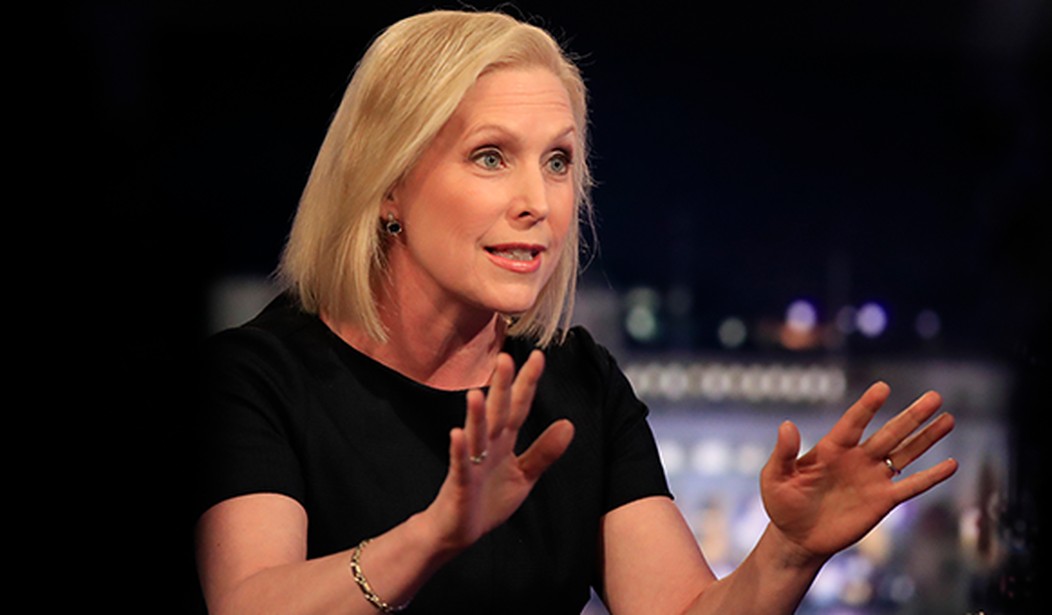
A handful of Democratic Senators signed onto an amicus curiae brief in New York State Rifle and Pistol Association v. City of New York, defending New York City's blatant attack on the Second Amendment. For years, those who live in NYC could transport handguns, as long as it was to a few select gun ranges in the area. If you were a gun owner in NYC and wanted to take your firearm outside of city limits to a different gun range, that wasn't allowed.
The Senators who signed alongside New York City include Sheldon Whitehouse (RI), Mazi Hirono (HI), Richard Blumenthal (CT), Dick Durbin (IL) and Kirsten Gillibrand (NY).
According to the group, the Supreme Court should not take up this case because the plaintiffs – gun rights advocates – are looking to "thwart gun safety legislation" and have the desire to "expand the Second Amendment." The other argument they make: the Second Amendment and gun control is a political issue and the Supreme Court is supposed to be impartial, not a legislative body.
Translation: gun control proponents have realized this is a lost cause and, if the Supreme Court decided in the case, this could expand gun rights, not restrict them. This case could and would, more than likely, build upon both Heller and McDonald, which protects a person's right to own a firearm in their home for self-protection.
From the brief (emphasis mine):
The judiciary was not intended to settle hypothetical disagreements. The Framers designed Article III courts to adjudicate actual controversies brought by plaintiffs who suffer real-world harm. This reflects the Framers’ intent that the judiciary “may truly be said to have neither force nor will but merely judgment.” The Federalist No. 78, 464 (C. Rossiter ed. 2003) (A. Hamilton) (capitalization altered).
"Real-world harm."
Apparently being limited to where you can take your handgun for self-protection isn't "real-world harm."
Apparently a city infringing on a person's Second Amendment rights isn't "real world harm."
So tell us, Senators, what exactly do you deem "real world harm?" We're waiting.
The rationale for this long-settled principle is simple: “this Court is not a legislature.” Obergefell v. Hodges, 135 S. Ct. 2584, 2611 (2015) (Roberts, C.J., dissenting). “It can be tempting for judges to confuse [their] own preferences with the requirements of the law,” id. at 2612, and to legislate political outcomes from the bench. But a judge “is not a knight-errant, roaming at will in pursuit of his own ideal of beauty or of goodness.” Benjamin N. Cardozo, The Nature of the Judicial Process 141 (Yale Univ. Press 1921). Accordingly, justiciability doctrines, such as standing and mootness, have evolved to serve as an “apolitical limitation on judicial power,” confining the courts to their constitutionally prescribed lane. John G. Roberts, Jr., Article III Limits on Statutory Standing, 42 Duke L.J. 1219, 1230 (1993). In short, courts do not undertake political “projects.” Or at least they should not.
Yet this is precisely—and explicitly—what petitioners ask the Court to do in this case, in the wake of a multimillion-dollar advertising campaign to shape this Court’s composition, no less, and an industrial-strength influence campaign aimed at this Court. Indeed, petitioners and their allies have made perfectly clear that they seek a partner in a “project” to expand the Second Amendment and thwart gunsafety regulations. Particularly in an environment where a growing majority of Americans believes this Court is “motivated mainly by politics,” rather than by adherence to the law, the Court should resist petitioners’ invitation.
The Supreme Court is the highest law in the land. It is the final decision maker and the protector of our Constitutional rights. The justices are supposed to be unbiased, but guess what? We know they're not. We know that some believe in a strict originalist interpretation of the Constitution. Others believe the Constitution is a living document that evolves over time. Anyone who tries to tell you the Court doesn't have activist judges is straight up lying.
That's why we know RBG, Sotomayor, Bryer and Kagan are pretty much guaranteed to side with liberals. It's why we know Kavanagh, Gorsuch, Thomas and Alito almost always side with conservatives. Roberts is the toss up.
Democrats can argue that the Court shouldn't get involved in political issues, but it's the dumbest argument they can make. Pretty much every single case the Supreme Court hears is a political issue of some sort. There's a question of Constitutionality that needs to be addressed. If there wasn't, the Court wouldn't get involved.
Gun control proponents, like these Senators, are backtracking because they've realized they put their foot in their mouth. They've realized this case is a big loser for them and it can actually harm their cause.

Join the Conversation
VIP members get the ability to comment on articles.