
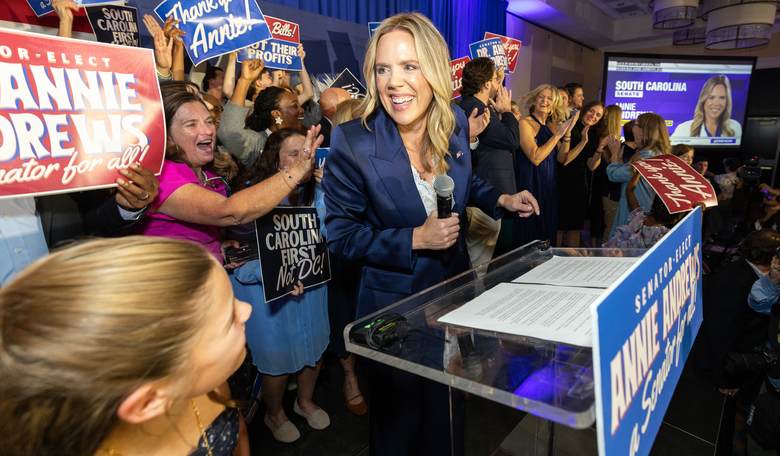
Democrat Annie Andrews pulled off an epic upset. It’s South Carolina. It’s Republicans. It’s deep-red. It’s Sen. Darline Graham, the late Sen. Lindsey Graham’s sister — what could go wrong? Apparently, a lot. Her roots could be traced back to her debate with Ralph Norman in the runoff, where she displayed an appalling interest in foreign affairs. She was asked about Taiwan, the South China Sea, and our national security concerns there vis-à-vis China. Her answer was pretty much, ‘this ain’t my thing.’
“I’m just gonna be honest—I’m not that informed on national security,” she said.
We’re bombing Iran. The Senate is crucial in making decisions on these matters. It’s a chamber not solely dedicated to domestic affairs, and your late brother was all about this stuff — it was a disqualifying answer. It showed she wasn’t ready for prime time. She could serve the interim period, but not a full six-year term.
And then Democrat Annie Andrews comes out of nowhere, from the proverbial sacrificial lamb to a U.S. senator. Since this race was seen as unwinnable for Democrats, we’re now learning about Andrews, who, to the GOP’s horror, seems to have good political instincts. She also has no shortage of confidence, as noted in a Semafor piece, where she said outside help from national Democrats would be appreciated but not necessary. Andrews exploited divisions within the GOP field, specifically Ralph Norman’s camp. It was sneaky good, but paid off in an internal poll that had Andrews up three points over Graham. They kept it quiet to avoid drawing attention. When that attention did come, it was too late (via Semafor):
As soon as Republican Sen. Darline Graham won the GOP nomination to replace her late brother in August, Democrat Annie Andrews made her move.
Andrews immediately began spending more than $5 million on advertising in South Carolina’s Senate race at a moment when she largely had the airwaves to herself as her new opponent struggled to raise money. At the time, Republicans were racing to prioritize other competitive races across the country — and most people in both parties still saw South Carolina as a pipe dream for Democrats.
But by October, when the rest of the country began tuning into South Carolina — and spending money — Andrews quietly became the frontrunner, according to internal campaign details shared with Semafor following her victory on Tuesday.
On Oct. 5, the Andrews campaign received a poll showing her with a 3-point lead over Graham. But the Democrat’s campaign decided against publicly releasing the poll — or any subsequent internal poll — showing Andrews with a lead over Graham, wary of drawing too much attention from national Republicans and jeopardizing a peak at the right time, according to Chas Goldman, a strategist for Andrews.
The last time a Democrat was elected to the U.S. Senate was in 1998.