
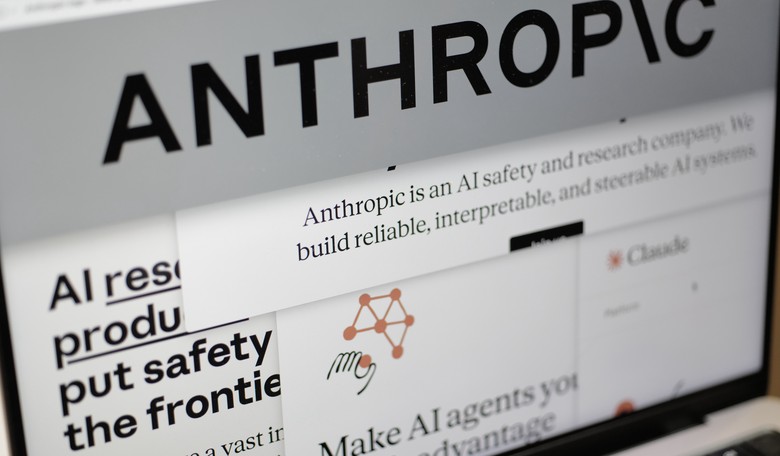
It can seem as though no one can imagine a future in which AI does more good than harm. Tao Lin, who works on AI safeguards at Anthropic, offered one particularly bleak forecast in an interview earlier this week.
Speaking in a personal capacity to Palisade Research, a California-based nonprofit that studies AI capabilities “to prevent loss of control,” Lin said he believes AI will eventually make every human on Earth unemployable, leaving people entirely dependent on government welfare.
Anthropic Researcher Tao Lin: Pretty much all humans on earth will become permanently unemployable because of AI "It's very likely that pretty much all humans on earth will become permanently unemployable" "And will need to strictly rely on government welfare to sustain themselves" "Human employment will go away."
— jesse (@jessexai_) November 17, 2026
"Pretty much all humans on Earth will become permanently unemployable," he said. "[They] will need to strictly rely on government welfare to sustain themselves and human employment will go away."
Lin went on to say that he expects “broadly superhuman AI,” systems matching or surpassing the best human experts in almost every field, around the end of 2027. But he expects mass unemployment to come much later, because deploying AI across the workforce and building robots to replace human labor will take time. Instead, his dystopian scenario unfolds gradually. People move from their current jobs into temporary alternatives before AI eventually replaces them altogether.
More concerning still, Lin described his view as broadly shared in the AI safety community and at Anthropic. He called for AI research to slow to a quarter of its current pace, saying people “should be angry at me and everyone else developing AI.”
Dystopian predictions have shadowed AI since its inception, leaving people unsure whether they are hearing a worst-case scenario or a forecast of where we are actually headed. Anthropic has been among the most prominent voices warning of that future. But there are several reasons to question such a bleak outlook.
First, several AI researchers and tech leaders have poured cold water on these dystopian predictions. Dystopia, believe it or not, helps sell the product. The more powerful and world-changing AI sounds, the more attention it attracts, and the more indispensable it seems. And if that is not enough reason to question these predictions, it is worth asking why the open-source AI community seems less consumed by the same visions. Companies like Anthropic and OpenAI stand to gain not just customers, but government restrictions that could make life harder for their smaller, less organized competitors.
Second, others have chalked up the doom to a kind of fantasy that pervades Silicon Valley. The idea that robots and AI will replace humanity has long occupied the tech world’s imagination. At some point, it becomes difficult to tell whether these are genuine concerns about the technology or a dark fantasy being projected onto it.
Finally, every major technological advance has brought warnings about its power, its risks, and its potential to replace workers. Those transitions have often been painful, but humanity has continued to find new work and become better off. None has led to the permanent replacement of all human labor. Why should AI be any different?
Better yet, why shouldn’t the prospect of AI fill us all with hope? Already, it is helping solve mathematical problems that have long perplexed mathematicians, helping researchers search for cures for cancer and other diseases, and helping doctors diagnose patients more accurately so they receive the right treatment. It is improving scientific models, expanding access to communication, and automating tedious tasks that nobody wants to do. From transportation and cybersecurity to detecting financial fraud, it's potential reaches across the economy, and with it comes the possibility of better lives for us all.
But look at the news, and so much of what we see is fear. Humanity has always adapted, always invented, and always sought to improve its condition. That spirit has been especially powerful in the United States, where the belief that tomorrow can be better than today has inspired generations to build what once seemed impossible.
New technology should be a cause for hope. A chance to solve problems that have plagued us from the very beginning, freeing people from exhausting labor, and bringing health and prosperity within reach of more of humanity. AI need not mark the end of humanity. It will help carry us into a new age of discovery, abundance, and human achievement.