
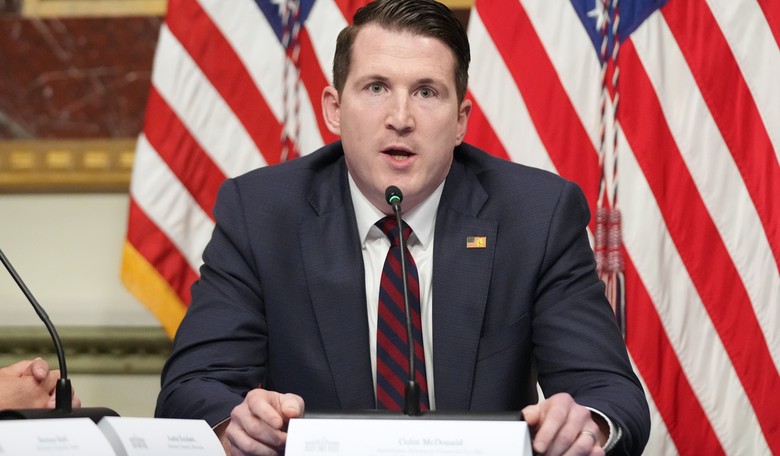
The Department of Justice announced Thursday a nationwide crackdown on student aid fraud dubbed “Operation Ghostbusters,” unveiling charges against five defendants and the seizure of more than $750,000 in cryptocurrency.
Among the cases announced was an indictment involving an alleged scheme in which a Kenyan national and associates in Kenya stole Americans’ identities and used artificial intelligence to enroll “ghost students” in college, register them for classes, complete assignments, and collect taxpayer-funded financial aid.
.@AAGMcDonald breaks down the results of Operation Ghostbusters—a @DOJ investigation into a large-scale federal student loan fraud scheme: "Today, we are announcing charges against five defendants and the seizure of more than $750,000 in cryptocurrency tied to this scheme and laundered through a network associated with Kenyan nationals."
— Rapid Response 47 (@RapidResponse47) October 29, 2026
According to Colin McDonald, assistant attorney general for the Justice Department’s National Fraud Enforcement Division, Francis Mogambi, a Kenyan national indicted by a federal grand jury in Nebraska, allegedly worked with associates in Kenya to steal Americans’ identities, enroll “ghost students” in college, and collect federal student aid payments.
The alleged scheme went beyond simply submitting fraudulent applications. Participants used artificial intelligence to complete paperwork and coursework, creating the appearance that the students were actively attending classes. The goal was to keep them enrolled as long as possible so that financial aid payments would continue. After tuition and fees were paid, the remaining funds were allegedly routed through intermediaries in the United States and sent overseas.
Mogambi had already been charged in Nebraska with second-degree forgery, a Class 2A felony, and it is unclear what his legal status in the United States is.
BREAKING: The DOJ is exposing a major student loan fraud scheme targeting Americans who never attended college, with stolen identities allegedly used to create fake students and obtain taxpayer-funded financial aid. Assistant Attorney General Colin McDonald says fraudsters are using AI to complete college applications, submit coursework, and even create the appearance of students attending virtual classes, tricking schools into believing real people are enrolled. "Some even create the appearance of a fake student in an online classroom to trick schools into believing a real person is present... The goal is to keep the ghost student in school for as long as possible."
— Fox News (@FoxNews) October 29, 2026
The fraud bust highlights a familiar problem with overly generous federal subsidies and a central concern behind the Trump administration’s fraud crackdown. When the federal government makes large sums of money available, fraudsters have an incentive to find increasingly creative ways to claim a share. Many will be quick to say the problem is simply that the money went to the wrong people, foreigners rather than Americans. But that overlooks the broader question of whether the government should be so generous in the first place.
Conservatives have long argued that Americans should take responsibility for themselves, especially economically. Yet decades of public policy have focused on how much money the government can collect from taxpayers and redirect toward redistributive programs.
The problem lies in the redistribution itself. Federal student aid has become an overly generous subsidy rather than a limited form of assistance, and the response to fraud is always to demand more safeguards rather than question the spending. If we want fewer schemes like this one, the government needs to hand out less money, not keep expanding these programs and then ask taxpayers to pay for policing them, too.