





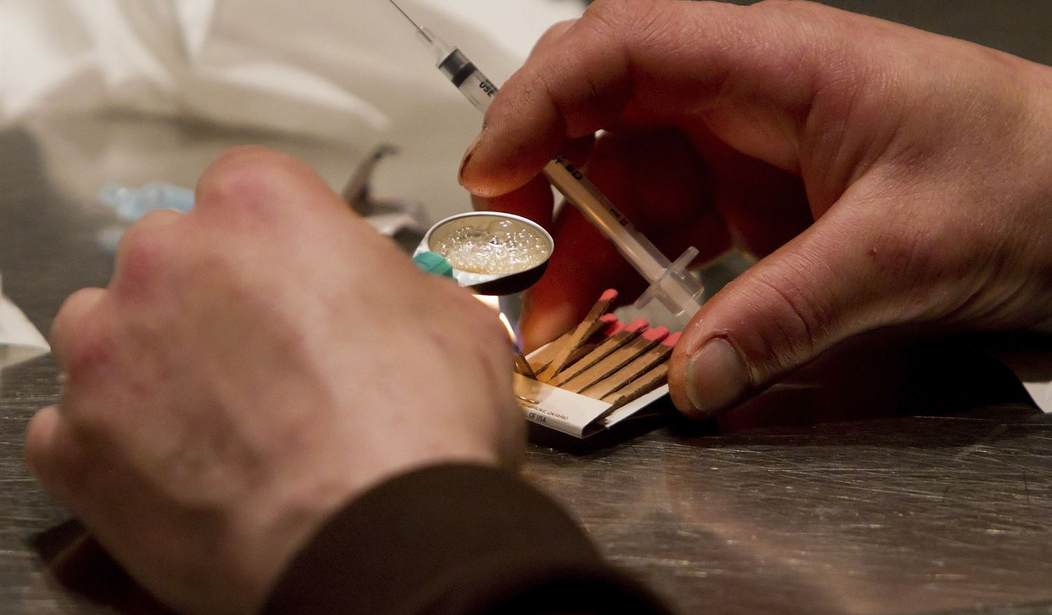
Philadelphia has just had a great week with the Eagles winning the Super Bowl. But now some city leaders are focused on a radically different competition.
Call it the Syringe Bowl.
It pits Philadelphia against San Francisco, and perhaps one or two other cities, to see which one will be first to provide local heroin addicts with facilities where they can inject themselves with poison.
On federally funded NPR last month, reporter Bobby Allyn of WHYY, the NPR affiliate in Philadelphia, explained, as host Terry Gross put it, "how and why some local officials and public health advocates are trying to make Philadelphia the first city in the U.S. to open a legally sanctioned safe injection site."
Allyn summarized what would happen there.
"So how a safe injection site typically works is, someone will come from off the streets into this facility, and they will bring their own drugs," Allyn said. "If the user wants, the drugs can be tested for fentanyl, that very potent synthetic. And it's done very quickly. ...
"Medical staff are sort of waiting, watching, supervising and providing clean, sterilized equipment," said Allyn.
"So, they're providing, you know, all the things you need to do heroin," he said.
"There's this thing called a cooker. They're given needles. They're given clean swabs," he said. "And this way, the people who are using won't contract infectious diseases like Hepatitis C or HIV.
"And nurses are standing by watching people essentially shoot up with oxygen and the overdose-reversing drug naloxone," he said. "And when they're done, they go into what's known as this chill area. And there, their breathing is monitored, and other vital signs are monitored.
"And from that point," Allyn said, "they're kind of released back onto the streets."
Presumably, this is so they can be good constructive citizens, who happen to be high on heroin -- and who will no doubt be in search of whatever resources they need to obtain more heroin so they can return to the official injection center and shoot up again.
Columnist Heather Knight of the San Francisco Chronicle published a report this week suggesting that the City by the Bay will beat Philadelphia -- and also Baltimore and Seattle, which are also reportedly considering it -- by opening two "safe injection sites" in July.
"Barbara Garcia, director of San Francisco's Department of Public Health, said Monday that she's tending to the details, including where the facilities will be located," Knight reported.
The city won't "initially" provide the funding for the sites because they know the facilities will violate both state and federal law.
"The safe injection sites will initially be privately funded, though Garcia wouldn't say where the money's coming from," Knight reported. "She said that will help the city avoid liability, since intravenous drug use is against state and federal law."
The current mayor of San Francisco, Mark Farrell, favors the heroin-injecting sites.
"I understand the misgivings around it and some of the rhetoric from people who don't support it, but we absolutely need to give it a try," he told the Chronicle.
California State Sen. Scott Wiener, Knight reported, is pushing to enact a state law that would guarantee that people associated with the heroin-injecting facilities "don't face arrest."
The bill has stalled in the state senate, but that may not stop San Francisco.
"I'm fully supportive of the city moving forward, just like we did with needle exchange before it was technically legal," Wiener told the Chronicle.
Thus, the headline on Knight's column: "SF safe injection sites expected to be first in nation, open around July 1."
The advocates of heroin-injection centers argue they can help lead addicts away from heroin injection.
"Now, during this process, if they want, they can be directed toward detox and other drug treatment programs," Allyn said on NPR. "And that's been a big selling point for the advocates, the so-called harm reductionists who are very much in support of these safe injection sites."
But if San Francisco and other cities succeed in opening facilities where people can inject heroin with impunity and then walk back onto the streets, it will not only be doing harm to non-heroin users but also to addicts and would-be addicts.
The advocates of "safe injection sites" are essentially arguing they can facilitate the non-use of an extremely addictive drug by first facilitating its use.
The truth: Any use of heroin is wrong. No one should ever facilitate it.
The heroin trade should be attacked at every phase: Ideally, every opium field would be destroyed. To the degree they survived, not an ounce of heroin should be allowed to cross our border. Every trafficker who tried should be jailed.
If someone is discovered on the streets using heroin -- because we failed to destroy it at the source, intercept it at the border, or incarcerate those who smuggled it -- they should not be imprisoned.
Nor should they be pointed to a government-sanctioned facility that helps them use it.
They should be brought to a shelter that helps them never use it again.


Join the Conversation
VIP members get the ability to comment on articles.