





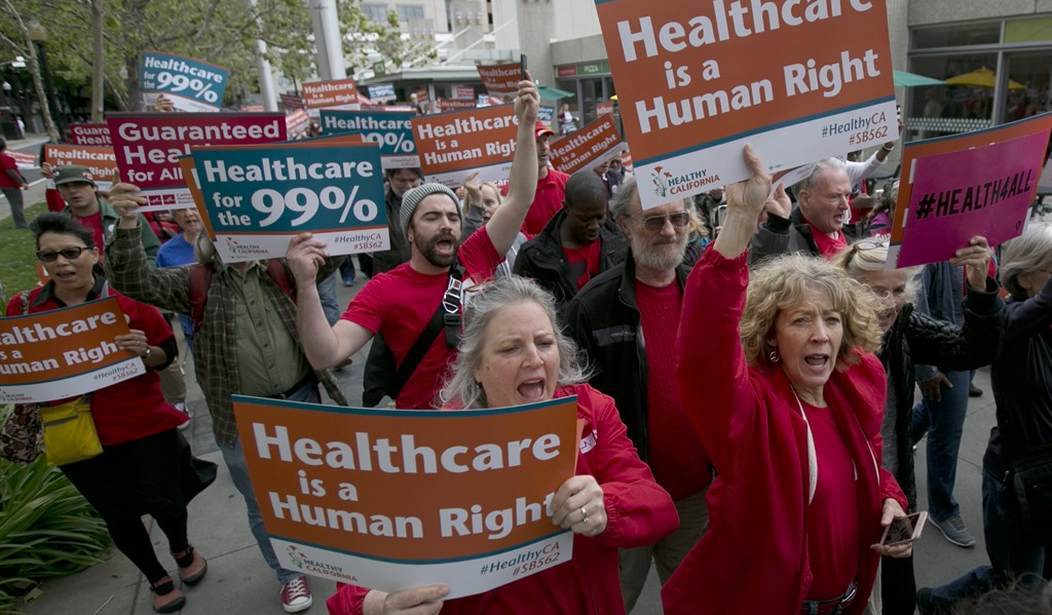
The other day, Rep. Tom MacArthur, R-N.J., held a town hall meeting where constituents grilled him about his role in passing the American Health Care Act. When he claimed the insurance market is "collapsing," a chant went up: "Single-payer, single-payer!"
That chant will be heard again, and it should worry Republicans. It reflects the fact that their replacement for Obamacare is unpopular even before its effects have been felt. It suggests that undoing Barack Obama's alleged government takeover of health care could open the way to a real government takeover of health care.
One House Republican said in 2012, "Today America is threatened with a stage 3 cancer of socialism, and Obamacare is Exhibit 1." In reality, it was a centrist attempt to preserve the existing framework -- which relies mostly on private insurance, largely provided by employers -- while using various measures to expand the number of people with coverage.
Though some Democrats preferred a single-payer system similar to Canada's, Obama rejected it, and his party mostly concurred. Sen. Bernie Sanders, who has long favored the idea, acknowledged in 2010 that "in the Senate, there are at most 10 votes for a single-payer plan."
But the GOP rallied furiously against Obama's blueprint, nearly keeping it from being enacted and opposing its implementation at every turn. Republicans in Congress vowed to repeal and replace it if they ever had the chance, which this year they do.
They've found that the task was more alluring in theory than it is in practice. For most of its life, the Affordable Care Act has been underwater in opinion polls, with a plurality of Americans taking a negative view. But since Donald Trump became president, its popularity has grown.
A March Monmouth University poll showed that 58 percent of Americans favor keeping it, and a Quinnipiac University survey found that only 17 percent support the GOP replacement plan.
Republicans are learning what Democrats discovered: Americans are maddeningly hard to please. They dislike paying for health insurance, jumping through hoops to get it, dealing with claim forms and copayments, and being denied whatever they want whenever they want it.
In 2007, according to Gallup, 56 percent of Americans said there were "major problems" with our health care system. Only 25 percent were satisfied with the "availability of affordable health care." But when Obama tried to address those issues, they were not happy with his remedies. Rest assured, though, that if Republicans repeal it, citizens will almost certainly dislike the replacement.
If none of these options is satisfactory, what others are left? The obvious one is a single-payer system, with the federal government providing coverage financed with tax revenue.
That's the worst option from the GOP point of view. And it has a surplus of flaws. Sanders' plan, according to the center-left Urban Institute, would swell the federal budget by more than $3 trillion a year and increase the nation's total spending on health care. Liberal economist Paul Starr of Princeton says it "would require staggering increases in federal taxes."
But if Democrats regain power, they'll have no reason to tinker with the status quo. Obama tried that and got vilified. They might as well try something that would be simpler to explain and more far-reaching in its effects.
There are grounds to think a single-payer system would be comparatively popular. A third of Americans are already in one -- through Medicare, Medicaid or military or veterans insurance. Three-quarters of people in these programs are satisfied -- a higher figure than among those with employer-provided or individual policies.
Single-payer systems are not the only path to near-universal coverage. The U.S. could achieve it with some combination of employer-based insurance, subsidized coverage for individuals and adequately funded high-risk pools, alongside Medicare and Medicaid.
But if Republicans succeed in scrapping the law, they will reduce the number of people with insurance rather than expand it. They will also ensure that upon regaining power, the Democrats will not bother resurrecting Obamacare.
Democrats are more likely to try to build a single-payer system one brick at a time. Starr, for example, proposes "Midlife Medicare" -- opening the program to uninsured people between ages 50 and 64. Further expansions could follow when the time is right.
Republicans had better find a way to meet the expectation of near-universal coverage if they want to preserve our system of private health insurance. They may never get another chance.


Join the Conversation
VIP members get the ability to comment on articles.